
Sep 5, 2025
From Great Depression to Great Smokies: The CCC’s Legacy in East TN
Written by: Emily Huffstetler
On September 2, 1940, thousands gathered at Newfound Gap to dedicate Great Smoky Mountains National Park. President Franklin D. Roosevelt, standing against the backdrop of spruce and fir, promised the land “to the service of the millions of American people.”1
“There are trees here that stood before our forefathers ever came to this continent; there are brooks that still run as clear as on the day the first pioneer cupped his hand and drank from them. In this Park, we shall conserve these trees, the pine, the red-bud, the dogwood, the azalea, the rhododendron, the trout and the thrush for the happiness of the American people,” Roosevelt said.
That moment didn’t come without a cost. When Congress authorized the park in 1926, Tennessee and North Carolina set out to buy nearly half a million acres from private owners. For many residents, the outlook was grim. Offers often amounted to only half of a farm’s value, and when owners resisted, the state invoked eminent domain. More than 5,000 people ultimately left their homes.
By the early 1930s, the park was a patchwork of cut-over timberlands, abandoned farms and rough roads—a challenge only deepened by the Great Depression.
Change arrived in 1933 with Roosevelt’s creation of the Civilian Conservation Corps (CCC). The program put young men to work on conservation and infrastructure projects across the country. In the Smokies, it became the single most important force in shaping the new park.
The first CCC camps arrived that May. Within a few years, there were 22 across the Smokies, with Tennessee sites at Sugarlands, Elkmont, Cades Cove, Greenbrier, Cosby Creek and along the Middle Prong of Little River. At the program’s peak in 1935, 17 camps operated at once—nearly 15 percent of all CCC camps in national parks nationwide.2
From 1933 until the program ended in 1942, enrollees transformed the Tennessee side of the park. They cut and graded trails across rugged ridges and converted logging railroad beds into roads still traveled today, including the Little River Road. Road crews stabilized slopes, laid culverts and rebuilt bridges near Cades Cove and Townsend.3

Stone masonry became one of the CCC’s most lasting signatures. Workers built miles of guardrails and dozens of bridges with locally quarried rock. In Elkmont, they completed the arched stone bridge over the Little River, still in use over 80 years later.
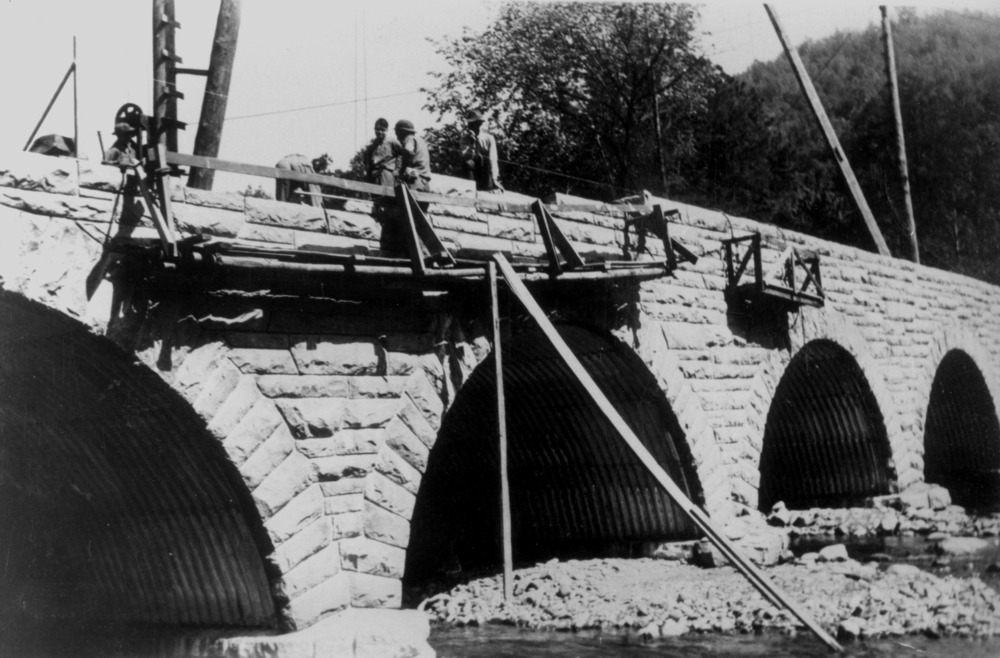
Key sites across the Smokies also bear their imprint. At Newfound Gap, crews landscaped the overlook, created parking areas and erected the Rockefeller Memorial. Near Kuwohi (formerly Clingmans Dome), they carved a trail to the summit and, in 1938, raised a 40-foot wooden observation tower. In Sugarlands, they laid the foundation for the park’s headquarters complex.3
The CCC also supported park management, stringing telephone lines, maintaining fire breaks and building nine fire towers with lookout cabins. At Kephart Prong, they constructed a fish hatchery that stocked mountain streams with trout.
In Cades Cove, crews turned their attention to cultural preservation. Between 1935 and 1937, they restored the Cable Mill and moved historic farm buildings to the site, creating the park’s first outdoor museum. They stabilized homesteads belonging to the John Oliver, Elijah Oliver, Henry Whitehead and Peter Cable families, ensuring some of the cove’s oldest structures survived.3
By the time the last camps closed in 1942, more than 4,000 men had passed through 22 Smokies camps.3 What Roosevelt dedicated in 1940 as a promise to the American people was, in large part, the hard work of the CCC.
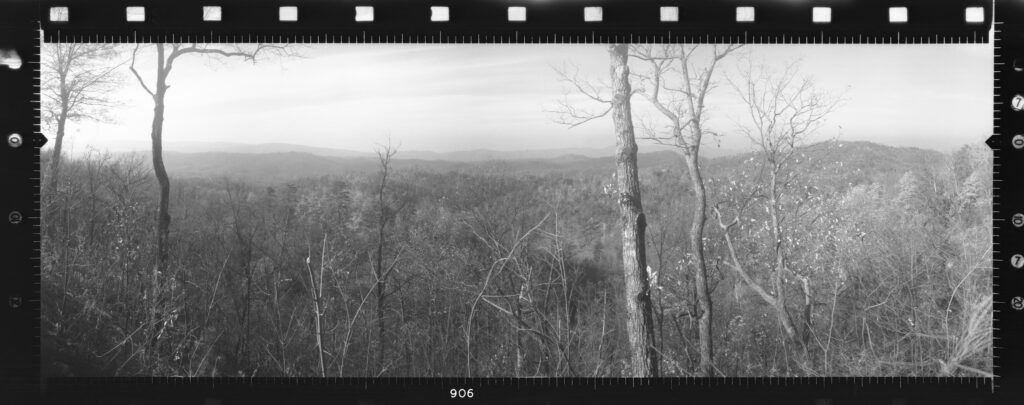
The CCC’s work also included documenting the landscape. In 1933, a young enrollee named Lester Maynard Moe was assigned to photograph panoramic views from fire towers as part of a nationwide project to map and manage the new parks.
Moe later continued the effort with the National Park Service, producing nearly a hundred sweeping images of the Smokies. His photographs remain among its earliest enduring records.
__________________________________________________________________________________________________________________________________
- Tennessee State Library and Archives
- Superintendent’s Monthly Report, May 1933
- National Register of Historic Places Multiple Property Documentation Form, prepared by The Public Archaeology Laboratory, Inc.
- National Park Service
Born and raised in Maryville, Tennessee, with roots tracing back to Cades Cove, Emily Huffstetler is a proud Maryville College graduate and passionate storyteller of the Greater Smokies region.