
Nov 7, 2025
Meet the Archivist Bringing Downtown Maryville’s History Back to Life

Written by: Emily Huffstetler
With an abundance of new places to dine, shop and play, downtown Maryville is undergoing a revival. Behind the scenes, city archivist Mark Bennett is bringing its history back to life.
Bennett, a Maryville native, stepped into his role about four years ago. Before that, he worked in genealogy, helping people trace their family trees. “I’ve always been interested in the past ever since I was a child,” he said. “I used to visit nursing homes and listen to the residents tell their stories. I was fascinated by them, and eventually I started trying to document the history.”
Right now, his biggest project is documenting the history of downtown Maryville. “I’ve come across some very interesting things—especially documenting when the buildings were constructed,” he said. “Some of those buildings didn’t have a written history at all.”
He’s been unofficially naming some of those buildings after the people who had them built. “You know where the new Raven’s Steakhouse is?” he said. “I wrote the history of that building. One of the former mayors, David Franklin Young (1873-1949), had it constructed around 1939.” He calls it the Dave Young building.
That research led to one of his favorite discoveries—the exact location of William Bennett Scott Sr.’s printing press. Scott, who served as Maryville’s first Black mayor in 1869, also published a local newspaper, The Maryville Republican. “It was on the eastern half of where Raven’s Steakhouse is located,” Bennett said. “On the western part of that lot, his son, William Bennett Scott Jr., had a small residence.”
Since taking the archivist role, Bennett has analyzed nearly every downtown deed. “That’s not a simple process,” he said. “I’ve had to work with some title attorneys. But when I do something, I’m gonna get it right.”
He’s found other traces of early Black-owned businesses downtown. “There’s a gap between Bill Cox and The Roost,” he said. “In the late 1800s, there were two small buildings there. On the eastern part of the lot, Charles Wallace had a barbershop, and on the western part, Thomas Lillard had a confectionary.”
Lillard served as an alderman—what’s now called city council—in Maryville. “There was a school named after him or his son across the street from the back of St. Paul A.M.E. Church,” Bennett said. “He was involved with education in the early 1900s.”
His research has also uncovered stories of early immigration. “We had a Joseph Arbeely, the first person ever to immigrate here from Syria,” he said. “That would’ve been in 1878. His family only lived here a few years, but they were very well accepted. His wife, Mary, is buried up at New Providence Presbyterian Cemetery, and one side of her tombstone is written in Arabic.”
Bennett said the oldest building in the original downtown—between Cates Street and Norwood—was built in 1885. “We don’t have any buildings downtown that were constructed before the Civil War,” he said. “None of them have lasted.”
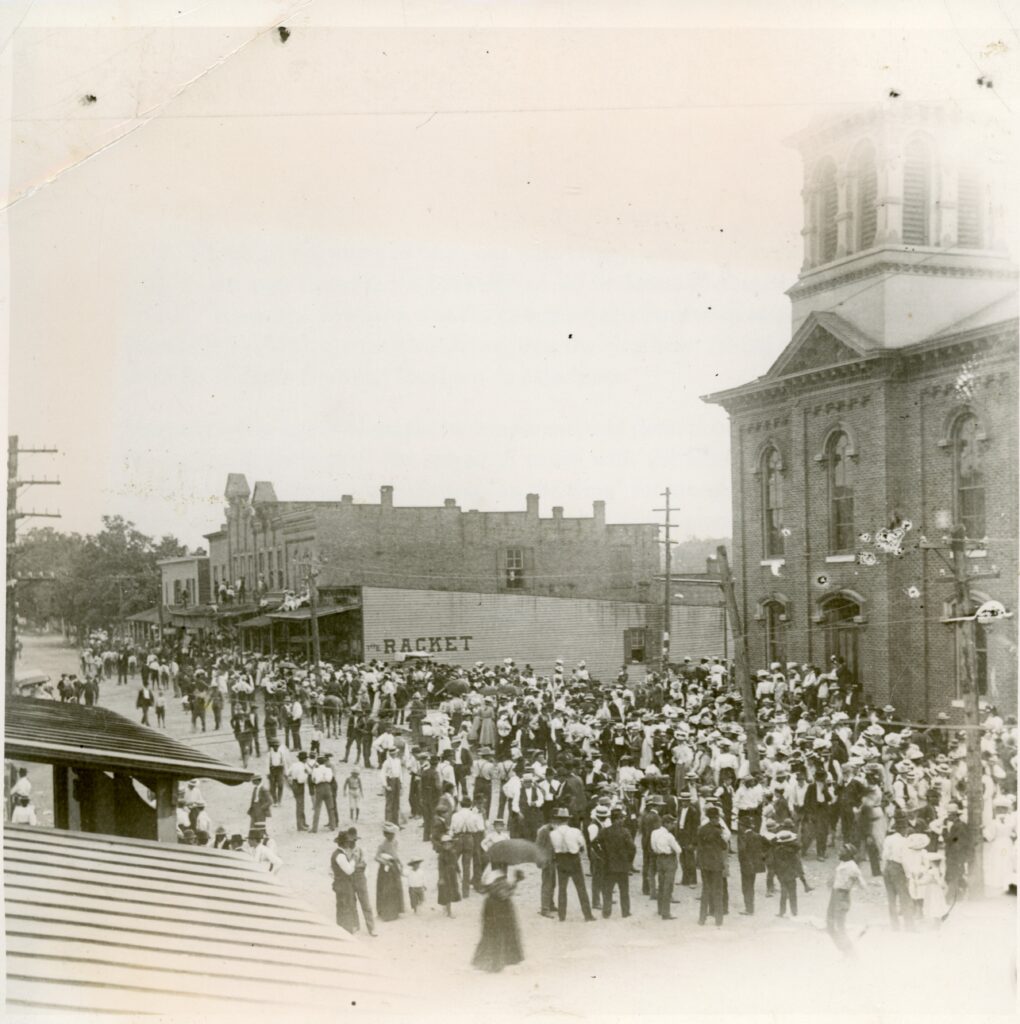
He also traced the first location of The Daily Times. “That would’ve been where Bill Cox is, on the eastern corner,” he said. “There was a separate building there, and it was in that building, but that building perished in the 1906 courthouse fire.”
Bennett said some of the Quakers who came from Indiana and Ohio helped rebuild downtown after the fire. “Some of the Quakers lived near where Maryville High School is,” he said. “Some near where Miller Funeral Home is, and some close to where the Maryville Municipal Building is. There were others who came down from Indiana and Ohio, but they weren’t necessarily Quakers. The founder of The Daily Times, A.J. Neff, came from Indiana.”
He works from many sources—Sanborn fire insurance maps, newspaper microfilm, tax records, deeds and lease records—to build a complete picture. “Our earliest Sanborn map is from 1887, and the latest is around 1945,” he said. “I want a continuous history of downtown.”
That process has helped him correct long-accepted stories. “Some of the history that had already been done, I’ve been able to go back and correct some inaccuracies,” he said. “Some stories have been based off of lore, but when you get into the documentation, it can be contradictory.”
He’s also tracked downtown’s visual record. “I’ve been able to better date pictures now with this analysis,” he said. “There were some pictures that people said were taken earlier than I was able to place them, and I was able to put a more accurate timeframe on them.”
Bennett said he keeps up with what’s happening downtown because, as he puts it, “today’s events are tomorrow’s history.”
He often works with local business owners who want to know more about their buildings. “Some people will ask me the history of their houses, too,” he said. “It’s been tedious, but very rewarding.”
Recent investment has brought fresh life to downtown’s older buildings. “It’s called a renaissance right now,” Bennett said.
He hopes to share his research through guided walking tours next year. “I’d like to tell what used to be on Broadway,” he said. “There were horse livery stables, the first car garages and dealerships, and several murders downtown…It’s interesting to see the transition and how things have evolved over time.”
Born and raised in Maryville, Tennessee, with roots tracing back to Cades Cove, Emily Huffstetler is a proud Maryville College graduate and passionate storyteller of the Greater Smokies region.