
Feb 12, 2026
Courtship in Cades Cove: Corn Husking, “Sparking” and Weaner Cabins
Written by: Emily Huffstetler
Still looking for a Valentine? In Cades Cove, you might have started with a corn husking.
Cades Cove’s first permanent Euro-American settlers arrived in 1818, and the community grew steadily through the mid-1800s. By 1850, the Cove’s population was in the high six hundreds.
In a working valley, neighbors relied on each other. Seasonal labor brought people off isolated farms and into the same place at the same time.
Corn husking, molasses making and gathering chestnuts were some of the community events where young people could mingle under adult supervision.
One local account describes a tradition that turned the search into a game. If a young man found a red ear of corn in the husking pile, the discovery earned him the right to “kiss the lady of his choice.”
Weekly church services brought people together, too. Baptist life split into two congregations in 1839, when a group left over mission work and other practices. Methodists also had an established church presence in the Cove by the 1820s.
For courting couples, Sunday was another chance to see each other.
Large households shaped the logistics of dating. Families of 10 to 12 children weren’t unusual, and privacy was limited in one- and two-room cabins. That pushed conversations outside, on porches and in yards.
One interpretive guide for the Cove published by the Great Smoky Mountains Institute at Tremont points visitors to a porch bench near Cable Mill used for “sparking,” an older term for courting.
The word also shows up in a recorded Cades Cove interview from the 1930s, where a speaker recalls older boys teasing children about “sparking,” and an adult stepping in to explain what it meant.
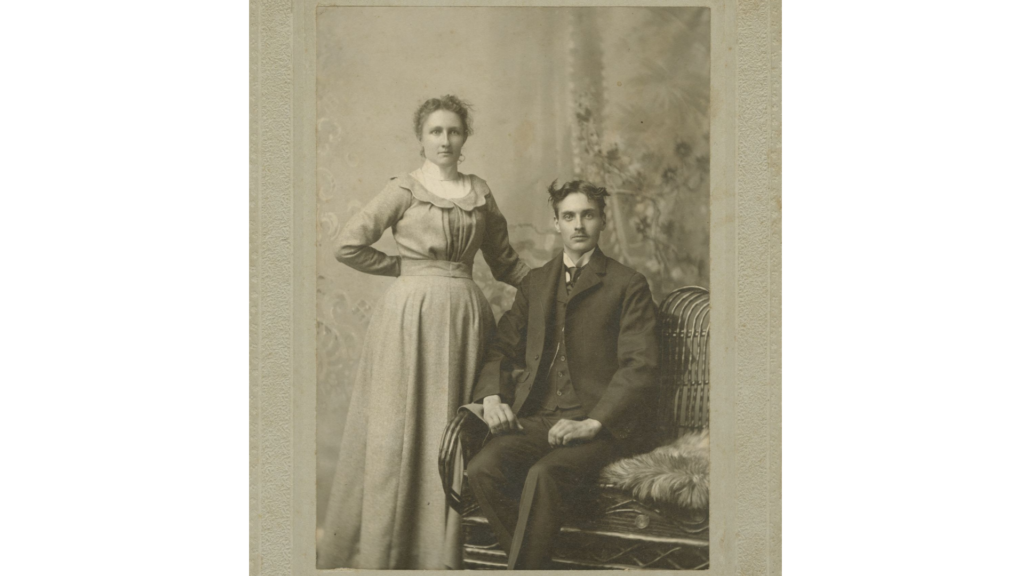
Oliver (1878–1966) is the author of the Fifty Years in Cades Cove memoirs, a handwritten account of the valley’s families and daily life from early settlement through the early 1900s. Photo courtesy of University of Tennessee, Knoxville. “Fifty Years in Cades Cove Collection.” John W. Oliver and wife, Nancy Ann (Maryville, 1901).
Sparking often moved toward marriage. In much of Southern Appalachia, weddings were informal during this era, staged in either the bride’s or groom’s home.
Some newlyweds would spend their early days of marriage in a “weaner cabin,” far enough away for independence but close enough for family assistance.
After the ceremony, friends sometimes returned late at night to “serenade” the couple. They’d go from house to house making noise, ringing cowbells and even firing guns. This was part of a wider rural tradition known elsewhere as a “shivaree” or “charivari.”
Born and raised in Maryville, Tennessee, with roots tracing back to Cades Cove, Emily Huffstetler is a proud Maryville College graduate and storyteller of the Greater Smokies region.