
May 1, 2025
Bigfoot Festival Returns to the Smokies: A Conversation with Explorer Adam Davies
Written by: Emily Huffstetler
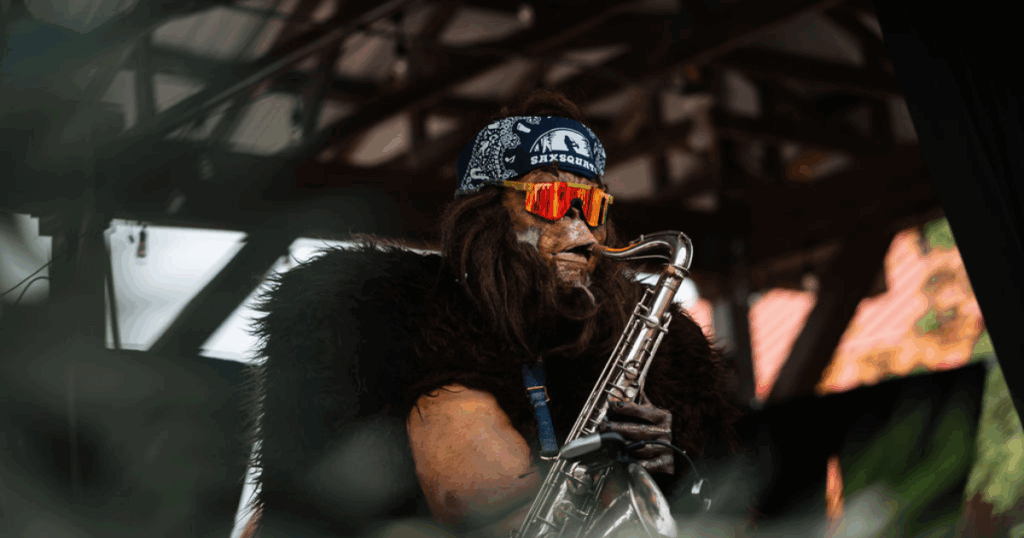
The Smoky Mountain Bigfoot Festival returns to Townsend on Saturday, May 3 for its fifth year—bringing legendary creatures, live music, food trucks and a full day of cryptid-themed fun. This family-friendly, pet-friendly event is just as much for true believers as it is for anyone looking for a unique outing on the Peaceful Side of the Smokies.
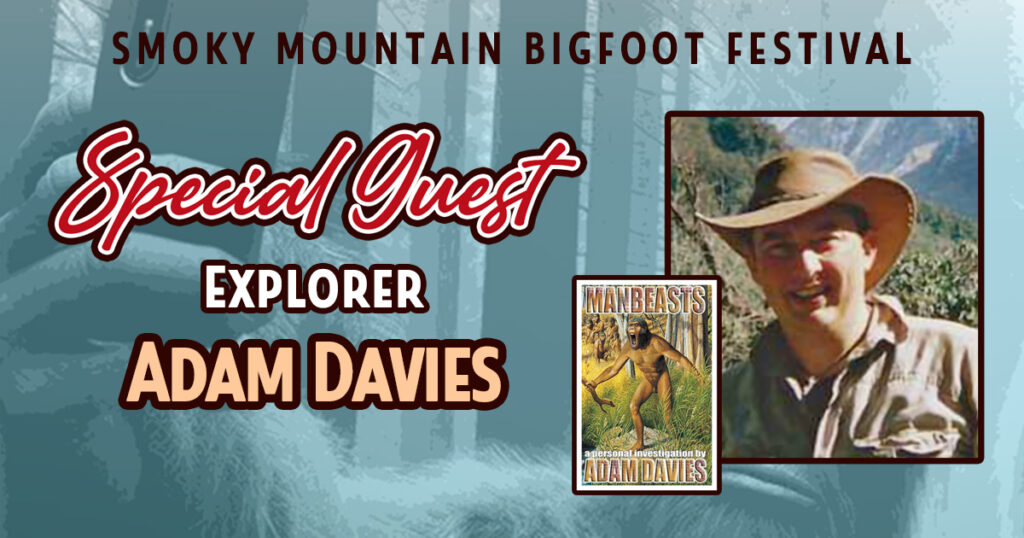
This year’s theme is a “Legendary Family Reunion,” and Bigfoot isn’t coming alone. Expect nods to Yeti, Mothman, Dogman and more—as well as guest speakers, including Adam Davies, a British researcher who’s explored jungles, deserts and the Smokies in search of the unknown.
Davies recently joined the team at Bigfoot in the Smokies, a gift shop in Townsend. We caught up with him ahead of the festival to talk sightings, skepticism and what keeps him curious.
What first drew you to the field of cryptozoology and exploration?
When I was very young, I had a sister that died of neuroblastoma. It was very painful, and it taught me not to take life for granted—even at that young age.
Later, I was hit by a police officer’s son who was illegally riding a motorbike on the sidewalk. My leg was shattered in several places, and the doctors told my parents I’d probably never walk again. But that wouldn’t happen. I committed to rehab, did a lot of swimming, and a year later, I became a swimming champion. That experience showed me I had real determination.
I’d always been fascinated by unknown species and tracking animals. I read constantly and eventually found my way into forests and wilderness areas. That’s how it all started.
Can you share how your interest in Bigfoot developed over the years?
My interest in Bigfoot specifically gelled in 2008 when I was making a film with Dr. Jeff Meldrum in China about the Yeren, the Chinese Wildman. He and I talked about the Pattlin-Gimlin film [about Bigfoot], and he told me why he thought it was credible. I decided to turn my interest to Bigfoot in that stage and come to North America.
You’ve explored some of the most remote regions on the planet. How do the Smoky Mountains compare in terms of terrain and mystery?
I love the terrain. I’m not just saying it because I live here—the forest life is wonderful. It’s a vibrant ecosystem. I’ve been out in the jungle in the Congo and Sumatra, […] but I prefer the forests here. They’re my favorite in all of the world.
Have you investigated any firsthand accounts of Bigfoot sightings in the Smoky Mountains?
Yeah, I have, and I recently was interviewing a witness who’d seen something at White Oak Sinks. She was talking about how it moved like liquid, which is fascinating because that correlates with my experiences of people talking about it in Nepal.
What tools or techniques do you rely on when searching for cryptids like Bigfoot?
I plan carefully. Before any expedition, I assess the viability of the area, research the historical pedigree and contact local guides. Of course, sometimes you have to adapt quickly—especially in dangerous situations, like I’ve had to do in Congo. But overall, I like to be as prepared as possible.
Have you had any dangerous encounters in the Smokies?
No, not really. You’ve always got to be careful with bears, of course. And I’ve been exhausted a few times. But most of the hikes around here are wonderful and exciting—and so beautiful.
How do you handle skepticism? Do you mind that some just see it as something fun?
No, I don’t mind that at all. I’m not here evangelize people. I’m not here on behalf of the “Bigfoot Party.”
I’ve had an encounter with Bigfoot—on the land between the lakes on the border of Tennessee and Kentucky. So, I know it’s around. I’m interested in questions like how intelligent it might be and things like that. But you know, if people [see it as a curiosity], that doesn’t trouble me. It’s up to them.
What was the Bigfoot encounter you describe like?
It was extremely intense. We were setting up for a night shoot when it happened. Several creatures appeared. One was behind a tree, throwing sticks and stones. Another one, about nine feet tall with red eyes, was roaring. It was astonishing.
The cameraman, bless him, freaked out and tried to run. The producer had to grab him. What struck me most was how the creatures used strategic thinking. One seemed to be drawing us in while others flanked us. It was a remarkable experience.
When you have experiences like that, is it always something incomparable to the last?
The first thing I want to say is that it’s very rare. I’ve been doing things like this for many years, and instances like that hardly ever happen. […] Each cryptid experience is very, very different. If I can gather scientific evidence which can be objectively analyzed by scientists, then I do that as well.
What type of scientific evidence do you gather?
It depends. The best sort of evidence can be analyzed and corroborated. DNA evidence would be really good, but that’s something I’m working towards.
Nowadays, with Photoshop and all these things, it’s difficult. Photos wouldn’t be enough on their own to convince people of the existence of Bigfoot. However, if it were analyzed and found out not to be fake, it would be very interesting for potentially learning about the anatomy of the creature.
With witnesses, I am used to cross-examining people because I used to work for British government. I approach it quite carefully because people can be completely genuine but mistaken. Particularly in the Smokies, if you accept that someone is telling the truth, you still have to consider that it could be a bear.
You recently started a YouTube channel sharing local stories. What role does storytelling play in your work, and in keeping interest in Bigfoot and other cryptids alive?
I love the subject, and I love talking to people about it. I really got into it because I wanted to answer questions for myself.
What’s next for your research? Any upcoming expeditions related to the Smokies or elsewhere?
When I’m not working, I’m pretty much normally out in the Smokies, searching and enjoying the mountains. Sometimes, I’m just hiking, but I’m researching every week.
The views expressed in this interview are those of Adam Davies and do not necessarily reflect the beliefs or positions of SmokyMountains.org. Those interested in learning more about Davies and his work can visit www.adamdaviesexplorer.com. He is open to answering questions.
__________________________________________________________________________________________________________________________________
Born and raised in Maryville, Tennessee, with roots tracing back to Cades Cove, Emily Huffstetler is a proud Maryville College graduate and passionate storyteller of the Greater Smokies region.