
Jan 31, 2025
Capturing the Smokies: The Trailblazing Photographs of Albert “Dutch” Roth and Paul J. Adams
Written by: Emily Huffstetler
Albert “Dutch” Roth (1890-1974) and Paul J. Adams (1901-1985), both avid hikers, were among the earliest photographers of the Smokies. Their journals document their adventures and capture the landscape’s transition into a national park.
Albert “Dutch” Roth
In 1927, the Smoky Mountains Hiking Club honored Dutch Roth for his participation in every hike led by the club since its establishment in 1924. However, those hikes were only a small part of his extensive expeditions in the Smokies.
Over 30 years, Roth completed 728 hikes, climbing every mountain in the Smokies. He ascended Mt. LeConte, the park’s third-highest peak, around 90 times—sometimes at moonlight and without a trail.
Regardless of the conditions, Roth never left his camera behind.
“We hiked in all kinds of weather, and I never forgot my camera, despite the cold or rain. You never know when you might miss a good shot. We hiked around rocks, on rocks, hopped rocks, went up creek beds, down roads, in brush and on trails,” Roth wrote in his personal journal.
In total, Roth captured over 3,000 images, many of which earned awards. In 1954, he won first place in the Chamber of Commerce photography contest, earning the cover spot on their annual Smokies tourism guide.
Roth lived in Knoxville with his wife and children, who often joined him on his adventures. In 1951, Roth wrote that he and his kids brought two “Yankees” up Mt. LeConte, “to show them what real mountains looked like.”
In the early 1900s, before the Smokies became a national park, a train ran directly from the city to the mountains.
“This was quite a treat in those days to go to the mountain for the day. The train was the best way to travel then. It was hard for it to keep a schedule, because of the washouts, landslides and inquisitive cows on the track,” Roth wrote.
The train spurred tourism and led to the construction of several hotels in Elkmont and Sunshine (Kinzel Springs).
Simultaneously, the Little River Lumber Company was clearcutting the land. Roth was a young boy when the first log was cut in the Smokies.
“I don’t believe I have ever visited Sunshine that it doesn’t bring back memories of the past and the history behind this section of the mountains,” Roth wrote.
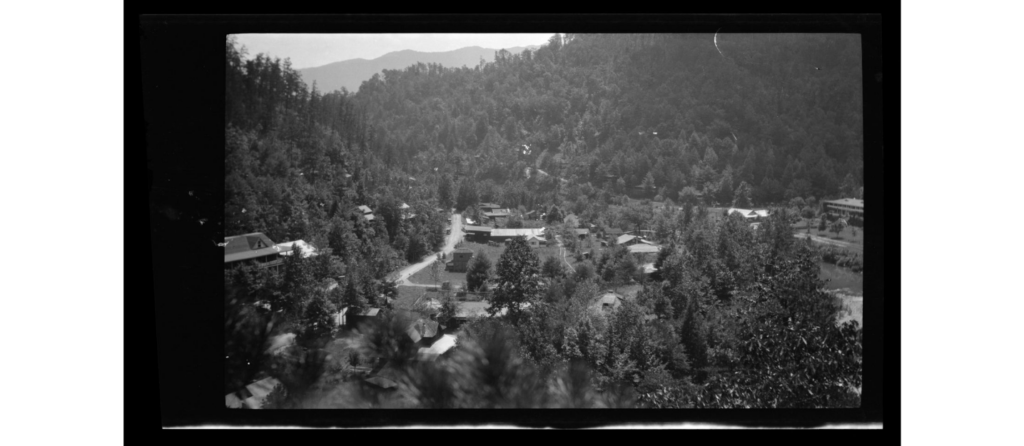
From his hikes to the highest peaks, Roth had a bird’s-eye view of the changing landscape.
“Sunshine is surrounded by four mountains. They are named Matthew, Mark, Luke and John. From the top of any of these, you can get a good view of the town. In 1928 we had a trip to Mt. Luke. One day we managed to climb all four mountains in one day. From the top I got a good picture of the town. It shows the train and the old swinging bridge [that] used to cross the river, and the two hotels, both now gone.”
In 1957, Roth retired and, with his family, made Gatlinburg their permanent home. His photography collection is now housed in the University of Tennessee Digital Archives.
Paul J. Adams
Paul J. Adams was born in Illinois in 1901 and moved with his family to Tennessee in 1918. Growing up a nature enthusiast, he was excited to explore the Smokies.
“I was determined to learn the whole range,” he recalled in an interview.
Due to a health condition, Adams left the University of Tennessee in 1924, shortly after enrolling. Following his doctor’s advice to spend more time outdoors, he set out to hike the most challenging terrain in the Smokies.
In 1925, the Great Smoky Mountains Conservation Association acquired a large tract of land and hired Adams as the property’s caretaker. His primary task was to construct a cabin near Mt. LeConte’s summit to serve as a resting place for hikers.
Adams purchased a canine named Smoky Jack, formerly owned by a Knoxville detective who had been killed. The detective’s widow sold the dog to Adams for half price—$250—after seeing how fond the dog was of him.
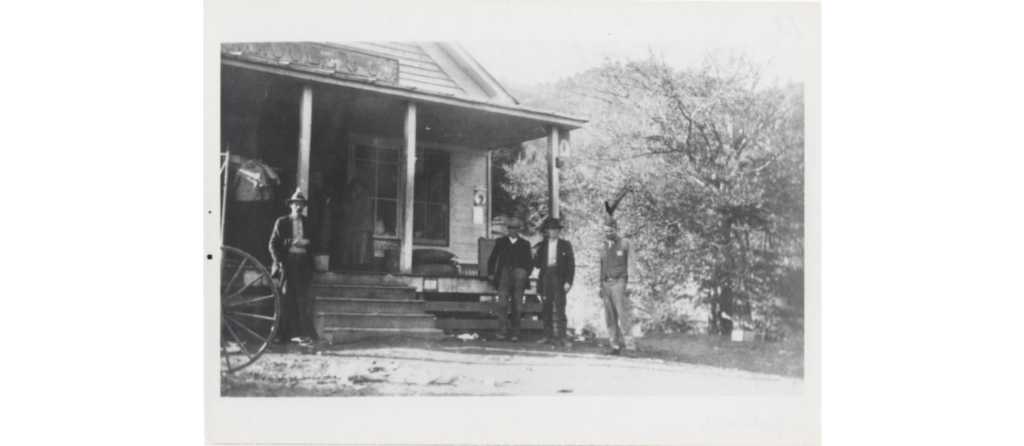
Jack proved an invaluable companion, as Adams trained him to carry saddlebags and make solo trips to Gatlinburg for supplies. Jack would trot down the mountain with money, a shopping list and outgoing mail, and Charles Ogle, a local store owner, would send Jack back up the mountain with the provisions.
Adams wrote about their experiences in his journal, published posthumously as Smoky Jack: The Adventures of a Dog and His Master on Mount Le Conte. Together, they survived blizzards, robberies, and encounters with wolves and bears.
Though he wasn’t formally trained in photography, Adams’ images offer a rare glimpse into Mt. LeConte’s transformation. During his time as caretaker, Adams established and managed a campsite, later taken over by Jack Huff in 1926.
One log cabin at a time, Huff and local workers turned the humble campsite into a hikers’ haven. Today, Mt. LeConte boasts the highest guest lodge in the eastern United States, with a highly coveted waitlist.
After a brief stint as a paid trail guide for the Mountain View Hotel in Gatlinburg, Adams and Smoky Jack moved to middle Tennessee, where they helped extinguish two fires.
Ultimately, Adams and his wife, Maxine, settled in the quiet town of Crab Orchard, Cumberland County. His photography collection, too, is housed in the University of Tennessee Digital Archives.
__________________________________________________________________________________________________________________________________
Born and raised in Maryville, Tennessee, with roots tracing back to Cades Cove, Emily Huffstetler is a proud Maryville College graduate and passionate storyteller of the Greater Smokies region.