
Sep 26, 2025
From Indiana to Indiana Avenue: Quaker Roots of College Hill
Written by: Emily Huffstetler
In the decades following the Civil War, Maryville was a town in transition. The war had left Downtown Maryville in ruins, and rebuilding came slowly. Brick and frame storefronts began to rise again, and on the city’s edges, new homes appeared. Among them was Indiana Avenue, where Quaker settlers from Indiana purchased land and built homes east of town.
By the 1880s and 1890s, Indiana Avenue had become the preferred address for Maryville’s professors and businessmen. Its hilltop setting beside Maryville College gave the neighborhood special distinction. Founded in 1819 and relocated from downtown after the war, the college drew faculty and administrators to settle nearby, establishing “College Hill.”
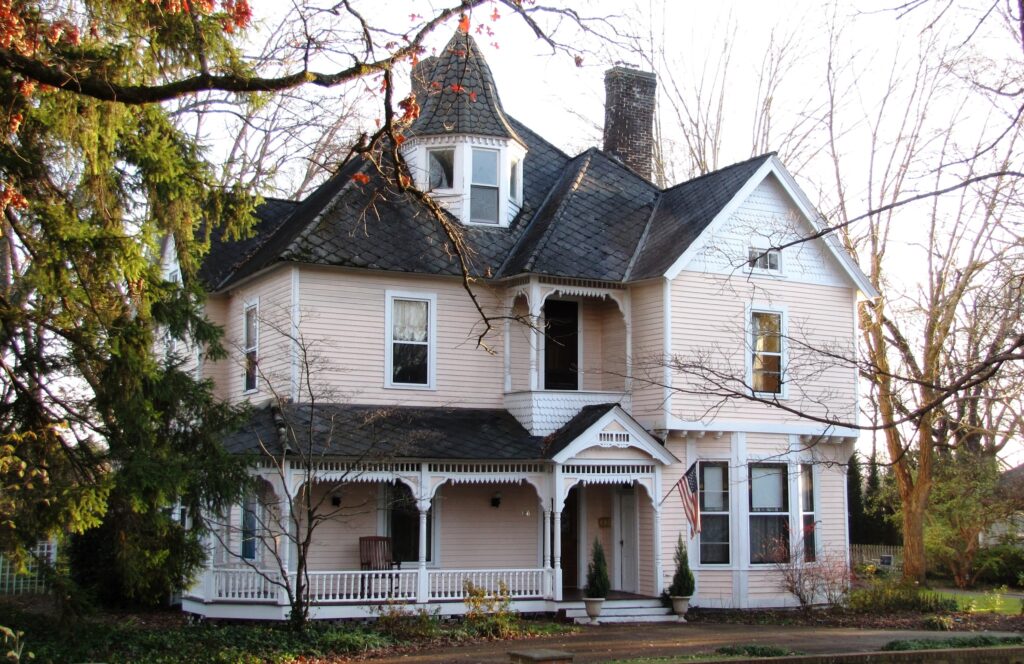
Victorian architecture became a defining feature of the street. The J.C. Barnes House (116 Indiana Avenue), with its corner tower and wide porch, remains Maryville’s only true towered Queen Anne. In recent decades, the house was painted pink, earning its neighborhood nickname as “the Pink House.” The house was painted grey in 2019.
The Hershey House (203 Indiana Ave.) shows a restrained Victorian style with weatherboard and shingles, while the E.E. Combs House (128 Indiana Ave.) stands out in brick with Romanesque touches—arched windows and roof dormers.
The turn of the century brought new influences. Colonial revival details—Doric and Tuscan columns, dentil molding and classical sidelights—were added to both new and existing homes. On Court Street, Samuel H. Dunn’s imposing Classical Revival residence featured paired Ionic columns. Several homes on Indiana Avenue were similarly updated with classically inspired porticos.
By 1905, Maryville’s population had grown to about 3,000. Residential development stretched along the ridgeline above Pistol Creek and continued eastward toward the college. The establishment of Alcoa (1914-1920) spurred even more growth.
The early 20th century brought dozens of Bungalows and Craftsman homes, many built from pattern books or even Sears, Roebuck & Co. Kits. These featured large porches, grouped windows, wide eaves with exposed brackets, and hipped or gabled roofs.
These homes belonged to many notable Maryvillians, including Robert Pflanze, President of the Cherokee Lumber Co. (321 Goddard Ave.); W.M. Caldwell, Director of the Bank of Maryville (138 Stanley Ave.); and W.F. Alien of the Maryville Electrical System (304 Indiana Ave.).1
Since the 1940s, very few houses have been built in the neighborhood, but a handful have been subdivided into boarding houses or apartments. In 1989, the Indiana Avenue Historic District (now known as the College Hill Historic District) was added to the National Register of Historic Places.
Interested in exploring Maryville’s living museum of historic homes? The College Hill Historic District invites visitors to its annual Fall Home Tour on October 11, from 3 to 5 p.m. Tickets are on sale now at www.collegehillhometour.com.
________________________________________________________________________________________________________________________________
Born and raised in Maryville, Tennessee, with roots tracing back to Cades Cove, Emily Huffstetler is a proud Maryville College graduate and passionate storyteller of the Greater Smokies region.