
Oct 2, 2026
“I Fell in Love With This Special One”: The Man Who Married a Walker Sister
Written by: Emily Huffstetler
In 1945, James Baldwin “J.B.” Shelton put his memories of mountain life on paper. He was writing to Elkmont summer resident Maidee DeLoche Adams, who was collecting his photographs and recording information about the people and places in them.
Shelton wrote about the Walker Sisters from a perspective few others could. He had known all seven since childhood, later worked for their father and married Sarah Caroline Walker, the only one of the seven sisters to marry.
“There are much said today about the Walker Sisters,” Shelton wrote. “There has been much written in books and papers about them. Some things are true and some are not.”
Growing Up in the Smokies
Shelton was born in 1886 and spent much of his childhood moving as his father searched for work. His mother died when he was about four years old.
Money was tight. Shelton remembered a good milk cow selling for $8 to $12, while wages ranged from 25 to 50 cents a day. At times, his family ate baked apples and roasted potatoes to get by until harvest.
When his father left for North Carolina to work for a railroad, Shelton and the younger children stayed with an older half-sister. After her husband decided to move west, the children were sent to find their father and relatives in North Carolina.
Shelton was about seven. He and the children followed railroad tracks and mountain trails and slept wherever someone would take them in. The journey was difficult and at times dangerous. They once found their path blocked by a swollen stream after the footlog, a simple log footbridge, washed away.
“Should we have washed down and drowned. Chances were that no one would have ever known our fate,” Shelton wrote.
His father later found work in Sevier County cutting timber and building splash dams. Shelton remembered logs being piled in the river until the dams were released, sending water and timber downstream. His older half-brothers followed the drives and rolled stranded logs back into the river.
“The water would be rolling high and logs would be rolling and tumbling and bouncing end over end,” Shelton wrote. The sound, he described, was a “continuous boom boom boom.”
Everyone who could work helped support the family. Schooling came second.
“In my boyhood days schools were short and my father was poor and it took everyone that could do a turn to keep starvation from the door,” he wrote.
One of the schools he attended was in Little Greenbrier, in the present-day Metcalf Bottoms area.
Meeting the Walker Sisters
John and Margaret Walker raised 11 children in Little Greenbrier, including seven daughters. John Walker and his son James Thomas helped build the Little Greenbrier Schoolhouse in 1881, where classes were generally held for two or three months during the winter.
Shelton attended school with all seven Walker girls, but one of them stood out in particular.
“There was a sweet and lovely little girl going to the same school. Well in fact there were seven of the sisters going to school. And all of them good looking and had a very nice and friendly turn. But I in a childish manner fell in love with this special one. And much that I dreamed one night that we were married. But alas when I awoke how sad I was. For it was only a dream.”
That little girl was Sarah Caroline Walker.
Nothing came of Shelton’s childhood affection before his family left Little Greenbrier and moved to another state. Years passed before he returned.
Back to Little Greenbrier
“I finally drifted back to this same community,” Shelton wrote. “But I had almost forgotten my childish dream back yonder when I was a little school boy. But I had grown to be a young man and this little girl also had grown to be a beautiful young woman.”
After returning to Little Greenbrier, Shelton took farm work and odd jobs before being recommended to John Walker.
“So I was almost afraid to bargain with the old man at first,” Shelton wrote. “But finally I picked up nerve enough to tell him I would work for him for a few days.”
Those few days turned into two years. As time passed, Shelton became more comfortable with the family.
“The old Lady Walker was an exceptional good old lady,” he wrote. “They were very strict and religious. And one had to be a pretty good boy to stay in their home.”
“Mr. Walker fell in love with my work and I fell in love with his daughter again,” Shelton wrote.
On Dec. 27, 1907, according to Shelton’s account, he married Caroline.
“After proving myself to be a good boy for two long years I finally gained her affection and […] my childhood dream came true.”
Shelton and Caroline went on to have seven children. Leona, Effie, Hazel and John survived to adulthood, while three of their siblings died in infancy.
The Walker Sisters in the Public Eye
Caroline was the only one of the seven Walker sisters to marry. Her six sisters continued living at the family homestead in Little Greenbrier. When the federal government acquired the property for Great Smoky Mountains National Park, the sisters received a lifetime lease.
Related Read: The Six Sisters Who Kept One of the Smokies’ Last Homesteads
By the time Shelton wrote his account in 1945, the Walker Sisters were already appearing in books and newspapers. He corrected two claims: that the family was of German rather than English and Irish descent, and that there were only five sisters rather than seven.
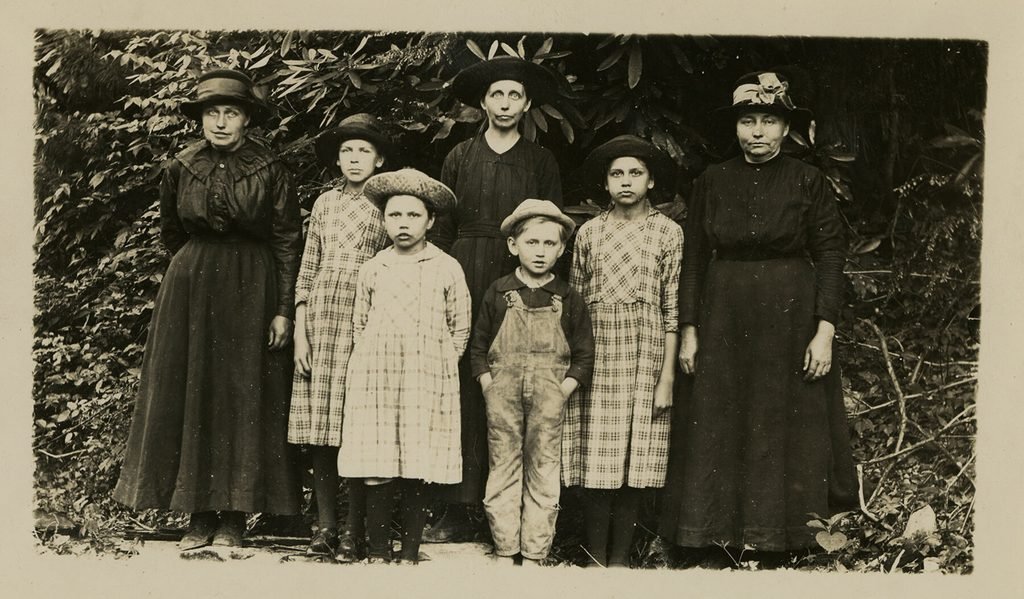
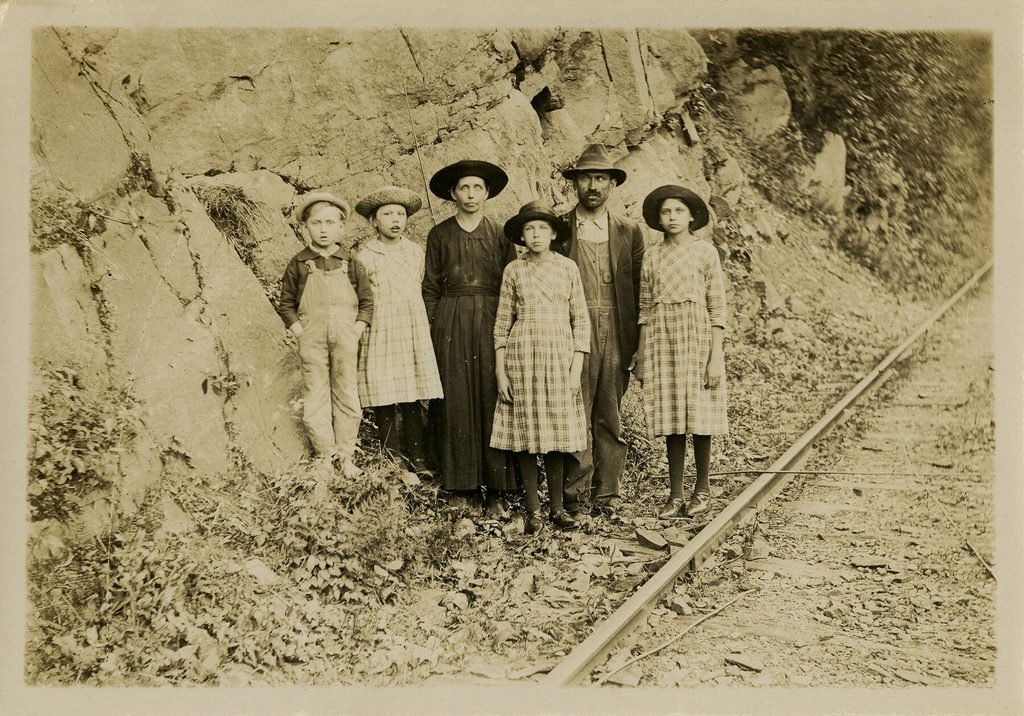
Shelton also photographed the Walker family, logging operations and other Smokies scenes. He carried a large camera, glass plates and a tripod through the mountains and developed his negatives in a darkroom built over a stream.
Many of his photographs, including images of the Walker sisters, their home and Shelton and Caroline’s children, are now available through Western Carolina University’s Southern Appalachian Digital Collections.
Born and raised in Maryville, Tennessee, with roots tracing back to Cades Cove, Emily Huffstetler is a proud Maryville College graduate and storyteller of the Greater Smokies region. She holds a Master of Science in Conservation Education from Mississippi State University.
Source: James B. Shelton, “Notes on Mt. Ways and Mt. People,” 1945, J. B. Lawson Collection, HL_MSS97-07_04_01, Western Carolina University Hunter Library. Scanned copy provided by Western Carolina University.