
Nov 15, 2024
Sam Houston’s Life and Legacy in East Tennessee
Written by: Emily Huffstetler
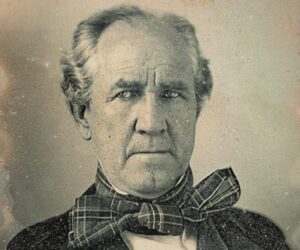
Sam Houston is best known for his leadership during the Texas Revolution and his presidency of the Republic of Texas, but he also has strong ties to the Peaceful Side of the Smokies. Born on March 2, 1793, in Timber Ridge Church, Virginia, Houston was the fifth of nine children. Following the death of his father in 1806, his family moved to a 419-acre farm in Maryville, Tennessee.
Young Houston didn’t get along with his family and was frustrated about his new responsibilities on the farm. At 16, he ran away to live with a band of Cherokees on the Tennessee River. Chief Oo-loo-te-ka (“He who puts away the drum”) became a father figure to Houston, giving him the name Co-lon-neh (“The Raven”).
By this time, most Cherokees were settled farmers and hunters, living in 60 to 70 loosely formed bands. Chief Oolooteka’s band comprised 82 men, 98 women, 66 horses, 170 head cattle, 242 hogs and 32 spinning wheels. The people lived in wigwams, dome-shaped shelters covered in bark or hide, while Chief Oolooteka had a two-story frame house.
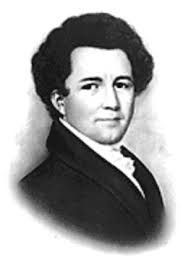
Houston would visit Maryville and purchase gifts for the Cherokees, like ammunition and blankets. In the spring of 1812, he decided to move back to town to repay his debts. Despite little formal education, he became a teacher, charging $8 per term. Students could pay one-third in cash; one-third in corn; and one-third in calico cloth, the material he made his shirts with.
From May to November, Houston taught a variety of subjects, including reading, writing, arithmetic, history, classics and German. He allowed the students a break in July for the crop harvest.
Following his teaching stint, in 1813, Houston joined the U.S. Army and served under General Andrew Jackson during the Creek War. Houston’s valor during the Battle of Horseshoe Bend in 1814 earned him severe injuries, but it also secured Jackson’s lifelong mentorship.
Jackson appointed Houston as the Indian Subagent in 1817. The next year, the U.S. started to implement a controversial treaty that forced the Cherokee to cede their lands in Tennessee in exchange for new territory west of the Mississippi River. Houston was tasked with removing his Cherokee foster family from Tennessee, an assignment he carried out despite its emotional toll. He ensured that the treaty’s promised provisions—such as blankets, rifles and rations—were supplied to the Cherokees.
In 1818, Houston encountered another challenging situation when he accompanied a Cherokee delegation to Washington, D.C., to meet President James Monroe. Houston appeared at the White House in traditional Cherokee dress, which offended John C. Calhoun, the Secretary of War. Calhoun reprimanded Houston and accused him of participating in the slave trade. Although Houston swiftly cleared his name, the incident prompted him to resign from his role as Indian Subagent. This series of events created a lasting rift between Houston and Calhoun.

Houston set out to study law in Nashville, passing the bar in just six months. He opened his own practice in Lebanon, where he could be close to Jackson. From there, his political career took off. He was appointed Adjutant General of Tennessee in 1818 and Attorney General of the Nashville district.
In 1823, Houston was elected to the U.S. House of Representatives, largely due to the backing of Andrew Jackson and his machine. He leveraged his position to support Jackson’s presidential bid. After serving a second term, he successfully ran for the governorship of Tennessee in 1827.
Houston was on his way to a national career in politics, but his personal life turned things upside down. At 35, he married 18-year-old (or 19-year-old, according to some sources) Eliza Allen of Gallatin. After just 11 weeks, she moved back home with her parents and refused Houston’s efforts to reconcile.
To this day, the cause of the marriage’s failure remains a mystery. However, the incident, along with his reputation for public drunkenness, led him to fall out of favor with the public. On April 16, 1829, Houston resigned as the Governor of Tennessee. He decided to reunite with the Cherokees in Indian Territory, modern-day Oklahoma, where they had been forcibly relocated.
Soon thereafter, Houston became a Cherokee citizen and married Tiana Rogers (c. 1799-1838), a woman of mixed English and Cherokee descent. During his three years in Indian Territory, Houston operated a trading post and continued to be notorious for his heavy drinking.
Houston eased back into politics, travelling to Tennessee, Washington and New York as a peacemaker and representative for the Cherokee, Osage and Creek tribes. His political momentum picked up after a dispute over a Native American issue with William Stanbery, a U.S. Representative from Ohio. After being reprimanded by the House of Representatives for assaulting Stanbery, Houston fully resumed his political career, with a new chapter awaiting him in Texas.
Visitors to Maryville can explore Sam Houston’s legacy at the Sam Houston Schoolhouse, a one-room log cabin where he taught as a young man. The site offers an immersive experience, allowing students of all ages to engage in colonial-era school activities, including games and traditional chores. Additionally, a bronze monument of Houston, recently installed at the Maryville Municipal Building, honors his life and legacy in Tennessee.
Sources:
Sam Houston Historic Schoolhouse
__________________________________________________________________________________________________________________________________
Born and raised in Maryville, Tennessee, with roots tracing back to Cades Cove, Emily Huffstetler is a proud Maryville College graduate and passionate storyteller of the Greater Smokies region.