
Written by: Emily Huffstetler
In 1900, a Pennsylvanian man named J.W. Fisher found himself in a predicament. The tannery he recently started in Blount County had taken off, producing up to 400 hides a day, and his local tanbark providers couldn’t meet the demand.
Meanwhile, in Clearfield, Pennsylvania, a businessman named Colonel W.B. Townsend was experiencing growing pains of his own. Now that almost all the timber in Pennsylvania’s Allegheny Mountains had been logged, Townsend was looking to relocate his logging enterprise.
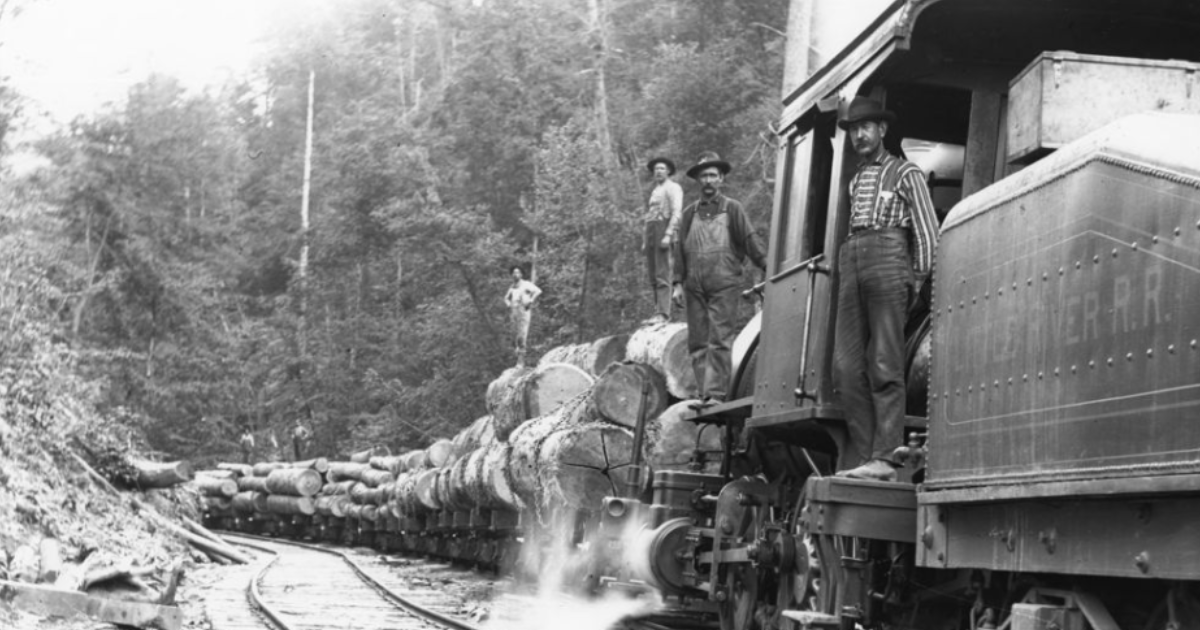
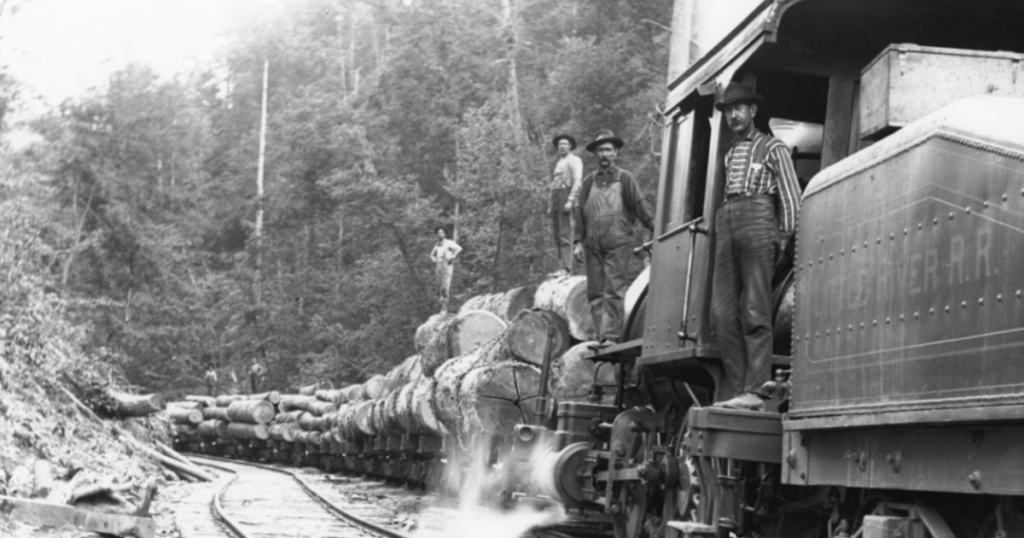
Seeing an opportunity to secure a reliable tanbark provider, Fisher invited Townsend to the Great Smoky Mountains. In 1901, W.B. Townsend—along with Pennsylvanian investors Asbury Lee, William McCormick, William Wrigley and Joe Dickey—purchased nearly 100,000 acres of timberland along the Little River and its tributaries. They chartered the Little River Lumber Company and then the Little River Railroad, to haul the logs.
Fully committed to his business venture, W.B. Townsend moved his family to Blount County. And in 1903, the community of Tuckaleechee—a Cherokee name loosely translating to “peaceful valley”—was named in his honor.
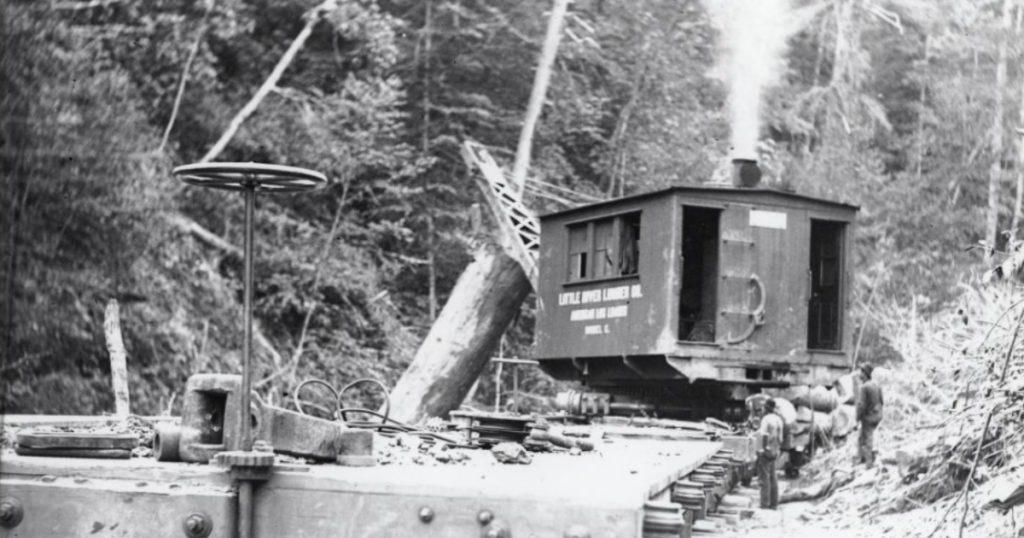
Over the course of 38 years, Townsend’s company built 150 miles of railroads and sawed 560 million board feet of timber—enough to reach California and back, if laid end-to-end. Environmentally and economically, the Little River Lumber Company and Little River Railroad reshaped the Peaceful Side of the Smokies.
“We’re learning more and more about [W.B. Townsend and the investors],” said Neal Stone, President of The Little River Railroad and Lumber Company nonprofit. They apparently had a 16-story office building in Pittsburgh, suggesting affiliation with a larger company. W.B. Townsend had also been logging in West Virginia and Kentucky, and he owned a railroad, coal mine and clay tile company in Kentucky.
Perhaps, then, it would come as no surprise that Townsend monetized nearly every aspect of his East Tennessee logging community. Workers and their families rented on-site prefab homes from the company, and they were paid in “doogaloo,” redeemable only at the company stores.
“It was a very monopolistic situation,” Stone said.
W.B. Townsend also transformed a hunting camp, Elkmont, into a tourist destination for wealthy East Tennesseans. Since the trains already had flat cars to restrain their loads, the company decided to add side rails and charge people a small fee to ride from Knoxville to Townsend.
When that did well, they built the Elkmont Observation Car, which had 16 benches capable of seating two people each, for a total capacity of 32 people. Regular passenger cars were used as well.
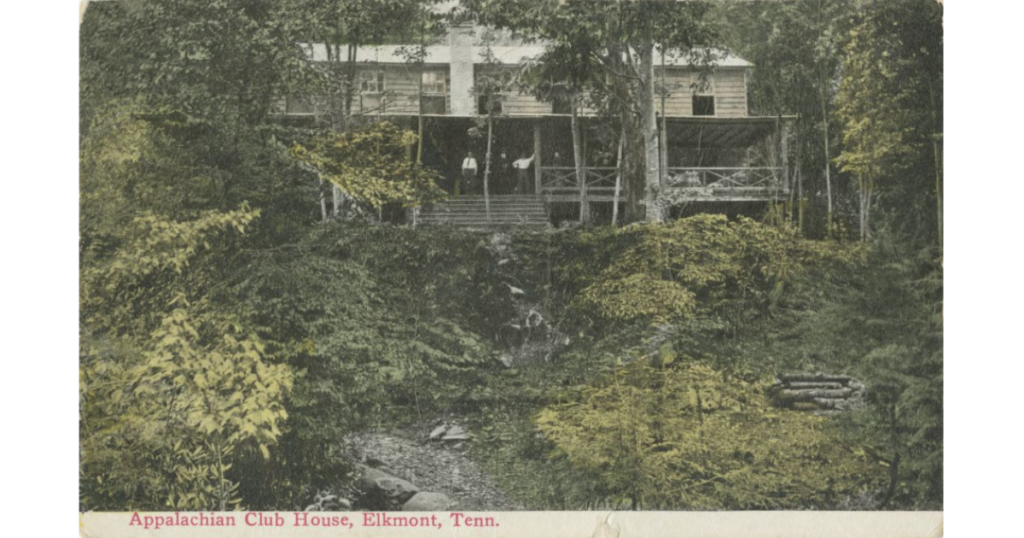
In 1910, W.B. Townsend decided to subdivide the property. He sold 50 acres to the Appalachian Club, a group of wealthy businessmen from Knoxville. Members paid the Elkmont Construction and Supply Company, also owned by Townsend, to build a clubhouse and cottages.
“They’d live there all summer, and the husbands would come there on the weekends,” Stone said. For those who could afford it, the mountain retreat was an idyllic escape from the heat.
A couple years later, three brothers from Knoxville bought 65 acres and opened the Wonderland Hotel. The brothers ended up selling the hotel to rivals of the Appalachian Club looking to form a club of their own.
Members of the two clubs refused to interact with each other on the train ride to their respective properties. But they did eventually find a common interest: protecting their land.
“The irony is that the lumber company’s clearcutting led to the preservation of the park,” Stone said. At the time, the process for lumbering was clearcutting, an extreme method that stripped the virgin landscape bare. The tourists wanted to put an end to this.
The national park movement was still relatively new. Yellowstone, the first national park, was only established in 1872. Creating a park would prove especially complicated because people had been living on the land for generations.
Nevertheless, the club members and environmentalists persisted. In 1926, Congress approved the authorization of the park, and Tennessee and North Carolina started raising money to purchase nearly half a million acres from private owners.
The outlook was grim for most residents. The Tennessee state government was only willing to pay about half of what their properties were worth. When the owners resisted, the state invoked the right of eminent domain. Over 5,000 people had no choice but to leave their homes. Meanwhile, the influential Wonderland and Appalachian Club negotiated a rental agreement that would extend into the early 90s.
The Little River Lumber Company sold 76,507 acres for the park, on the stipulation that they could keep logging for the next 15 years. In 1939, the last logs came out of the mountains.
“There are three locomotives left in the world that we know worked for the Little River Railroad Company,” Stone said.
“Number 110 lasted the entire lifetime of the railroad…It has been fully restored and runs today in Michigan pulling passengers.” It’s the smallest standard gauge Pacific steam locomotive ever built in the United States.
“Number 126 was another technological advancement. It was what they called a Mallet type, and it had eight driving wheels…It was a rod type engine, but it was hinged in the middle, so it could go around tighter curves,” Stone said.
That locomotive didn’t stay with the Little River Railroad long due to technical issues. It went back to the manufacturer and was sold out West, where it derailed and was abandoned for years. About three years ago, it was returned to full active service pulling excursion trains on the west coast.
The last surviving locomotive, Shay 2147, eventually made its way back home.
Shay 2147 was only used for about three or four years as the Little River Railroad was winding down. It pulled the last train across the Little Tennessee River (now part of Tellico Lake) near Chilhowee while workers disassembled the tracks and bridge.
The locomotive changed hands several times after that, travelling across the country, before it was put up for sale for $8,000 for parts. After local train enthusiasts banded together, the Towsend Chamber of Commerce decided to purchase it as a monument for a future park.
At least, that was the plan.
“Well, when word got out about the Shay, there was this huge groundswell of public support,” Stone said.
“You heard stuff like, ‘My daddy used to do that; my grandaddy used to do that; I drove that; I got to be an engineer for that.’ We still had people around back then that worked for the company, and people were coming up with pictures and artifacts,” Stone said.
In November 1982, several community members came together and formed the Little River Railroad and Lumber Company nonprofit corporation. They converted the former Walland Depot, donated by Joe Henry Everett on behalf of her late husband, into a museum.

“The Shay arrived on Thanksgiving weekend 1982, and we’ve been growing ever since,” Stone said.
“Earlier, we received grant [funding] to build a gift shop that resembles the Elkmont post office. And our main restoration shop conference room is designed to look like the Elkmont train engine house,” Stone said. In other exciting news, the nonprofit recently received a grant from the Tennessee State Museum to put a new roof on the depot and water tower.
A variety of artifacts have turned up over the years—most recently, a mint condition box of crayons that would’ve been used to mark the wood 80 to 90 years ago. Everything is on rotation at the Little River Railroad and Lumber Company Museum, which is open to the public from April through November. Admission is free, but donations are encouraged.
The Little River Railroad and Lumber Company Museum annual Railroad Days Heritage Festival is coming up on Sept. 28 and 29, from 10 a.m. to 5 p.m. You can ride the hand pump car, check out the reproduction Elkmont Observation Car and see special exhibits and artifacts. There will be local food vendors and craftsmen, as well as live music.
__________________________________________________________________________________________________________________________________
Born and raised in Maryville, Tennessee, with roots tracing back to Cades Cove, Emily Huffstetler is a proud Maryville College graduate and passionate storyteller of the Greater Smokies region.
Recent Comments