
Cades Cove is one of the most visited parts of America’s most visited national park, but there’s more going on in these Tennessee woods than breathtaking natural beauty. Visitors to the Cove with a taste for history will get more than their fair share when they experience the famous Cades Cove loop for themselves.
How to Do the Loop
Cades Cove is a wide valley famous for its wildlife viewing, and it’s also one of the most accessible ways to experience a national park. No hiking is necessary; visitors can drive an 11-mile, one-way loop road through the park, and pull off at certain points to stretch their legs and experience the Cove. It takes from 2 to 4 hours to make it through the Cades Cove Loop in a car, but bikers and pedestrians have the loop road all to themselves on Wednesdays and Saturdays before 10 AM, and so they won’t be slowed down by traffic.
Look Out for the Locals
Cades Cove isn’t just popular with people; animals like white-tailed deer, black bears, coyotes, ground hogs, and wild turkeys also love the valley. Foxes and even the occasional beaver also make the region their home. The hiking trails nearby, like the trail to Abrams Falls or to Rocky Top, offer even better chances to see some animals in action, since they are less likely to be spooked by crowds. Birders will want to keep their eyes peeled for Great Blue and Green Herons, as well as Golden Eagles and American Kestrels.
Check Out the Architecture
Cades Cove was settled by Europeans beginning in the 1820s, and some of their architecture is still standing. Pioneer life in early Appalachia wasn’t easy, and the buildings reflect that. The John Oliver cabin, built in 1822, is sturdy and still stands, as do a number of churches from the mid-1800s, and other 19th– and early 20th-century pioneer cabins and outbuildings.
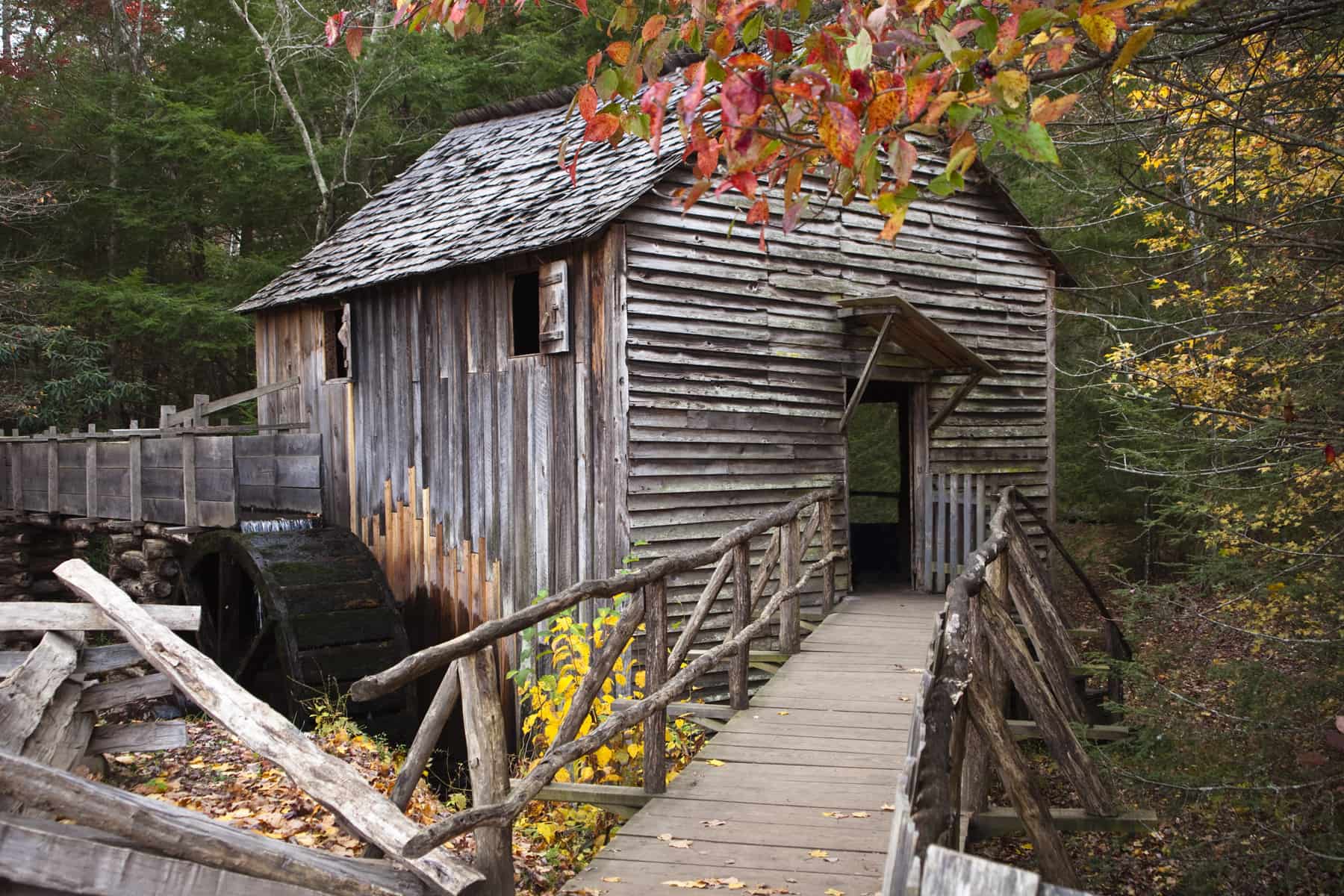
Cades Cove is also famous for the John Cable Grist Mill, which features the typical mill wheel. The mill actually still works; Cades Cove visitors can watch grain being ground, and then purchase the results at the Cades Cove Visitors Center (along with various jams, jellies, and locally-made trinkets). How’s that for a taste of history?
Take in History, Step by Step
One of the great things about Cades Cove is how visiting these buildings in the Tennessee woods feels like stepping directly into the past. Make sure to stop at the Cades Cove Visitor Center for trail maps and historical information to give you all the context you need to fully appreciate your visit, and don’t procrastinate about taking your trip to see Cades Cove. Even history buffs shouldn’t wait forever!
Tag: Smoky Mountain Tourism
Holiday Craft Markets on the Peaceful Side

Written by: Emily Huffstetler
Whether you’re hunting for a gift from the heart, a new ornament for the tree or just a little extra holiday cheer, local makers have you covered. Here’s a preview of holiday markets on the Peaceful Side.
November 15 – Maryville Farmers’ Market Holly Day Market

The Maryville Farmers’ Market wraps up the 2025 season with the Holly Day Market at Founders Square in downtown Maryville. From 8:30 to 11:30 a.m., you’ll find late-fall produce, baked goods, specialty foods and booths stocked with ornaments, artwork and other handmade gifts. This is the final market of the year.
November 15 – Holiday Handcrafters Fair

The Great Smoky Mountains Heritage Center in Townsend hosts the Holiday Handcrafters Fair from 10 a.m. to 4 p.m. Artisans will set up across the grounds with pottery, textiles, fine art and seasonal pieces, all made in the region. Admission is free, and shoppers can wander through the marketplace at their own pace.
November 29 – Downtown Maryville Holiday Market

On Small Business Saturday, the Downtown Maryville Holiday Market fills Broadway Avenue with more than 150 artisan booths. Beginning at 10 a.m., shoppers can walk the length of downtown and browse everything from jewelry and woodwork to candles and Christmas décor. Families can also look for “Candy Cane Lane,” a row of free children’s activities along the street.
December 4–6 – Santa Mouse Christmas House Arts & Crafts Show and Sale

The Santa Mouse Christmas House returns to Dotson Memorial Baptist Church in Maryville for a three-day sale organized by the Blount County Arts and Crafts Guild. Over 50 artists and craftsmen bring jewelry, wood pieces, textiles, home décor and holiday items. Hours run 10 a.m.–5 p.m. on Thursday and Friday and 10 a.m.–3 p.m. on Saturday.
December 6 – Foothills Holiday Market

The Foothills Holiday Market marks its 10th year at Smithview Pavillion in Maryville. From 10 a.m. to 3 p.m., vendors set up indoors and out with handmade gifts, seasonal décor and food items. It’s a small, single-day market that works well for wrapping up holiday shopping close to home.
Make Your Own Holiday Gifts

If you have the time, why not get a little crafty yourself? Here are some upcoming holiday classes where you can make a gift yourself—or sit down with someone you love and create something together.
- November 16 – Traditional Holiday Wreath, 2–4 p.m.
- November 20 – Holiday Bow Making, 5:30–7:30 p.m.
- November 15 – Watercolor Card Class: Bear and Cardinal, 12:30–3 p.m.
- November 21 – Wood Burning: Cardinal Ornaments (Set of 3), 5:30–7:30 p.m.
- November 28 – Needle-Felted Ornaments, 12:30–3 p.m. and 5:30–7:30 p.m.
- November 29 – Needle-Felted Ornaments, 12:30–3 p.m.
- December 5 – Watercolor Christmas Card, 1–3:30 p.m. and 5–7:30 p.m.
- December 11 – Needle-Felt Snowman Class, 2–4:30 p.m.
- December 12 – Needle-Felt Snowman Class, 5:30–8 p.m.
- December 13 – Collage Christmas Card, 12:30–3 p.m. and 5–7:30 p.m.
- November 23 – Reindeer, 2–4 p.m.
- November 23 – Santa Gnome, 4:30–6 p.m.
- November 30 – Winter Village Apothecary, 3–6 p.m.
- December 13 – Snowman Mug, 2–4 p.m.
- December 14 – Santa’s Milk and Cookies Set, 2–4 p.m.
Great Smoky Mountains Heritage Center
- November 17 – Holiday Herbals Class with Herbalist Debbie Dickie, 10:15 a.m.–12:45 p.m.
Born and raised in Maryville, Tennessee, with roots tracing back to Cades Cove, Emily Huffstetler is a proud Maryville College graduate and passionate storyteller of the Greater Smokies region.
Hops in the Hills craft beer fest gets a boost from MC student brewers
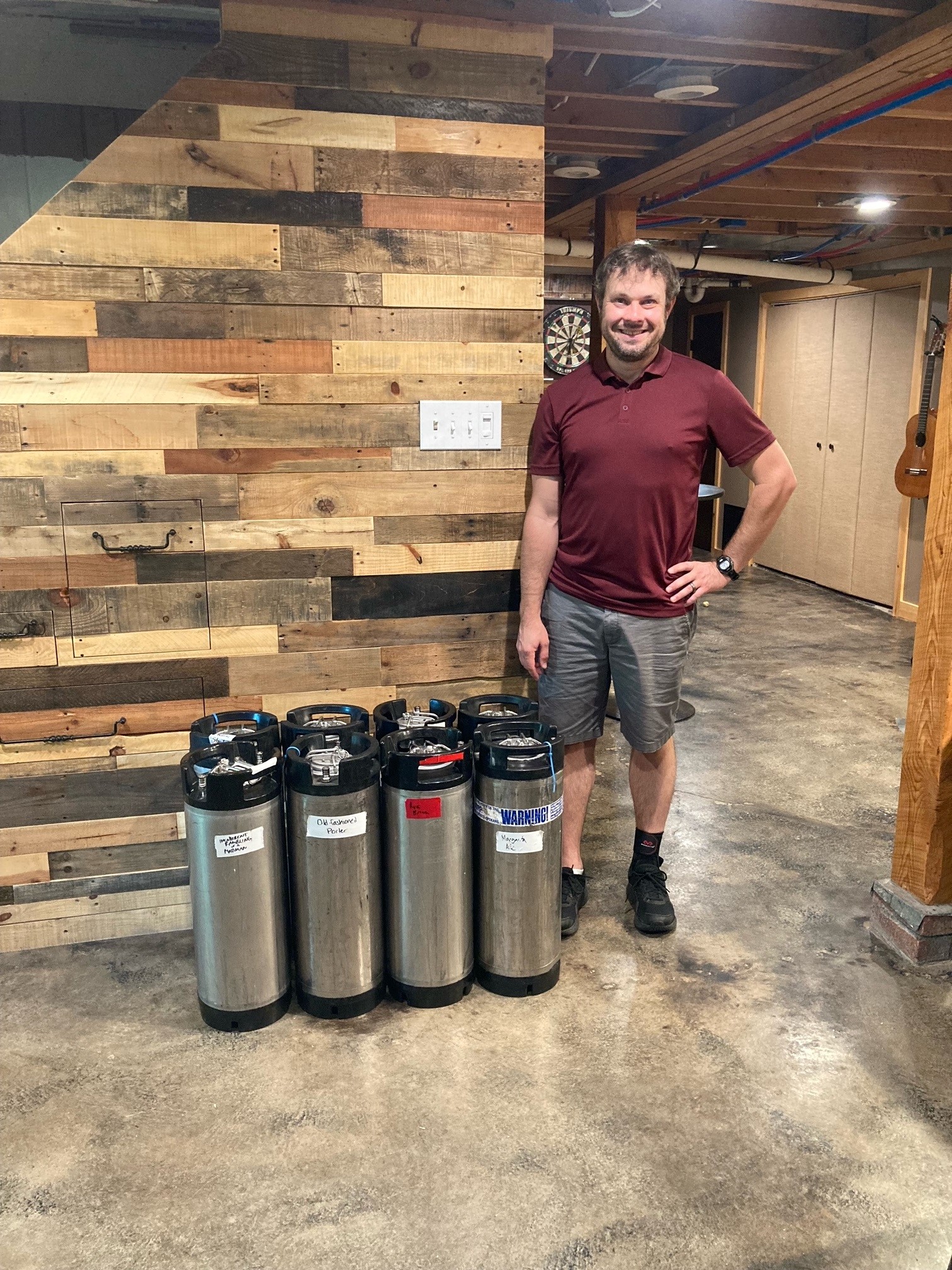
They’re currently stored in the cool confines of Dr. Nathan Duncan’s basement, but on Saturday, June 25, eight brews created by Maryville College students will be available for sampling by roughly 1,000 attendees of a craft beer festival.
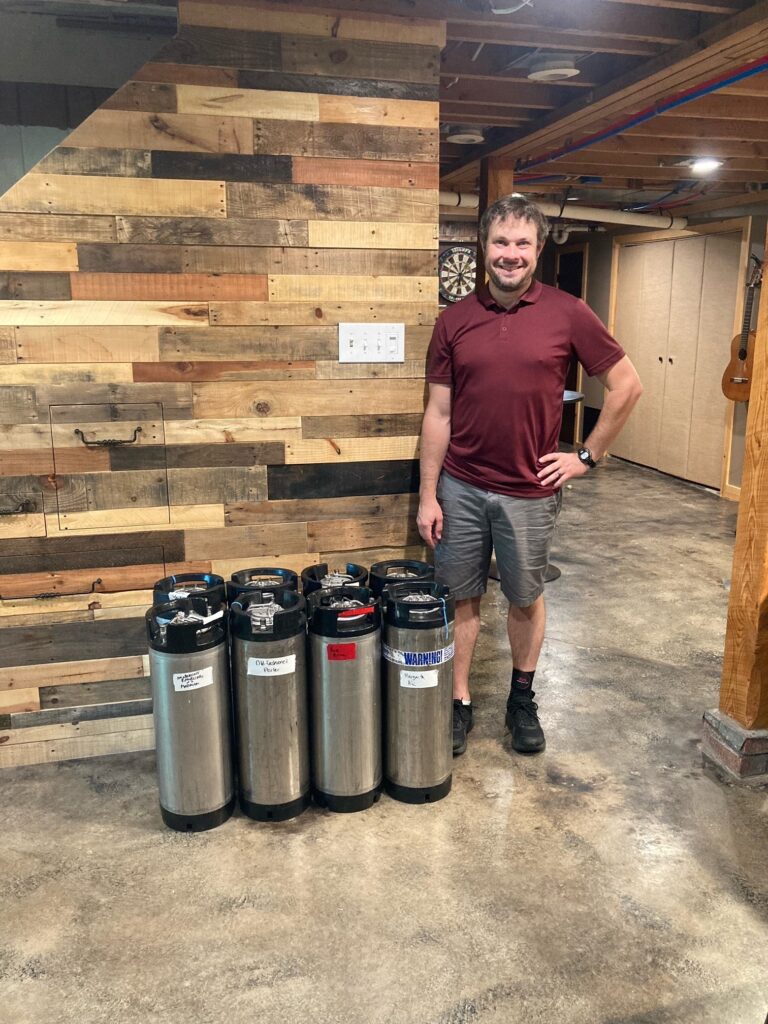
The annual event, known as Hops in the Hills and held in downtown Maryville, is part of the City of Maryville’s annual Summer on Broadway extravaganza and will include over two dozen professional breweries — along with sample pours from Duncan’s “EXP200: Introduction to Brewing” course that the professor of chemistry launched in 2018.
“For this, we have about eight different beers we’re bringing, and almost all of them are student recipes,” said Duncan, who took the beer home with him during recent summer renovations to the College’s Sutton Science Center. “Two are my recipes, including the Irish red ale we brewed earlier this year for the Choir of Man show at the Clayton Center, and I brewed my brown ale this year for it as well. Those are the only two that aren’t student recipes.
“The rest are all from this class except for one, and it’s from an alumnus who took the class in 2020. In addition to students from this year’s class that are working as volunteers for Hops in the Hills, I have students that go back to the very first time we offered it in 2018 who are coming this year as well. A lot of Maryville College alumni will make up the volunteers for this event, and I’m really excited from the standpoint that a lot of them took the class before it was even a part of Hops in the Hills.
“To see how much this little class has grown as far as really becoming a part of our regional craft brew scene is exciting,” he added.
Duncan offers the course every spring and has room for roughly 20 to 24 students. It’s an upper-level class for students 21 and older that focuses on the brewing process, and because beer can be fermented under pressure and turned around in as little as two weeks depending on the style, there’s ample opportunity to try various creations and concoctions.
And some of them, he added, succeed beyond anyone’s expectations, including his own.
“The beer I’m most excited about is one that was created by Becca Roberson ’22 that’s supposed to be a beer that has all of the components or nuances of an Old Fashioned cocktail,” he said. “It’s a porter-style beer that’s aged with some oak, some bourbon, some cherry and also with some orange peel. It’s one she made early in the semester, and it tasted really good. Now that it’s been aging for a while, it should be even better. As soon as we tried it, I told everyone, ‘We’re saving this for Hops in the Hills.’”
In addition to Roberson’s creation — for which she’s designed its own logo — and Duncan’s ales, some of the other brewing class offerings for Hops in the Hills include an imperial stout and for those who find the overly hoppy flavor of stouts and ales off-putting, there’s the brew by alum Sawyer Cradit ’20: a “margarita beer,” according to Duncan.
“It’s kind of a sour wheat style, very low on the hops,” Duncan said. “With this, he was making a beer that used sour mash barley, a lot of wheat to give it kind of the haziness and a little bit of sweetness, and the hops that he used were a New Zealand variety that adds kind of a lime flavor to it.”
Hops in the Hills, Duncan added, is the latest in a busy schedule of events for which his students have brewed beer. (Because their brews are not sold, and the class operates as a homebrewing club, they’re not required to obtain a license to serve it.) In addition to the Blount County Alumni Association’s annual spring barbecue and the aforementioned Choir of Man performance, MC beer was recently served at the banquet celebrating the end of KT Days, and Duncan addressed the assembled alumni about the course, and its plans for the future.
“We have some things in the works that we hope will formalize this class, meaning that it will eventually be replaced with a four-hour class,” he said. “What we’re doing now would be considered the lab part of the class, while it will also include a lot more deep-dive lectures, and we’ve talked with several folks in the brewing industry in our region who are interested in partnering with us for on-site and external internships.”
How to Spend Father’s Day Weekend on the Peaceful Side

Written by: Emily Huffstetler
It’s not too late to make Father’s Day plans on the Peaceful Side of the Smokies. Whether you’re building a full weekend around Dad or choosing one special outing, here are two itineraries to inspire you.
Townsend Father’s Day Itinerary

A Father’s Day weekend in Townsend can be as simple as a morning hike, lunch in town and a relaxed afternoon activity. You can stay overnight or make it a day trip.
Start the day with a hike. For something short, take the 0.8-mile roundtrip trail to Look Rock Tower off the Foothills Parkway. It leads to panoramic mountain views.
For a longer hike, try Middle Prong Trail. Indian Flats Falls is about 8.3 miles round trip, but the trail works well with a shorter turnaround point. Lynn Camp Prong Cascades is about 0.7 miles from the trailhead, making it an easier option before lunch in Townsend.
There are several restaurants in town to choose from. Peaceful Side Social has outdoor seating and a menu with options for the whole family.
Cades Cove Golf is just down the road. The new miniature golf course brings the feel of a traditional course to a smaller scale, with mountain views and a different challenge at each hole. It opens at noon on Saturdays and 2 p.m. on Sundays.

If you’re staying at Little Arrow Outdoor Resort, the annual Father’s Day weekend cornhole tournament runs Saturday, June 20, from 1 to 3 p.m. You can book it as an add-on when you reserve your stay.
Later in the day, stop by Company Distilling. For Father’s Day weekend, the Townsend location is offering etched bottles of Straight Bourbon Whiskey Finished with Maple Wood, plus a buy-one, get-one-half-off special on that product, excluding cask strength.
You can also reserve the Fill Your Own Bottle experience. Guests take part in a premium guided tasting, then fill, cork, seal and sign their own 750ml bottle from the barrel. The current release is an 8-Year Single Barrel Wheated Bourbon. The experience costs $139.99 per person and lasts about 60 to 90 minutes. It’s open to guests 21 and older with valid ID.
Stick around for live music. The Grassroots Gringos are performing on Saturday from 6 to 8 p.m. If you’re visiting with kids or anyone under 21, Townsend Abbey is another option for dinner and live music. Perry Bonck performs Saturday from 6:30 to 9 p.m.
If you’re staying overnight, let Sunday move slower. Grab brunch or an early lunch at Townsend Abbey, which is open for Father’s Day from 11 a.m. to 8 p.m. If the Fill Your Own Bottle experience at Company Distilling or a round at Cades Cove Golf didn’t fit into the day before, both can work as Sunday options before heading home. You could also take a walk along the Townsend River Walk & Arboretum by the Little River.
Maryville Father’s Day Itinerary
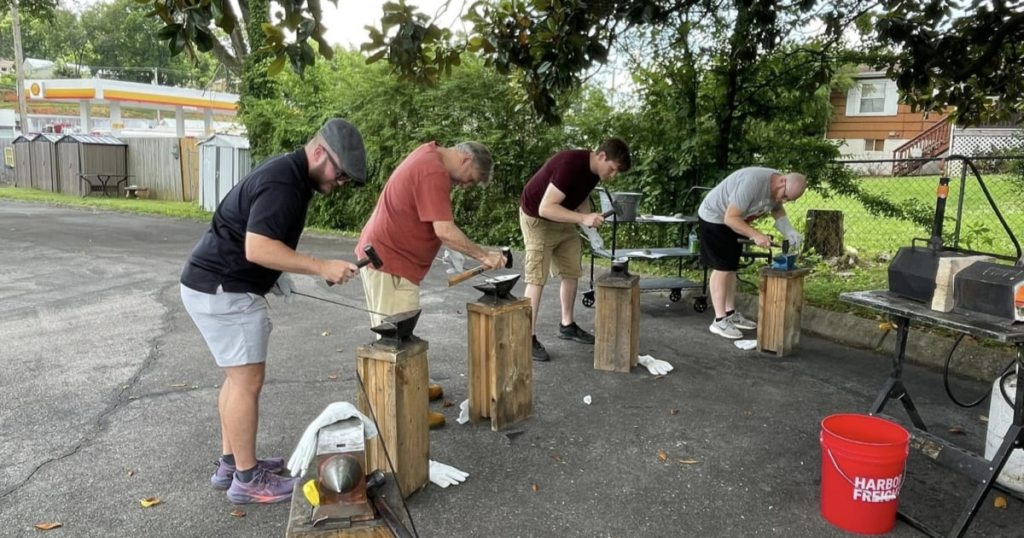
In Maryville, Father’s Day weekend can include a hands-on activity, live music, brunch and a new indoor golf experience at Greenway Village.
Creative Spark Studio offers Blacksmithing Basics with Bryan on Saturday, June 20. Classes run from 1 to 3 p.m. and 3 to 5 p.m. Book in advance to make a marshmallow roaster with Dad. The class is recommended for ages 18 and older, or 16 and older with a guardian.
After class, stay out for dinner or live music. Cats Away performs at Peaceful Side Brewery on Saturday from 6 to 9 p.m. For a later night, Two Doors Down has a Throwback party from 9 p.m. to 1 a.m.
On Sunday, Maryville has several Father’s Day brunch options. Daisy’s Non-alcoholic Bar and Bottle Shop is hosting theirs from 10 a.m. to 3 p.m. The all-ages event includes games and a pool table. Dads get their first drink free.
Raven Steakhouse is also hosting Father’s Day brunch. The special menu includes shrimp and grits, biscuits and sausage gravy, smoked salmon, beef tenderloin, pancakes, pastries and more. Brunch is $55 and requires advance reservation.

End the weekend at The FoxHole Golf Club in Greenway Village. The new indoor golf club uses Trackman-powered simulators, giving players a high-tech place to practice, play world-class courses and track their stats. Book tee times through the website. Children must be 13 and older.
Born and raised in Maryville, Tennessee, with roots tracing back to Cades Cove, Emily Huffstetler is a proud Maryville College graduate and storyteller of the Greater Smokies region. She holds a Master of Science in Conservation Education from Mississippi State University.
How Townsend Got Its Name: History of the Little River Railroad and Lumber Company
Written by: Emily Huffstetler
In 1900, a Pennsylvanian man named J.W. Fisher found himself in a predicament. The tannery he recently started in Blount County had taken off, producing up to 400 hides a day, and his local tanbark providers couldn’t meet the demand.
Meanwhile, in Clearfield, Pennsylvania, a businessman named Colonel W.B. Townsend was experiencing growing pains of his own. Now that almost all the timber in Pennsylvania’s Allegheny Mountains had been logged, Townsend was looking to relocate his logging enterprise.
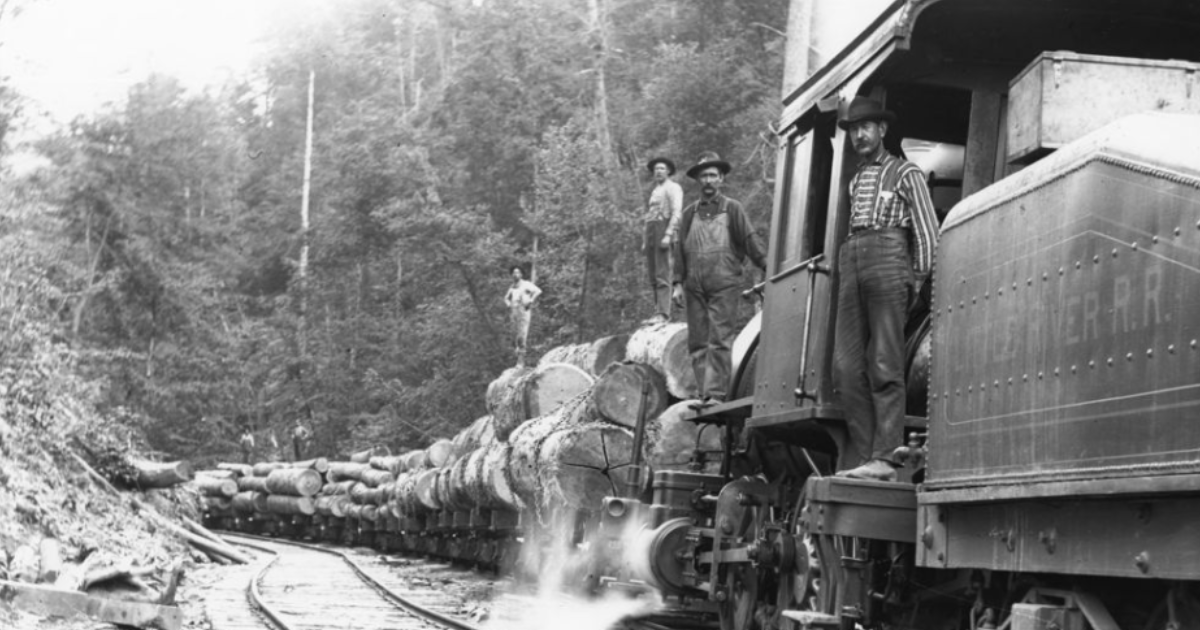
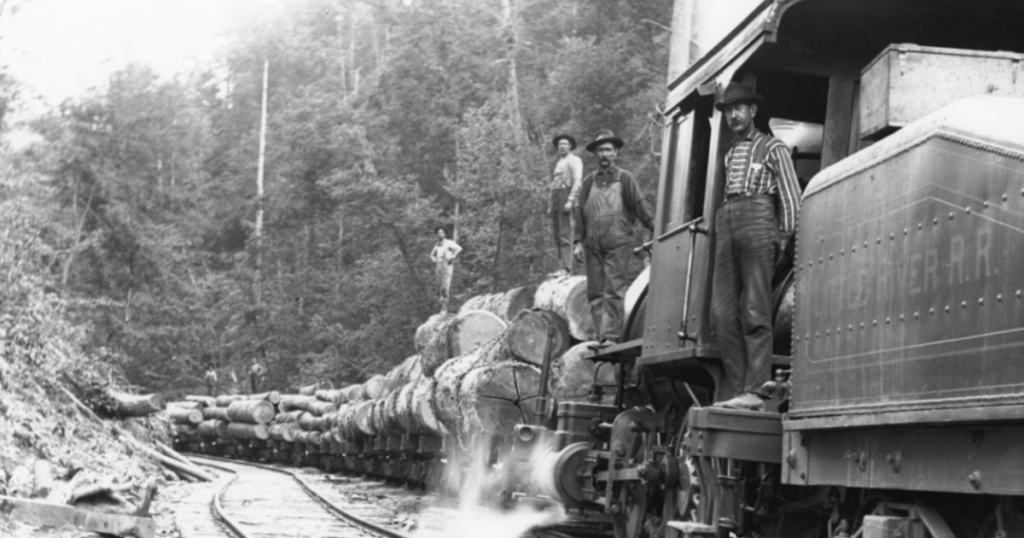
Seeing an opportunity to secure a reliable tanbark provider, Fisher invited Townsend to the Great Smoky Mountains. In 1901, W.B. Townsend—along with Pennsylvanian investors Asbury Lee, William McCormick, William Wrigley and Joe Dickey—purchased nearly 100,000 acres of timberland along the Little River and its tributaries. They chartered the Little River Lumber Company and then the Little River Railroad, to haul the logs.
Fully committed to his business venture, W.B. Townsend moved his family to Blount County. And in 1903, the community of Tuckaleechee—a Cherokee name loosely translating to “peaceful valley”—was named in his honor.
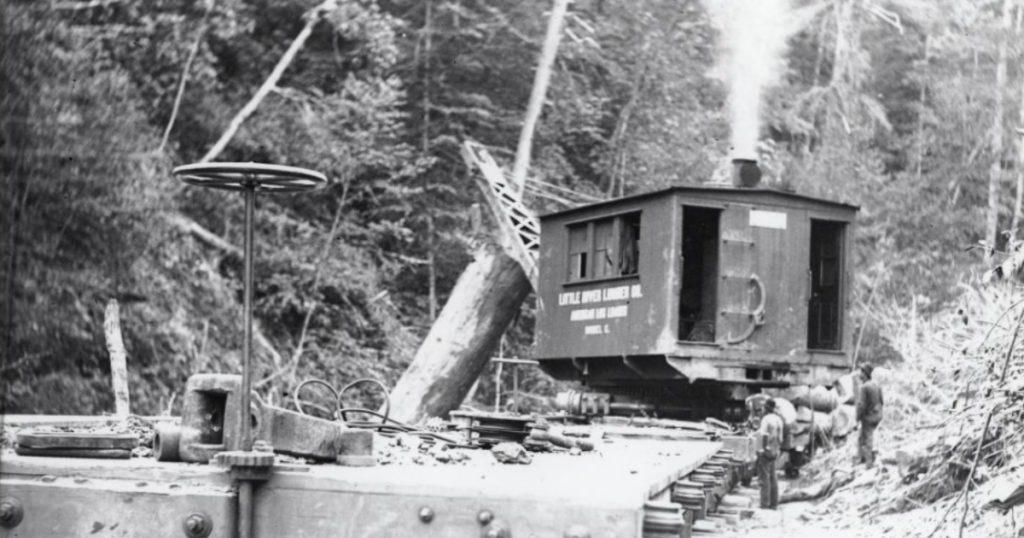
Over the course of 38 years, Townsend’s company built 150 miles of railroads and sawed 560 million board feet of timber—enough to reach California and back, if laid end-to-end. Environmentally and economically, the Little River Lumber Company and Little River Railroad reshaped the Peaceful Side of the Smokies.
“We’re learning more and more about [W.B. Townsend and the investors],” said Neal Stone, President of The Little River Railroad and Lumber Company nonprofit. They apparently had a 16-story office building in Pittsburgh, suggesting affiliation with a larger company. W.B. Townsend had also been logging in West Virginia and Kentucky, and he owned a railroad, coal mine and clay tile company in Kentucky.
Perhaps, then, it would come as no surprise that Townsend monetized nearly every aspect of his East Tennessee logging community. Workers and their families rented on-site prefab homes from the company, and they were paid in “doogaloo,” redeemable only at the company stores.
“It was a very monopolistic situation,” Stone said.
W.B. Townsend also transformed a hunting camp, Elkmont, into a tourist destination for wealthy East Tennesseans. Since the trains already had flat cars to restrain their loads, the company decided to add side rails and charge people a small fee to ride from Knoxville to Townsend.
When that did well, they built the Elkmont Observation Car, which had 16 benches capable of seating two people each, for a total capacity of 32 people. Regular passenger cars were used as well.
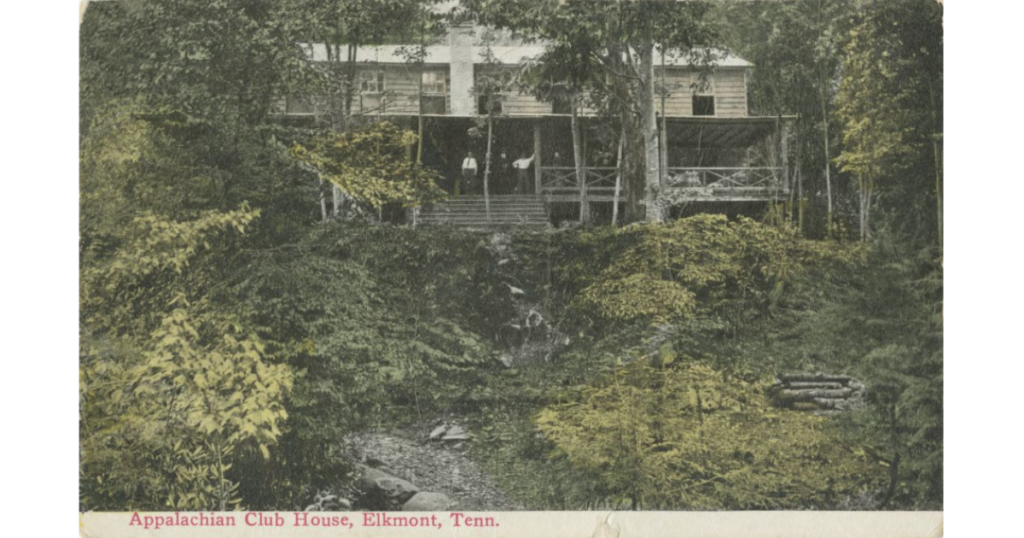
In 1910, W.B. Townsend decided to subdivide the property. He sold 50 acres to the Appalachian Club, a group of wealthy businessmen from Knoxville. Members paid the Elkmont Construction and Supply Company, also owned by Townsend, to build a clubhouse and cottages.
“They’d live there all summer, and the husbands would come there on the weekends,” Stone said. For those who could afford it, the mountain retreat was an idyllic escape from the heat.
A couple years later, three brothers from Knoxville bought 65 acres and opened the Wonderland Hotel. The brothers ended up selling the hotel to rivals of the Appalachian Club looking to form a club of their own.
Members of the two clubs refused to interact with each other on the train ride to their respective properties. But they did eventually find a common interest: protecting their land.
“The irony is that the lumber company’s clearcutting led to the preservation of the park,” Stone said. At the time, the process for lumbering was clearcutting, an extreme method that stripped the virgin landscape bare. The tourists wanted to put an end to this.
The national park movement was still relatively new. Yellowstone, the first national park, was only established in 1872. Creating a park would prove especially complicated because people had been living on the land for generations.
Nevertheless, the club members and environmentalists persisted. In 1926, Congress approved the authorization of the park, and Tennessee and North Carolina started raising money to purchase nearly half a million acres from private owners.
The outlook was grim for most residents. The Tennessee state government was only willing to pay about half of what their properties were worth. When the owners resisted, the state invoked the right of eminent domain. Over 5,000 people had no choice but to leave their homes. Meanwhile, the influential Wonderland and Appalachian Club negotiated a rental agreement that would extend into the early 90s.
The Little River Lumber Company sold 76,507 acres for the park, on the stipulation that they could keep logging for the next 15 years. In 1939, the last logs came out of the mountains.
“There are three locomotives left in the world that we know worked for the Little River Railroad Company,” Stone said.
“Number 110 lasted the entire lifetime of the railroad…It has been fully restored and runs today in Michigan pulling passengers.” It’s the smallest standard gauge Pacific steam locomotive ever built in the United States.
“Number 126 was another technological advancement. It was what they called a Mallet type, and it had eight driving wheels…It was a rod type engine, but it was hinged in the middle, so it could go around tighter curves,” Stone said.
That locomotive didn’t stay with the Little River Railroad long due to technical issues. It went back to the manufacturer and was sold out West, where it derailed and was abandoned for years. About three years ago, it was returned to full active service pulling excursion trains on the west coast.
The last surviving locomotive, Shay 2147, eventually made its way back home.
Shay 2147 was only used for about three or four years as the Little River Railroad was winding down. It pulled the last train across the Little Tennessee River (now part of Tellico Lake) near Chilhowee while workers disassembled the tracks and bridge.
The locomotive changed hands several times after that, travelling across the country, before it was put up for sale for $8,000 for parts. After local train enthusiasts banded together, the Towsend Chamber of Commerce decided to purchase it as a monument for a future park.
At least, that was the plan.
“Well, when word got out about the Shay, there was this huge groundswell of public support,” Stone said.
“You heard stuff like, ‘My daddy used to do that; my grandaddy used to do that; I drove that; I got to be an engineer for that.’ We still had people around back then that worked for the company, and people were coming up with pictures and artifacts,” Stone said.
In November 1982, several community members came together and formed the Little River Railroad and Lumber Company nonprofit corporation. They converted the former Walland Depot, donated by Joe Henry Everett on behalf of her late husband, into a museum.

“The Shay arrived on Thanksgiving weekend 1982, and we’ve been growing ever since,” Stone said.
“Earlier, we received grant [funding] to build a gift shop that resembles the Elkmont post office. And our main restoration shop conference room is designed to look like the Elkmont train engine house,” Stone said. In other exciting news, the nonprofit recently received a grant from the Tennessee State Museum to put a new roof on the depot and water tower.
A variety of artifacts have turned up over the years—most recently, a mint condition box of crayons that would’ve been used to mark the wood 80 to 90 years ago. Everything is on rotation at the Little River Railroad and Lumber Company Museum, which is open to the public from April through November. Admission is free, but donations are encouraged.
The Little River Railroad and Lumber Company Museum annual Railroad Days Heritage Festival is coming up on Sept. 28 and 29, from 10 a.m. to 5 p.m. You can ride the hand pump car, check out the reproduction Elkmont Observation Car and see special exhibits and artifacts. There will be local food vendors and craftsmen, as well as live music.
__________________________________________________________________________________________________________________________________
Born and raised in Maryville, Tennessee, with roots tracing back to Cades Cove, Emily Huffstetler is a proud Maryville College graduate and passionate storyteller of the Greater Smokies region.
How Walland, TN Got Its Name: History of Miller’s Cove
Written by: Emily Huffstetler
Walland is a small, unincorporated community tucked into Miller’s Cove, a peaceful valley in the northwestern foothills of the Smokies. Today, around 463 people call this quiet corner of Blount County home. But its story stretches back long before modern roads and homes appeared.
In 1567, Spanish explorer Juan Pardo and his expedition crossed the Little River at present-day Walland, searching for a route to a silver-mining town in Mexico. At that time, Spaniards believed that the Appalachian Mountains connected all the way to central Mexico.
For generations, the Overhill Cherokee used the cove as hunting grounds. By the time European settlers arrived in the 1780s, Cherokee presence and influence in the area were well established. As settlers moved in, they built small forts in response to Cherokee resistance, gradually driving them from the land.
As European settlement increased, land claims began to formalize. The earliest recorded land grant in the area was given to John Rhea for 940 acres in 1794. It referred to the region as Murphy’s Cove. Before long, the name changed to Miller’s Cove, likely in honor of brothers Alexander and Andrew Miller, who built several cabins during the early 1800s.
Around the same time, Swiss immigrant John Hess built a grist mill on the cove’s western end, while the Martin family established another mill to the east.
As more pioneers settled in the area, Miller’s Cove Baptist Church was established in 1810. It became Blount County’s first Baptist church and remains one of its oldest congregations today. A Methodist church followed in 1830.
With a growing community came industry. In 1845, George Amerine established an iron forge along Hess Creek. By the mid-1850s, it was producing as much as 15 tons of bar iron each year, making it the largest forge in the county. However, with the outbreak of the Civil War, production came to a halt, and the forge was abandoned.
While Tennessee sided with the Confederacy, Blount County remained largely pro-Union. In Walland, an estimated 1,500 people gathered for a Union rally, where they made an American flag and raised it on a tall flagpole.
As the story goes, when a Confederate cavalry passed through, some soldiers raised their rifles. But their lieutenant stopped them, reminding the troops that it was the flag under which they had been born. In a surprising moment of respect, the troops peacefully circled the flag, saluted it and rode on.
After the war, industry resumed in Miller’s Cove. John Waters built the first grist and sawmill and opened a post office, which operated from 1884 to 1912.
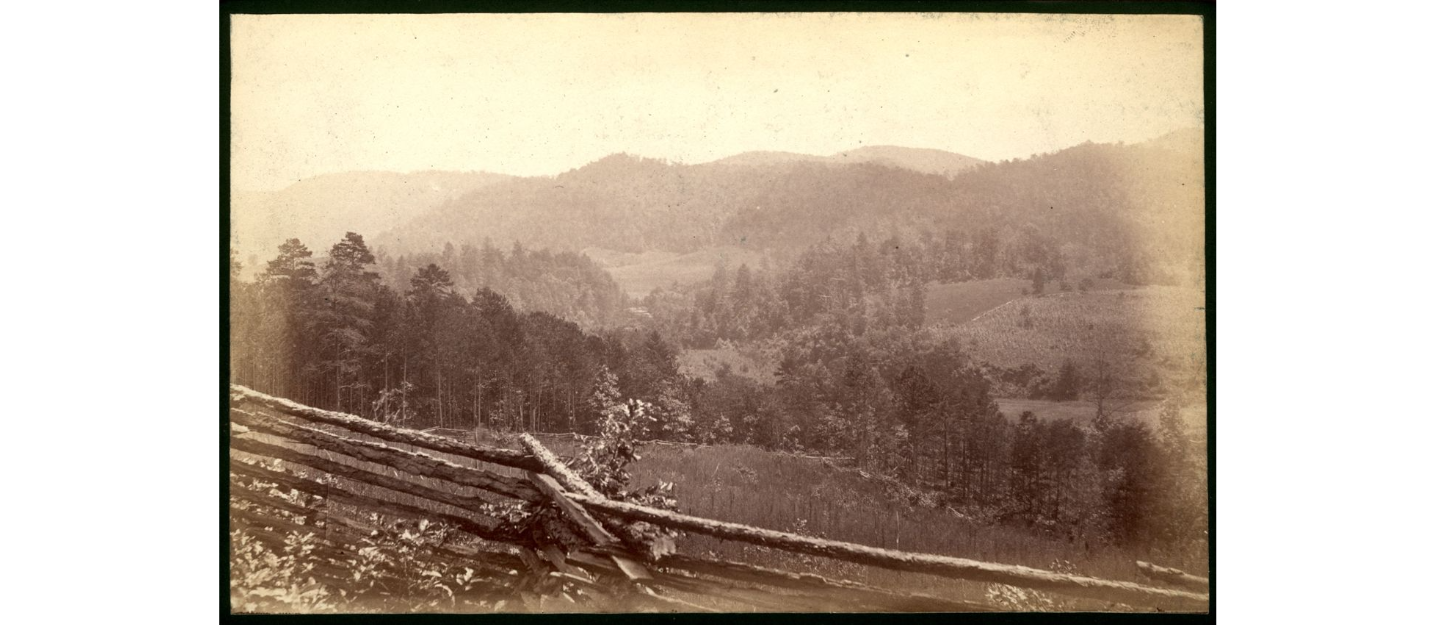
In August 1886, photographer William Cox Cochran captured dozens of photographs of people and landmarks in East Tennessee, including Walland. His images depict the timeless Little River, along with serene clearings and humble cabins.

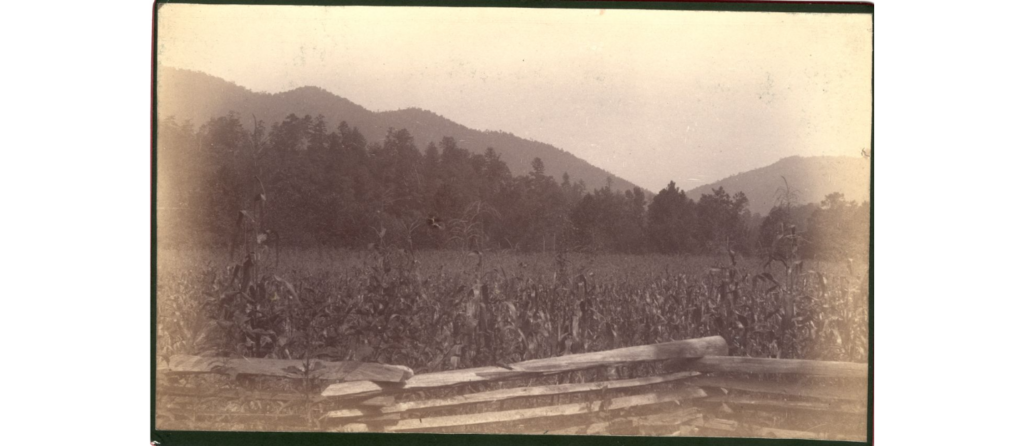
Little River Gap from road near Vance Walker’s house, Miller’s Cove. William Cox Cochran Great Smoky Mountains Photographic Collection
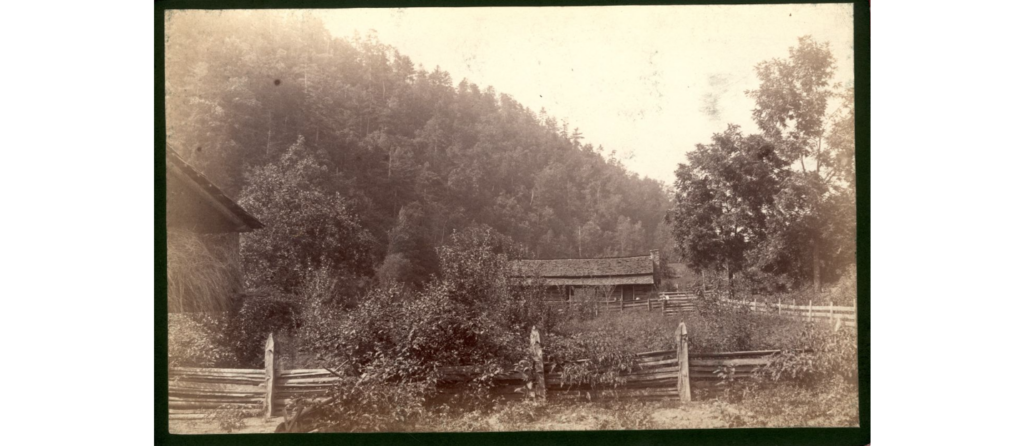
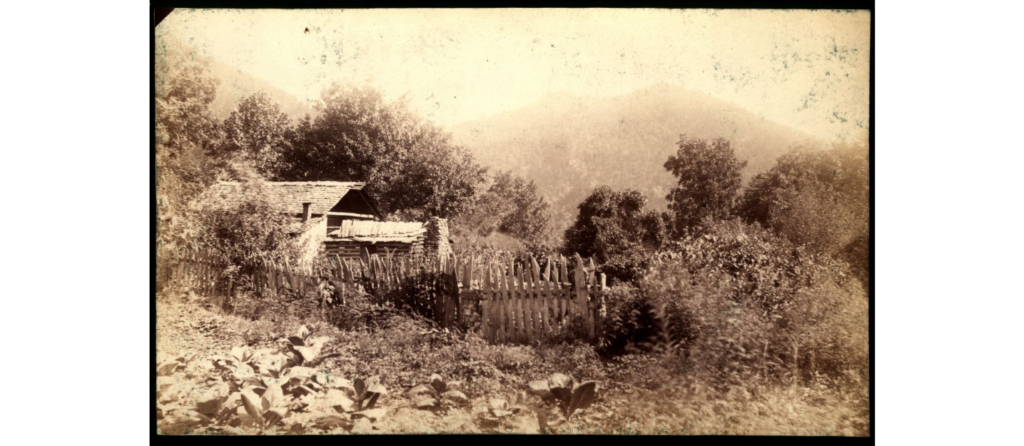
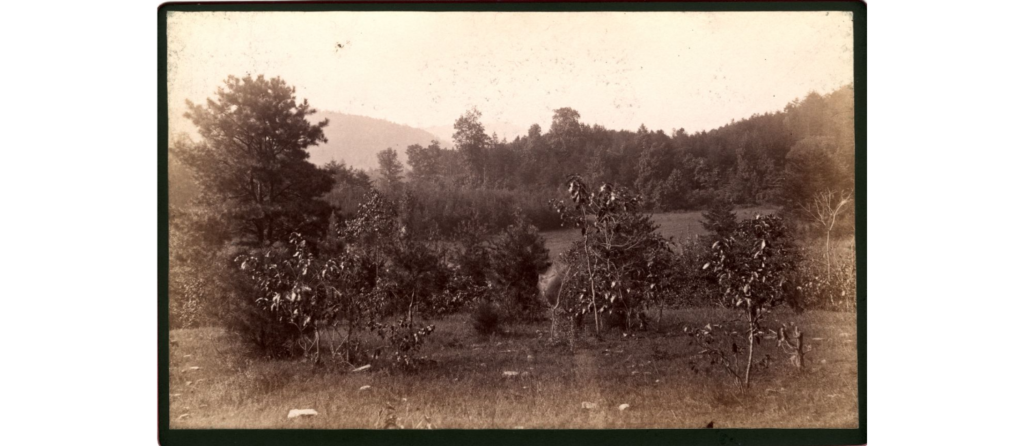
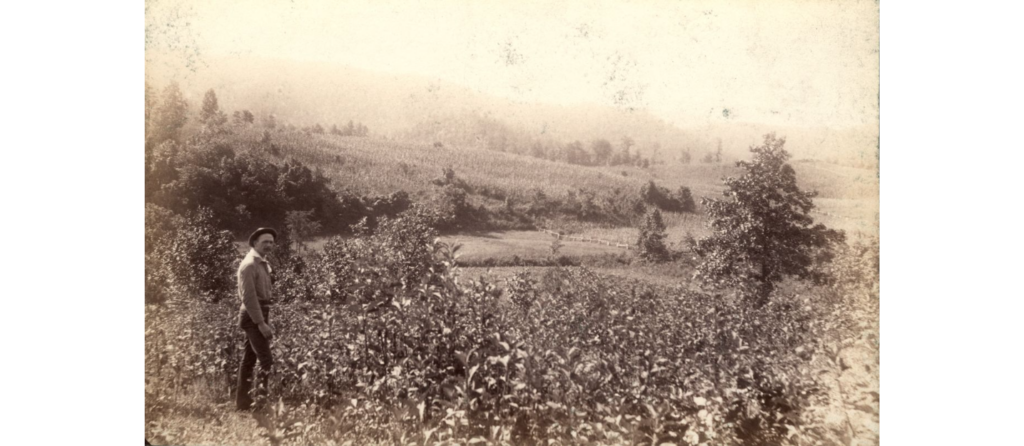
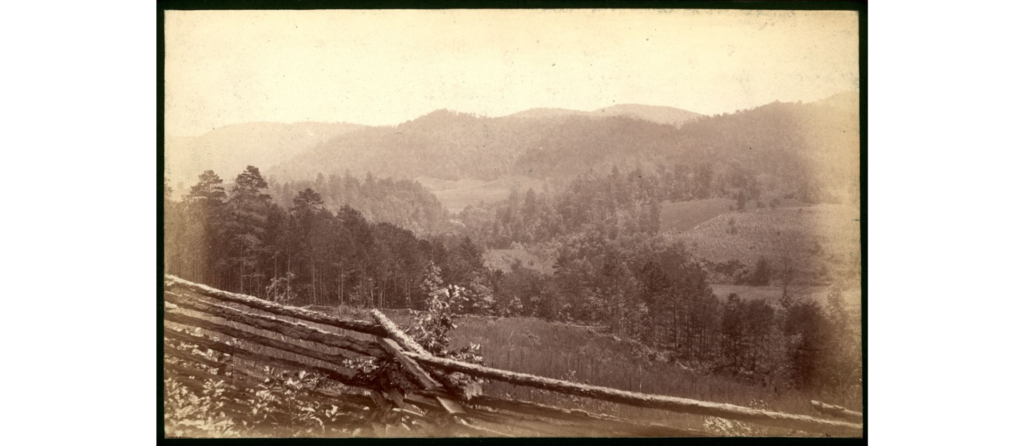
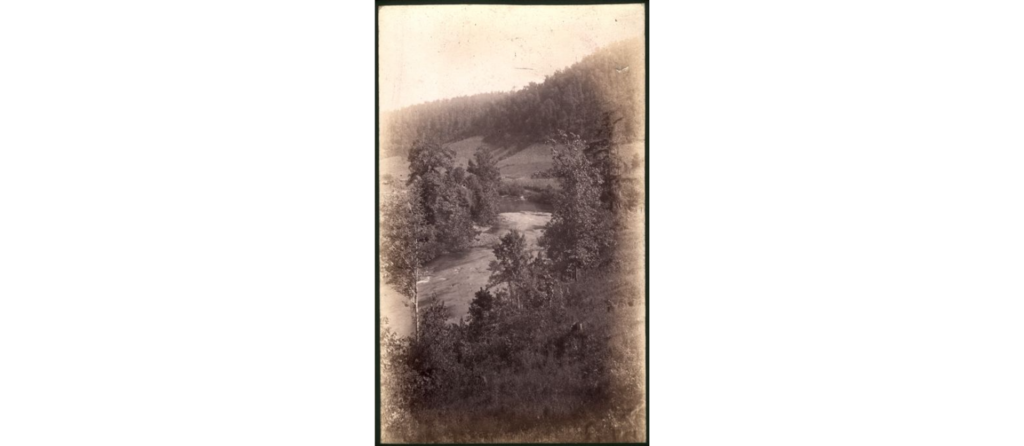
In 1901, the first railroad reached Walland, connecting the community to Maryville. Around the same time, the Schlosser Leather Company was chartered, with its tannery opening in 1902. The name Walland combines Walton and England, two key figures in the leather company’s formation.
At its peak, the plant processed an average of 300 to 400 hides each day, consuming roughly 250 carloads of tanbark annually. By 1909, the company had its own power plant. However, this plant burned down in 1931 and was never rebuilt. Following the fire, Chilhowee Inn, built and operated by the company, passed to private ownership. Today, it continues to welcome visitors as a bed and breakfast.
Walland’s first high school opened in 1922 and became a four-year school in 1926. While other schools in the county were open just six months of the year, the Schlosser Leather Company funded salaries for an extra three months of instruction. The high school closed in the mid-70s.
Walland is perhaps best known today for Blackberry Farm, which Kreis and Sandy Beall opened to the public in 1976 as a six-room country inn. Over the years, it has grown into one of the world’s most celebrated small luxury resorts. Set on 2,400 acres, Blackberry Farm offers 68 guest accommodations, world-class dining and a range of curated experiences that draw visitors from around the globe.
Learn more:
Blount County | Tennessee Encyclopedia
Walland, TN – Profile data – Census Reporter
History of Blount County, Tennessee, From War Trail to Landing Strip, 1795-1955
Overhill Cherokees | Tennessee Encyclopedia
Pardo Expedition | Tennessee Encyclopedia
William Cox Cochran Photographic Collection | Digital Collections
__________________________________________________________________________________________________________________________________
Born and raised in Maryville, Tennessee, with roots tracing back to Cades Cove, Emily Huffstetler is a proud Maryville College graduate and passionate storyteller of the Greater Smokies region.
Indulge in Southern Appalachian Cuisine on the Peaceful Side

Written by: Emily Huffstetler
Southern Appalachian cuisine is a blend of British, German and Italian immigrant traditions, along with Cherokee and African American influences—at least, that’s what Google says. Ask a local, and they’ll tell you it’s about clearing your plate, going back for seconds (or thirds), and still heading home with leftovers—especially if Mamaw’s cooking.
Shaped by rugged mountains and harsh winters, Southern Appalachians have long mastered the art of making the most of what’s available. For generations, foraging for ingredients like ramps, blackberries and black walnuts, along with canning, pickling and preserving, has been a way of life. Today, restaurants on the Peaceful Side of the Smokies carry on these traditions with their own modern twist.
Well, what are you waiting for? We’ve saved you a seat.
Southern Appalachian Staples

Before diving into the best places to try these dishes, here’s a breakdown of some key ingredients and meals that define Southern Appalachian cuisine:
- Benton’s Bacon & Country Ham: World-famous ham slow cured in East Tennessee using salt, brown sugar and sodium nitrite.
- Biscuits and Gravy: Not to be confused with the British cookie. Soft, flaky bread rolls served for breakfast.
- Blackberries: In season from July to October. Enjoyed as-is, or in jams and cobblers.
- Black-eyed Peas: Bean introduced to the region by West African enslaved people in the 17th century. Said to bring good luck in the New Year.
- Cobbler: Dessert consisting of a fruit poured into a large baking dish and covered with a batter or biscuit.
- Collards: Hardy greens that can survive the winter and summer. Like black-eyed peas, said to bring good luck in the New Year.
- Fried Green Tomatoes and Fried Okra: Southern summertime delight. Maybe not what the doctor had in mind when they said to eat your vegetables.
- Pimento Cheese: A.K.A. “Southern Caviar”. A blend of shredded cheddar cheese, pimentos, mayo and spices, typically served with crackers or as a sandwich.
- Pinto Beans and Cornbread: Budget-friendly and hearty meal.
- Ramps: Wild onion in season from mid-March to early April. Eaten raw or cooked.
- Wild Mushrooms: Oyster mushrooms, Chicken of the Woods and morels are some of the most common.
- Wild Nuts: Black walnuts, pecans and American Chestnuts are some of the most common.
- Fried Green Tomatoes – Served with house-made pimiento cheese and house-made tomato jam.
- Cheddar Pimiento Cheese – Served with fresh baguette slices and house-made tomato jam.
- Cletus Burger – Served with fried green tomato, pimiento cheese and tomato jam.
Dancing Bear Lodge & Appalachian Bistro
- Confit Rabbit Pasta – Confit rabbit leg, roasted ham hock meat, Benton’s bacon, preserved lemon, local oyster mushrooms, braised onions, smoked chicken velouté, baby kale and Italian apron pasta.
- Veal Picatta & Pasta – Crispy veal sweetbreads, Benton’s bacon, preserved lemon, crispy capers, local oyster mushrooms and Italian apron pasta.
- Green Goddess Salad – Artisan lettuce, cucumber, heirloom tomatoes, shaved radish, pickled red onion, cornbread croutons and spring herb dressing.
- Tennessee Haystack – Open-faced biscuit topped with bacon, ham, two eggs your way and homemade sausage gravy.
- Fried Green Tomato BLT – Applewood smoked bacon, fried green tomatoes, romaine lettuce and bacon aioli sauce, served on multigrain bread.
- Fried Green Tomatoes – Fried green tomatoes topped with tomato chutney, basil aioli and goat cheese.
- Pimento Cheese & Pork Rinds – Served with Vermont white cheddar and smoked gouda.
- Mixed Green Salad with Fried Okra – Mixed greens, crispy fried okra, tomatoes, grilled red onion, cheddar cheese and buttermilk garlic dressing.
- Baby Spinach Salad – Baby spinach, Benton’s bacon, goat cheese, shaved red onion, roasted black-eyed peas and warm bacon Dijon dressing.

- Appalachian Trail Board – Salami, Benton’s ham, pepperoni, regional cheese, pepper relish, pickled veggies, crackers and trail mix.

- Blackberry Smoke – Gourmet grilled cheese. Provolone, blackberry jam, pickled jalapeños and bacon.
- Grilled Pimiento Cheese – Cheddar pimiento cheese.
- Pinto Bean Plate – Pinto beans, collard greens and two hoecakes, served with a side of chow-chow.
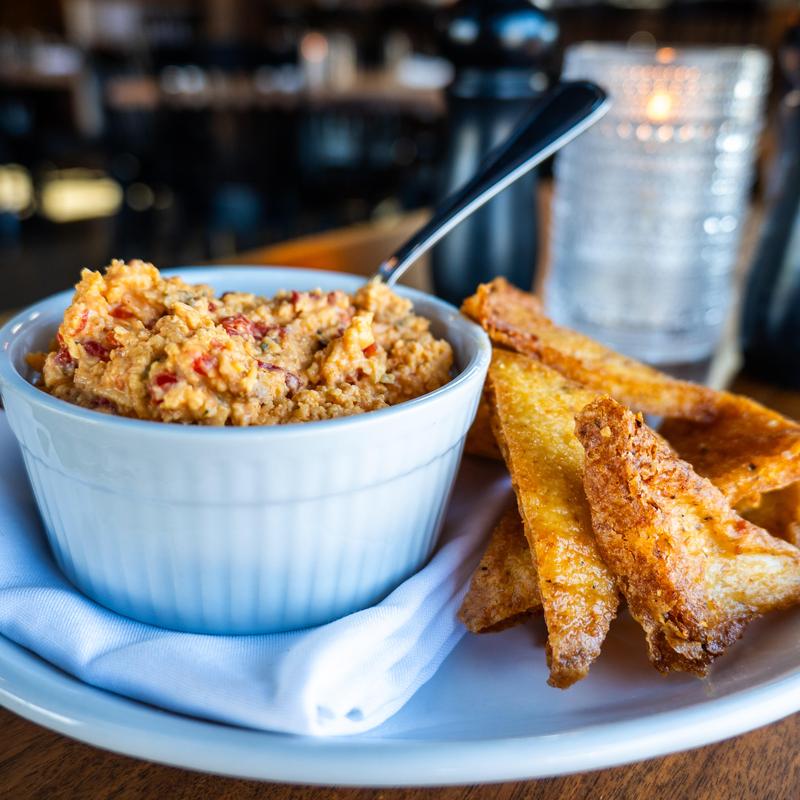
- Grit Chips & Pimento Cheese – House-made grit chips and pimento cheese.
- Appalachian Lardon Pasta – Blistered heirloom tomatoes, sun-dried tomatoes, northern beans, arugula, bucatini pasta, pecorino Romano cream sauce and Benton’s ham lardons.
- Elevation Burger – 8 oz. Simpson’s burger, pimento cheese, tomato jam, bacon, lettuce and tomato.
- Seasonal Cobbler – Local fruit marinated in seasonal spices and sugar, topped with a brown sugar crumble and served with vanilla bean ice cream.
- Southern Grilled Cheese – House-made pimento cheese, bacon, lettuce and tomato, served on Texas toast.
Want to dive deeper into Appalachian Cuisine? Check out our directory of restaurants on the Peaceful Side.
__________________________________________________________________________________________________________________________________
Born and raised in Maryville, Tennessee, with roots tracing back to Cades Cove, Emily Huffstetler is a proud Maryville College graduate and passionate storyteller of the Greater Smokies region.
Is Wine Your Thing? Indulge in a Visit to Blue Goose Vineyards
Located just outside Maryville, TN, is a local sight that many visitors pass right by, without even realizing what they’ve missed. Nestled into the heart of the peaceful side of the Smokies is the Blue Goose Vineyard and Winery, a family-owned business that produces some of the best wine in the state. The winery operates under the Appalachian spirit of farm-to-table – everything needed to create, store, package, and sell the wine is located right on the family vineyard, which has been in the family for five generations. Here’s why any wine lover should stop at the Blue Goose when visiting Maryville.
Have a Chic Date at the Rustic Farm Winery
The tasting room of the winery is located in the classic barn that was transformed from a working barn to a chic gathering space. Relax in the beautiful area while you sip, check out the gift shop, look at art from local artists, and more. The wine is a traditional Appalachian muscadine, which is sweet but not overly so. Whether your palette is very dry or more familiar with dessert wines, you’ll love Blue Goose.
The property is also home to livestock and crops – it is a real working farm in every sense of the phrase. You’ll be able to see some of the livestock and farm life as you visit, which makes it a unique adventure if you’ve never had the chance to see a farm up close before. The winery is open to visitors Wednesday, Thursday, and Saturday from 11AM to 6PM, and Friday from 11AM to 7PM.
Bring a Bottle of Blue Goose Home
A bottle of locally made wine is the perfect gift to bring home to family or friends, or for your own souvenir. Grab a bottle to take with you back to your cabin rental, hotel, or RV while you stay with us here in the Maryville area, and enjoy your night like the locals do. The wine selection is quite varied, so you can try a little of everything, or stick to your favorites.
The property is also used for local events frequently. The winery can be rented out for a wedding, a community event, and more. In recent years, the community held an eclipse-viewing event here, and many of the locals came by to get a good look at this celestial wonder – and sip some local wine, of course!
Make This Local Gem a Must on Your Vacation Itinerary
Find out more about Blue Goose or take a look at their wine menu online. The winery is a fantastic way to have a relaxing afternoon before you head into the city for dinner reservations, or as a way to wind down after a day of fun.
It’s Camping Season: Places to Stay in the Peaceful Side of the Smokies

With cooler temperatures and the emergence of vibrant red and orange hues, fall is upon us, which means camping season is here. Bundle up! These are the top places to camp in the Peaceful Side of the Smokies.

Make it a family vacation.
Big Meadow Family Campground (RV only)
It’s no surprise the National Association of RV Parks and Campgrounds named this RV park its National Small Park of the Year in 2013 and 2019. They offer easy in, easy out pull-through campsites on concrete pads and patios, protected by 24/7 security. Their full hook up sites include water, sewer, major cable, Wi-Fi and 30/50 AMPs. And with a dog park, workout room, splash pad, basketball court and corn hole, there’s something for the whole family to enjoy.
Townsend Great Smokies KOA (RV, tent and cabin)
With recreational activities abounding, including an outdoor cinema, a playground, a basketball court, wagon rides, a pool, bike and tube rentals, tie-dyed t-shirts and more, Townsend Great Smokies KOA is a great family vacation destination. Rough it in a tent, park an RV and plug into 50 AMPs, or book a cabin. Deluxe cabins feature private bedroom(s), bathroom, patio with a grill, and full linens. You can even stay right on the Little River.
Little River Campground & RV (RV, tent and cabin)
Little River Campground is a great place to make memories with your family. Go tubing in the Little River, swim in the pool, or play in the game room. There are arts/crafts to do on Fridays, including souvenir t-shirt decorating, and there are hayrides on Saturdays. The campsite has 30/50 AMPs, Wi-Fi and Direct TV.
Go on an adventure.
Twin Valley B&B Horse Ranch (Cabin and primitive shelter)
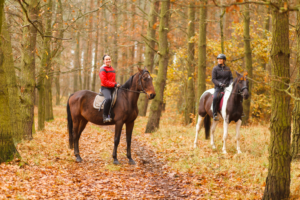
If you’re down for an adventure, consider camping at Twin Valley B&B Horse Ranch. They offer horseback trail riding and miniature horse hiking, and you can swim and fish in a spring fed pond on your own time. Lodge in a fully furnished cabin, or backwoods “rough it” in a one-room, four-sided primitive shelter. To make things easy, they can even pick you up and drop you off at the airport.
Keep it simple.
Riverstone Campground (RV and tent)
Perhaps, you aren’t about the razzle dazzle of most campgrounds. Riverstone Campground offers a more rustic experience. It has shaded and riverfront campsites, which come with a fire pit a picnic table and a nearby bathhouse, It also has places to park your RV. Tent sites start as low as $25 a night, with discounts available for extended stay.
Keep it classy.
Little Arrow Outdoor Resort (RV, tent and cabin)
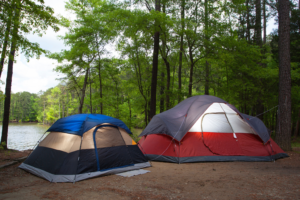
If you like glamping, you’ll like Little Arrow. You can bring your tent or RV, or you can stay in a heated platform tent, Airstream trailer, cabin or tiny home. The resort has a full calendar of activities for everyone in the family to enjoy, as well as a Spa, community garden, pool/hot tub, cabana, dog park, food truck area and gift shop.
Dancing Bear Lodge (Cabin)
If glamping is still too rustic for you, Dancing Bear Lodge provides the “in nature” experience, without the hassle. Dancing Bear is a full-service Lodge with hotel-like amenities, like daily housekeeping and complimentary snacks. Their cabins and cottages have access to two miles of hiking trails, so you’ll never be too far away from outdoor exploration.

Stay on the Little River.
Mountaineer Campground (RV, tent and cabin)
If you’re looking for the full Smokies experience, Mountaineer Campground is just a half mile from the entrance to the national park. There are a variety of sites to choose from, including ones right on the trout stocked river, with 30/50 amp service. If glamping’s more your speed, there are also cabins with kitchen and bath. In your downtime, enjoy the wildlife photo gallery, playground, pool, pavilion, cable TV and Wi-Fi.
Whispering River Resort (RV, tent and cabin)
Whispering River Resort has more direct river access than any other resort or campground in the area—and it’s yours to enjoy. Go kayaking, enjoy the swimming beach or simply walk the trails. Then, kick back at the bonfire area or pool. Tent and 30/50 AMP RV sites, as well as cabins, are available. There’s even a meeting room and an event center.
Lazy Daze Campground & Motel (RV, tent and cabin)
This family-owned and operated campground has a mix of cabins and campsites—including ones right on the river. Take a splash in the pool, or let your kids get their wiggles out on the playground. Wind down with complementary cable and Wi-Fi. With 24/7 laundry, bathhouses and 30/50 AMPs, this Lazy Daze has all the essentials.
For some fun camping ideas, check out the blog posts below:
Visit Cades Cove
Gourmet S’more Ideas
Leaf Peeping Season in the Smoky Mountains
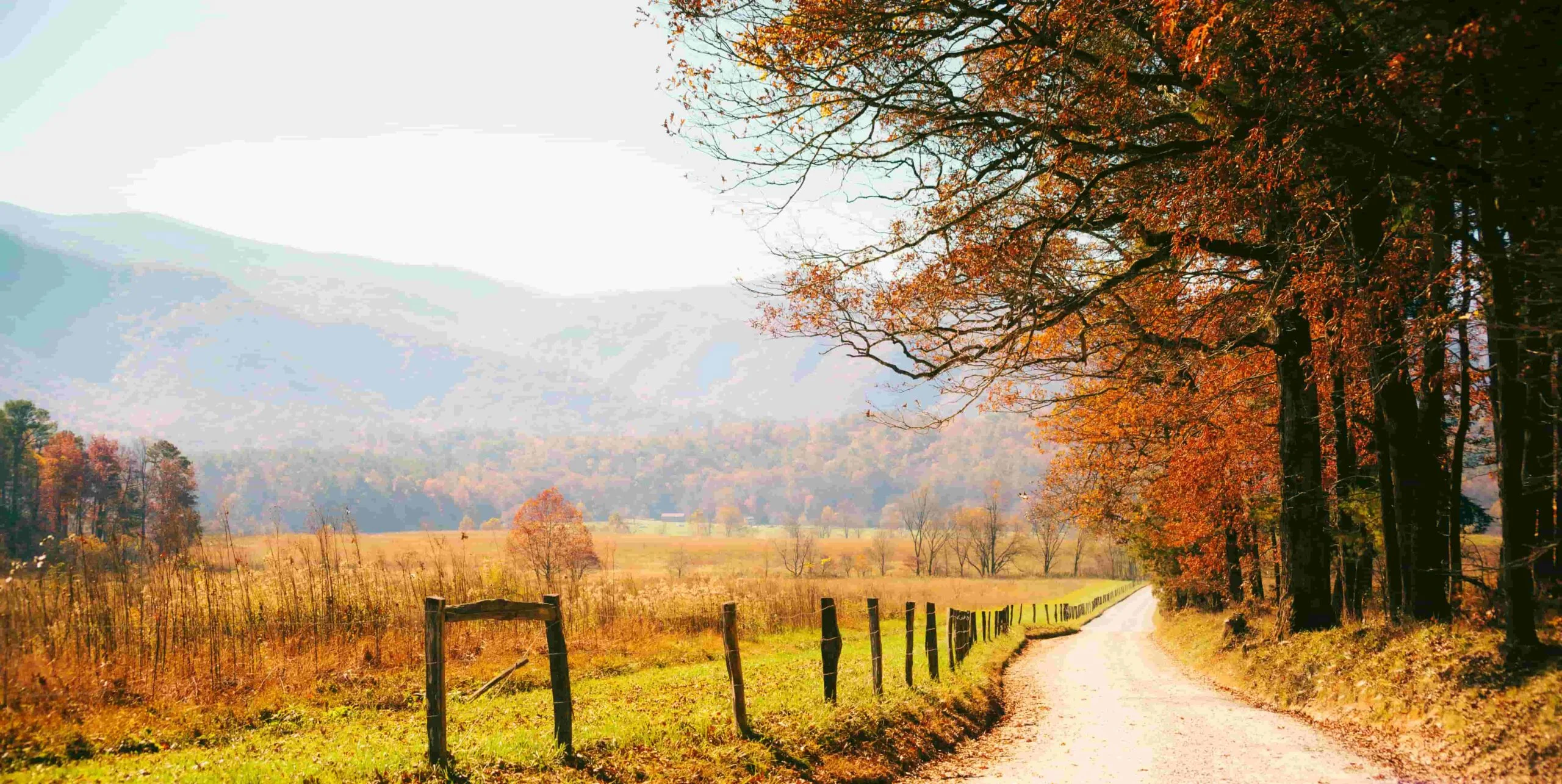
We’ve finally made it to that much-awaited time of year when the weather cools down and the fall foliage hits its climactic changes. Peak leaf peeping season is in full effect. The Smoky Mountains are bursting into wondrous red, orange and yellow hues – a must-see for locals and visitors alike.
Best Times to See Fall Colors
Click here for an interactive 2022 Foliage Map & Nationwide Peak Leaf Forecast.
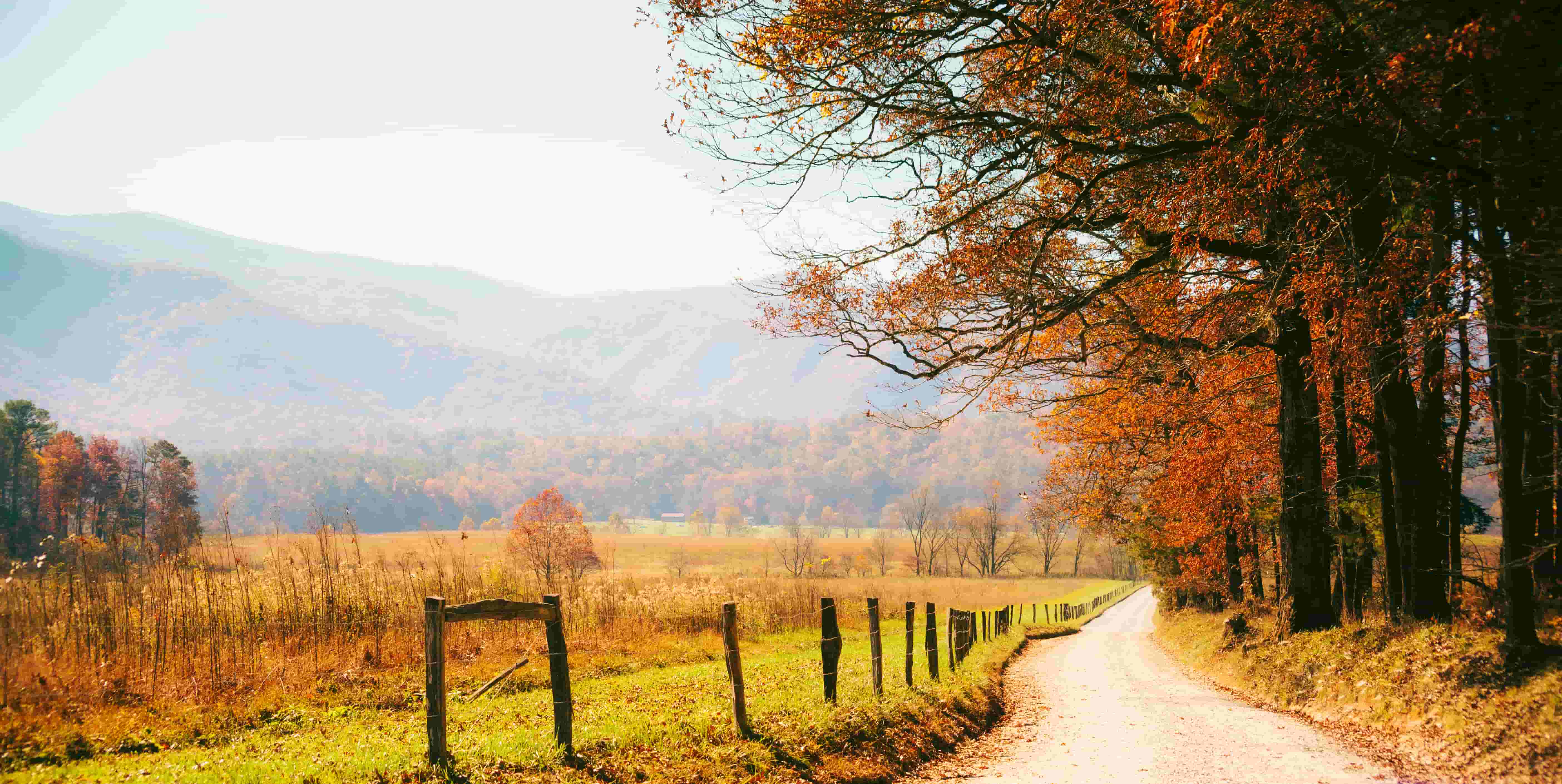
Fall color changes begin as early as mid-September at higher elevations, maintaining their beauty through mid-November. In the Smokies, you can expect peak fall foliage to occur in late October.
The Smoky Mountains’ long colorful season exists because of the different weather patterns found in the region’s various altitudes. Things cool down much more quickly at higher elevations, causing the leaves to transform earlier, like at Clingman’s Dome. Meanwhile, places at lower el
Fall is one of the park’s busiest times of the year, so we suggest making a game plan ahead of time. Here are several family-friendly trails we recommend hiking.
Laurel Falls Trail, which is a 2.3-mile round-trip hike that begins at a parking lot near the top of Fighting Creek Gap.
Clingmans Dome is the highest point in the Smokies, and it’s accessible via a ½-mile-long paved trail. It is a reasonably steep climb, but the panoramic views at the top that extend nearly 100 miles are worth the effort.
Rich Mountain Loop Trail is located in Cades Cove and is only mildly challenging, so it should be acceptable for all family members. Because it is a very popular trail, you should park in the campground and make the short walk to the trailhead.
If a country drive is more your speed, enjoy the changing foliage from your car by cruising the Cades Cove Loop, the Foothills Parkway or Balsam Mountain Road.evations, like Cades Cove, take a bit longer to kick into gear.
For a unique peek into fall in the Smoky Mountains, check out this video by our good friends at Visit My Smokies.
Planning Your Leaf Peeping Adventure
Fall is one of the park’s busiest times of the year, so we suggest making a game plan ahead of time. Here are several family-friendly trails we recommend hiking.
- Laurel Falls Trail, which is a 2.3-mile round-trip hike that begins at a parking lot near the top of Fighting Creek Gap.
- Clingmans Dome is the highest point in the Smokies, and it’s accessible via a ½-mile-long paved trail. It is a reasonably steep climb, but the panoramic views at the top that extend nearly 100 miles are worth the effort.
- Rich Mountain Loop Trail is located in Cades Cove and is only mildly challenging, so it should be acceptable for all family members. Because it is a very popular trail, you should park in the campground and make the short walk to the trailhead.
If a country drive is more your speed, enjoy the changing foliage from your car by cruising the Cades Cove Loop, the Foothills Parkway or Balsam Mountain Road.
Leaf Peeping Cheat Sheet
We’ve put together a cheat sheet to help you identify leaves by their fall colors. Once you’ve narrowed down the possibilities, you can reference this leaf identification guide created by the UT Institute of Agriculture to distinguish between them by shape.
- American Beech: yellow
- Birch: bright yellow
- Black Cherry: yellow
- Black Maple: glowing yellow
- Dogwood: deep red
- Hickory: golden bronze
- Mountain Ash: yellow
- Oak: red, brown, or russet
- Red Maple: bright scarlet or orange
- Shining Sumac: red
- Sourwood: brick red
- Sugar Maple: orange-red
- Tulip Poplar: golden yellow
Leaf peeping season only comes once a year, so be sure not to miss it! Plan your trip to the Peaceful Side of the Smokies today!
For More Fall Fun in the Smokies, Check Out These Links:
Kid-Friendly Activities on the Peaceful Side
Smartphones and Tablets help leaf peepers make the most of a Fall Smokies Visit
Learn About Appalachian Music and Instruments from the Experts: Wood-N-Strings Dulcimer Shop
In the Smokies region, history is all around you. Some might think that this history mostly just involves all the historic buildings in Great Smoky Mountains National Park and nearby, but there’s also an important musical legacy available to all who are curious, and there are two experts in Townsend with tons of knowledge on the subject. Connie and Mike Clemmer own the Wood-N-Strings Dulcimer Shop and keep an Appalachian musical tradition alive around the world with their handmade dulcimers.
Decades of Knowledge
Mike first began building dulcimers as a hobby in 1976, and eventually he and Connie opened up their shop. Each dulcimer takes weeks to build, using local woods like walnut, sassafras, butternut, cherry, or wormy chestnut, and customers can custom-order their own dulcimer with the soundhole pattern design that suits them.
Plenty of Innovation
Mike invented an instrument called the Ban-Jammer, his own banjo-dulcimer hybrid. Known for its distinct sound, ease of playability, and high-quality construction, the Ban-Jammer is tons of fun for musicians looking for an authentic Eastern Tennessee sound. Mike also created, upon request, a dulcimer called the “Baby Grand,” an extra-large dulcimer with a deep and resonant sound.
Besides both hammered and mountain dulcimers, the shop also offers banjos, guitars, harps, psaltries, lap harps, bohdrans, and even some steel drums and djembes, as well as a huge selection of books and CDs relevant to the Appalachian music scene.
Music for Everyone
Mike famously says, “If you can count to twelve without taking off your shoes, you can play a dulcimer.” That may be true, but musicians still need an audience! At Wood-N-Strings Dulcimer Shop, Mike and Connie host free concerts on the “Pickin’ Porch” every Saturday evening, May through September, and all are welcome to bring their camping chairs, relax and enjoy the music and the scenery of the shop’s woodsy location.
Mike and Connie also release their own CDs of mountain music. They actually have a book and CD combo, called Simple Faith & Homestead, that includes 2 CDs and tablature, so that listeners can actually learn to play the songs, whether in time along with the CDs, or on their own.
Fans of the music can also check out the resources they’ve gathered online, especially hours of free videos of their Saturday evening concerts, and clips from Tennessee Home and Farm, Tennessee Crossroads, a PBS special, and other clips that include tours of the shop or interesting facts about dulcimers and Appalachian music.
Come on Down and Visit
Mike and Connie invite everyone to visit them and learn more about the dulcimer and dulcimer music. The shop is open from 10 AM to 6 PM, Monday through Saturday, at 7645 E. Lamar Alexander Parkway in Townsend. More information, including an online shop (yes, they ship instruments!) is available on their website. Check them out, and whether you’re new to Appalachian music or an expert, you’re guaranteed to learn something before you leave!
Learn About the History of the Region with a Tour of Cades Cove
If you are coming to the Townsend, TN area for a vacation, a trip into the Great Smoky Mountains National Park is a must. And if you really want to learn all about the history of the region, then the best place to do so is by taking a tour of Cades Cove.
A First-Hand View of Cades Cove
If you are looking for a first-hand experience of what it must have been like to live here “back in the day,” then you have only to go inside the park and visit Cades Cove. From long walks through the grassy valleys, hikes in the mountains, a chance to see some of the local wildlife, or a walk through the historic buildings, this is the place to be. You and your family can get a taste of what it was like to live here in the early days.
The Cades Cove Loop Road typically takes around 3 to 4 hours to drive, but if you go this fast, you might miss out on a lot. Most of those who come here tend to be here all day since there is so much to see and do.
Things You Might Not Know About Cades Cove
Many of the buildings on display here in Cades Cove have been moved here from elsewhere or were built here after the park opened. For example, the Gregg-Cable House was built out on Forge Creek Road in 1879 by Leason Gregg. Many of the buildings around the John P. Cable Mill have been moved from their original location.
Did you know that the Cades Cove area is the most popular spot in the entire park, bringing in 2 million visitors every year? They come for the hiking trails, the biking opportunities, the spectacular scenery, and the deep history the area has to share with everyone who visits here.
Just Like It Used to Look
Perhaps the one thing that makes Cades Cove the perfect place to learn about the history of the area is the number of historic buildings and structures you get to see as you drive or walk along the route. There are churches, barns, a working grist mill that just got a new waterwheel, plenty of log houses, and many others to see. Make sure you pick up one of the Tour Guide Booklets at the entrance to the loop.
The guide can provide you with a vast amount of information on the various buildings, the park, and the history of the entire region. Be sure you stop by the Cades Cove Visitors Center to learn about the many Park Ranger-led tours scheduled for the day you plan to be here. Between the knowledgeable and friendly staff in the visitors’ center and your tour guide, you can learn all about the history of Cades Cove, the park, and the surrounding area.
When you are all done for the day, be sure you stop back in at the visitors’ center and pick out a few souvenirs to take home with you. No matter what else you do, be sure you take lots of pictures so you can show the folks back home how beautiful the Peaceful Side of the Smokies truly is!
Recent Comments