Category: Uncategorized

The Early 20th Century on “The Peaceful Side of the Smokies”, Through Postcards

Written by: Emily Huffstetler

The early 20th century marked a period of transformation for the Peaceful Side of the Smokies. Following the forced removal of the Cherokee people in the late 1830s, European settlers brought new developments to the region. The advent of commercial logging at the turn of the century drastically altered the natural landscape and sparked conversations about conservation. Browse through these vintage postcards and experience the Peaceful Side as it was over 100 years ago.
“The Smoky Mountains, Little River“

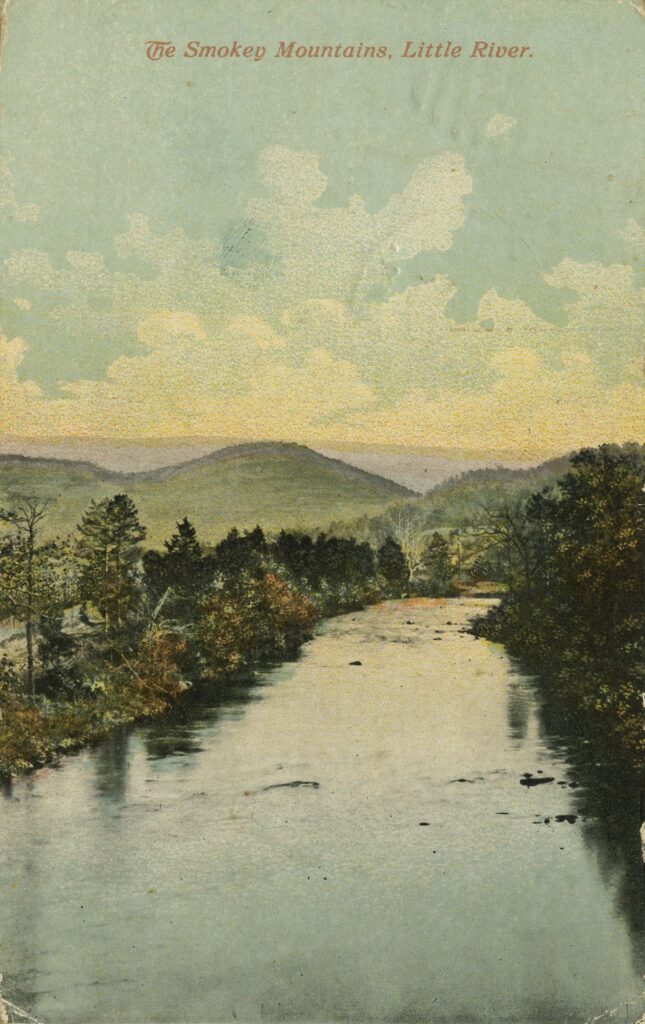
This postcard, postmarked in Maryville on Sept. 24, 1912, captures a tranquil view of the Little River. The Little River begins at Clingmans Dome, the highest peak in the Great Smoky Mountains National Park, and gains strength as it reaches the foothills.

In 2022, a resolution was passed to restore Clingmans Dome’s original Cherokee name, Kuwahi, which means “mulberry place.” The headwaters of the Little River, considered sacred by the Cherokee, remain a significant cultural landmark today.

Image Source: Great Smoky Mountains Post Cards

“Loading Logs near Elkmont, Little River Lumber Co.“

Image Source: Great Smoky Mountains Postcard Collection, 1910-1955, MS.3745

The Little River Railroad and Lumber Company, established in 1901, built 150 miles of railroads and sawed 560 million board feet of timber along the Little River and its tributaries. The last logs came out of the mountains in 1939, 15 years after the establishment of the Great Smoky Mountains National Park (GSMNP).

“In the heart of the Smokies. Elkmont, Tenn. Altitude 2,428 ft.”
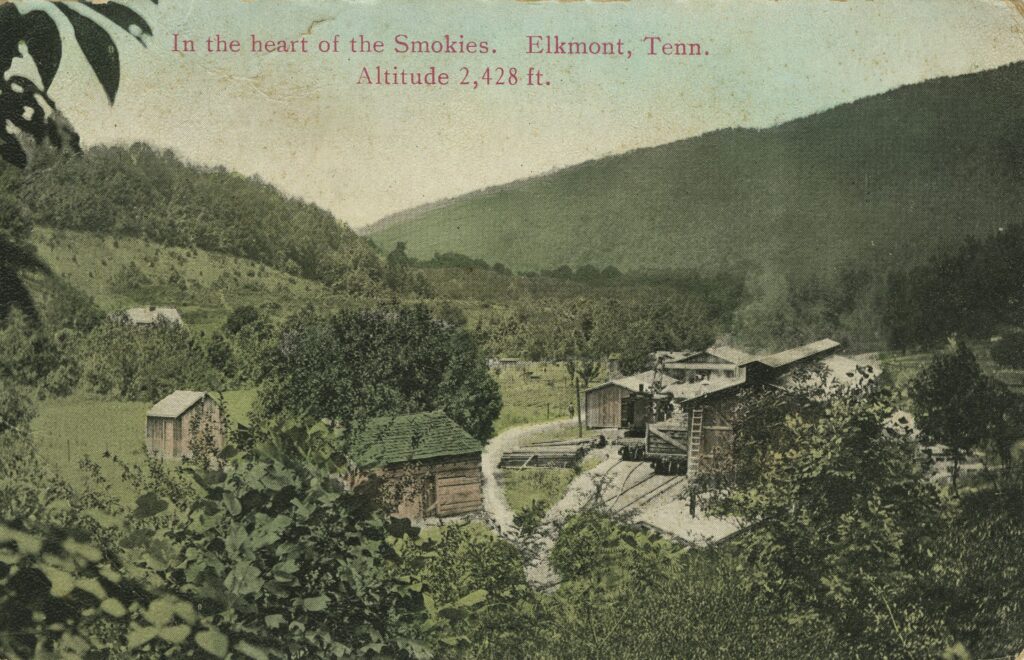
Image Source: Great Smoky Mountains Postcard Collection, 1910-1955, MS.3745

Elkmont began as a hunting camp, but in the early 1900s, the Little River Railroad and Lumber Company turned it into a logging town. Once the company started offering train service for passengers, Elkmont became a popular getaway for wealthy locals, especially in the summertime.

“Falls, Appalachian Club, Elkmont, Tenn.”
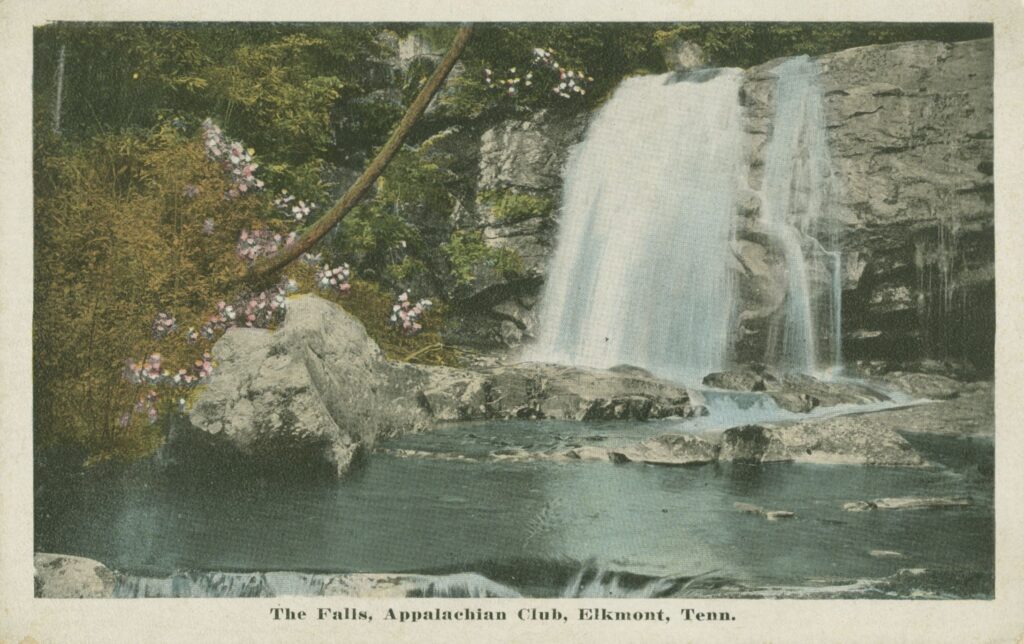
Image Source: Great Smoky Mountains Postcard Collection, 1910-1955, MS.3745

In 1910, the Little River Railroad and Lumber Company subdivided Elkmont, selling 50 acres to the Appalachian Club, a group of wealthy Knoxville businessmen. A few years later, three brothers from Knoxville purchased 65 acres and opened the Wonderland Hotel. Both clubs closed in the early 1990s, after their rental agreements with the Tennessee state government ended. Today, Elkmont hosts the most popular campground in the GSMNP.

“In the Smoky Mountains Near Maryville, Tennessee“
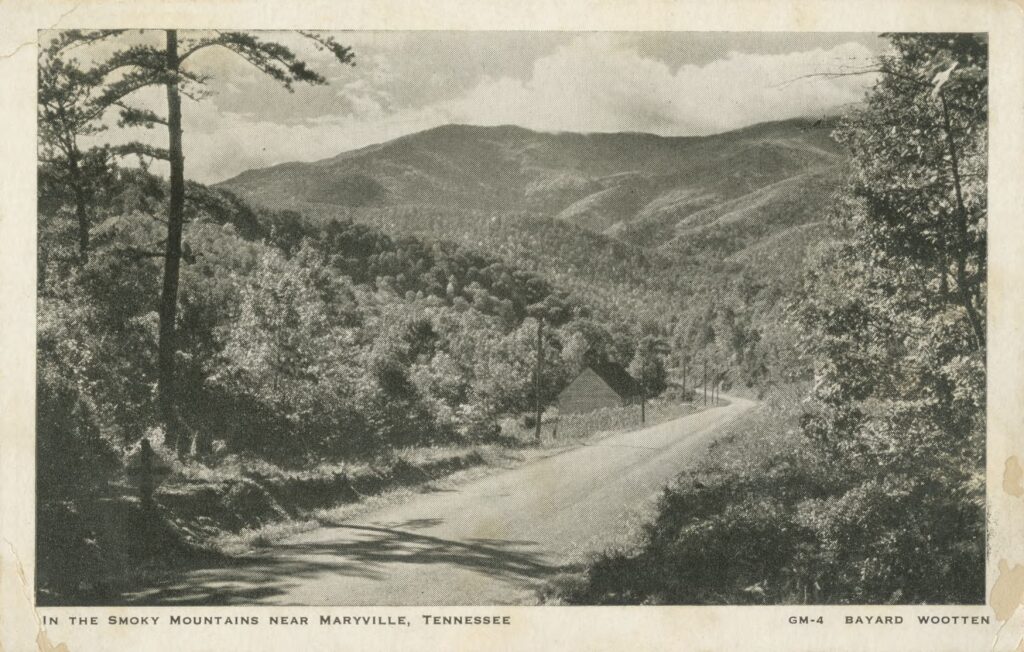
Image Source: Ridley Wills Postcard Collection, MS.3781

This snapshot of the Peaceful Side of the Smokies, near Maryville, was taken by Bayard Wootten (1875-1959). Wootten was a pioneering female photographer from North Carolina who became the first woman to serve in the North Carolina National Guard as “Chief of Publicity.” In this role, she used her photography to raise public awareness and support for the Guard. Wootten was also among the first women in the U.S. to take aerial photographs. Throughout her career, she produced over a million images.

“In the Appalachian Range”
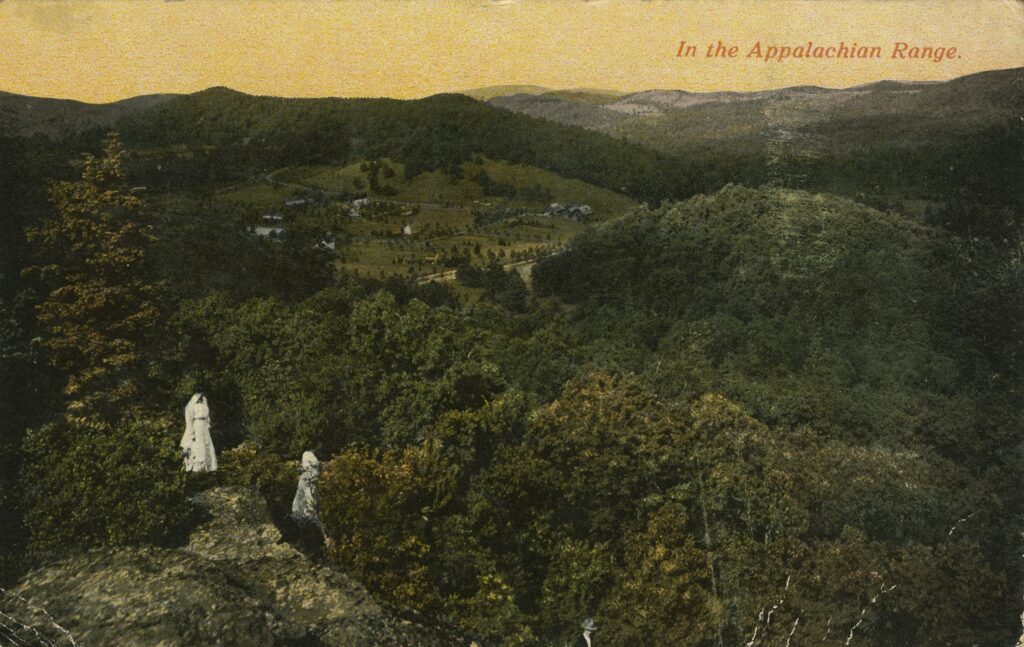
Image Source: Great Smoky Mountains Postcard Collection, 1910-1955, MS.3745

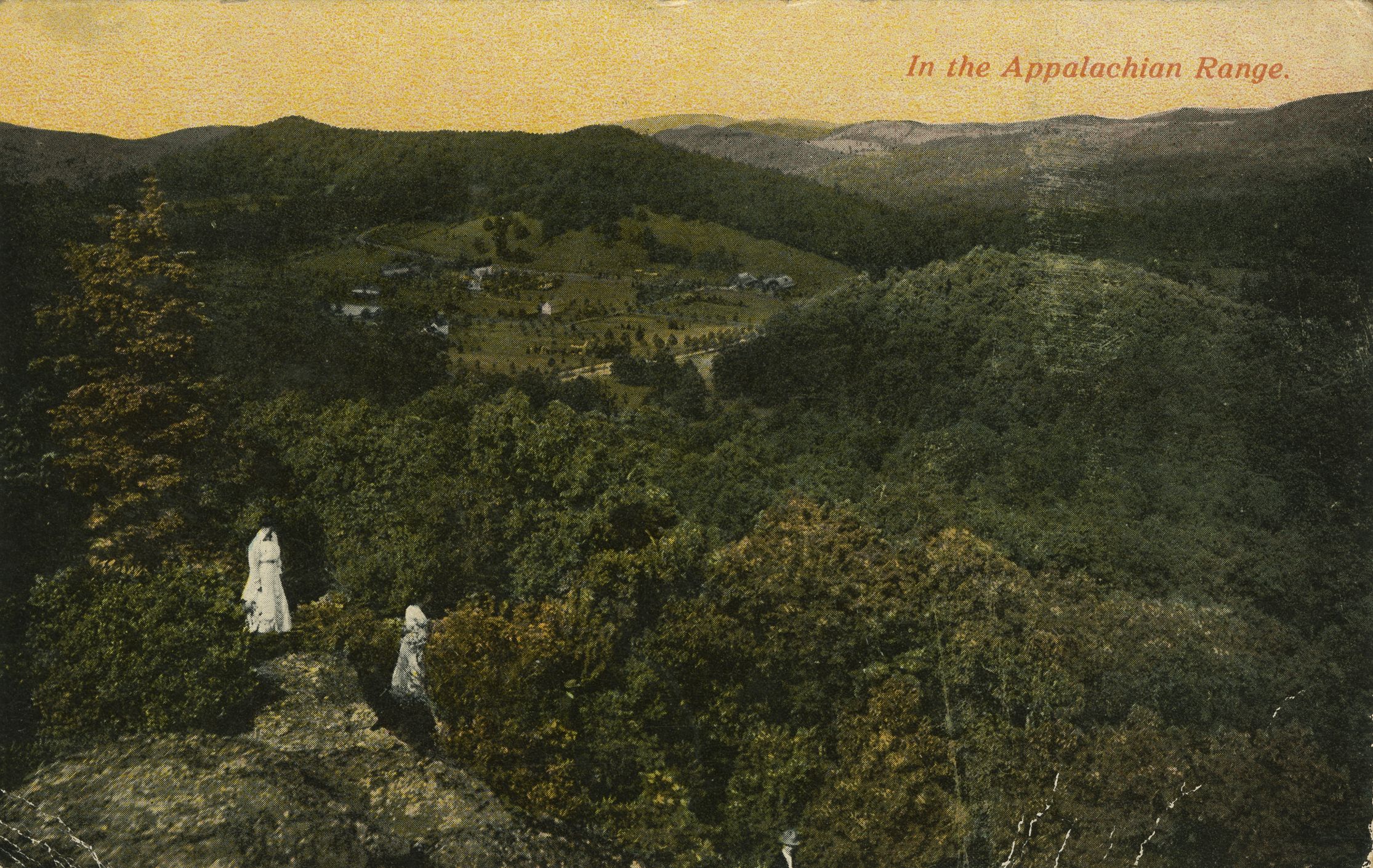
Mailed from Maryville to Knoxville on July 3, 1912, this postcard provides a glimpse into early 20th-century tourism in the Great Smoky Mountains. In the foreground, two women wear white cotton dresses, serving as a reminder of how much outdoor fashion has evolved over the past century.

Interested in learning more about the history of the Peaceful Side of the Smokies? We’re home to a variety of free and low-cost museums.

__________________________________________________________________________________________________________________________________

Born and raised in Maryville, Tennessee, with roots tracing back to Cades Cove, Emily Huffstetler is a proud Maryville College graduate and passionate storyteller of the Greater Smokies region.
The Parkman Resort Announces Opening of Ranger’s Smokehouse & Market

Ranger’s Smokehouse

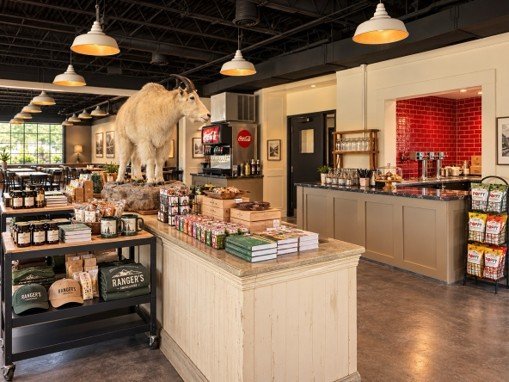
The Parkman Resort announces the opening of Ranger’s Smokehouse & Market next week in the historic Carriage House Restaurant space. Developed in partnership with Bryan Lewis, Ranger’s builds on his award-winning Highlands Smokehouse in Highlands, North Carolina, and brings together the craft of barbecue, the flavors of East Tennessee, and the welcoming spirit of the Smokies.

Ranger’s Smokehouse

Located on the peaceful side of the Smokies, Ranger’s is a place to settle in for a meal or a drink with friends, pick up provisions for a weekend in the mountains, or find something worth taking home.

The menu pairs slow-smoked barbecue with Southern-inspired dishes, seasonal sides, and house-made sauces, complemented by regional craft beer and wine. Ranger’s will also honor the Carriage House legacy with occasional nods to classics served over the years, such as a Sunday fried chicken special inspired by one of the Carriage House’s best-known dishes.

Chef Matt Kinner leads the kitchen, anchored by a custom smoker from Texas-based M&M BBQ Company. Fueled exclusively by wood, the smoker relies on live fire rather than gas-assisted heat, producing the deep, distinctive smoke flavor that will define Ranger’s barbecue. This piece of equipment brings a level of traditional, wood-fired barbecue craftsmanship rarely found in East Tennessee.

“Great barbecue takes patience, consistency, and respect for the process,” says Kinner. “The M&M smoker is the heart of our kitchen. It gives us the ability to build layers of clean smoke flavor and produce exceptional barbecue throughout the day. It’s something truly distinctive for this area.”

The market extends that experience with freshly prepared grab-and-go meals and provisions for guests headed into the park or on a getaway to the mountains. It will also feature a thoughtfully curated selection of wines, specialty foods, and pantry staples, along

with unique Smokies-inspired apparel and branded merchandise including hats, mugs, totes, and other keepsakes.

“We wanted to create a restaurant that feels at home in Townsend—comfortable, welcoming, and connected to the mountains,” says Bryan Lewis. “First and foremost, Ranger’s is a place to gather over really good food. The market builds on that experience, whether you are picking up some food before heading into the park or finding a piece of the Smokies to take home. We want Ranger’s to be a place people return to again and again.”

General Manager Micah Vitale leads the guest experience, pairing attentive service with the relaxed warmth that makes Townsend special. Ranger’s will o^er catering for gatherings and events throughout the area, extending its signature barbecue and Southern-inspired menu beyond the restaurant.

Ranger’s Smokehouse & Market is expected to begin welcoming guests next week at 8310 TN-73 in Townsend. Hours will be 11 a.m.–8 p.m. Sunday, Monday, Wednesday, and Thursday, and 11 a.m.–9 p.m. Friday and Saturday. Ranger’s will be closed Tuesdays.

The Peaceful Side in 1926: 100 Years Ago in the Smokies 

Written by: Emily Huffstetler 

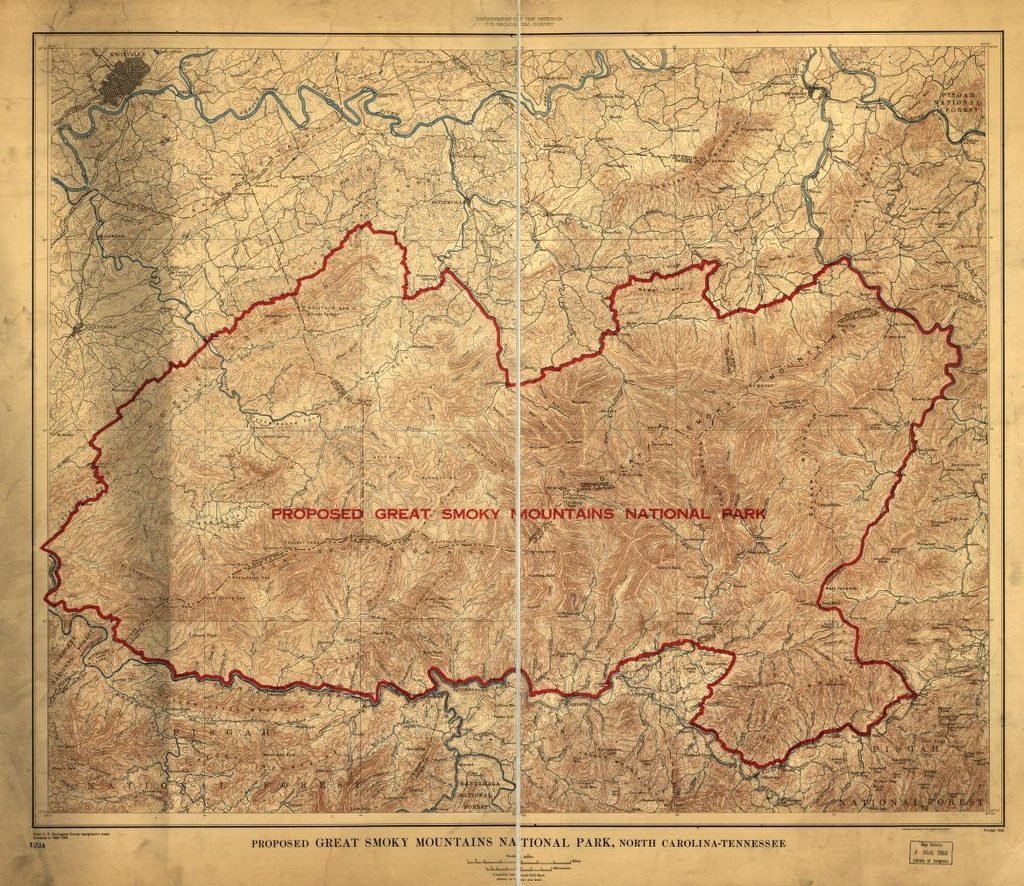
Proposed Great Smoky Mountains National Park map, 1926. Courtesy of Library of Congress, Geography and Map Division.

This year marks 100 years since President Calvin Coolidge signed legislation authorizing the establishment of Great Smoky Mountains National Park.1

By then, families had long lived in Cades Cove, logging crews worked around Tremont, Girl Scouts spent summers in Walker Valley and visitors came to the mountains to hike and swim. 

A National Park Was Authorized 

The May 22, 1926, act authorized both Great Smoky Mountains and Shenandoah national parks, but there were still years of land acquisition ahead. Congress did not authorize full development of the Smokies until 1934.1,2 

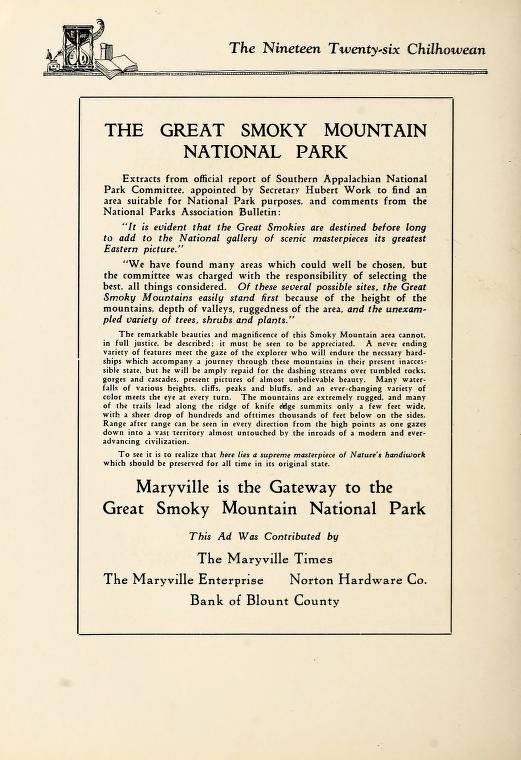
Even so, local boosters were already promoting the proposed park. A full-page advertisement in Maryville College’s 1926 Chilhowean yearbook declared: “Maryville is the Gateway to the Great Smoky Mountain National Park.”3 

Advertisement for the proposed Great Smoky Mountains National Park in Maryville College’s 1926 Chilhowean yearbook. Courtesy of Maryville College.

Much of the proposed park remained privately owned, and people continued to live and work throughout the mountains.2 

Related read: “From Great Depression to Great Smokies: The CCC’s Legacy in East TN”

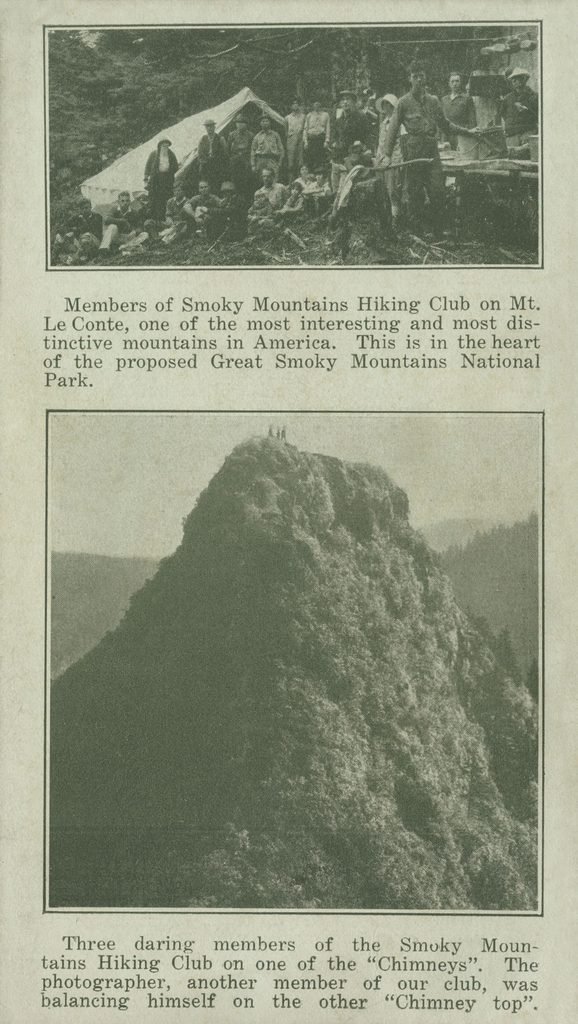
The Hiking Club Organized Trips 

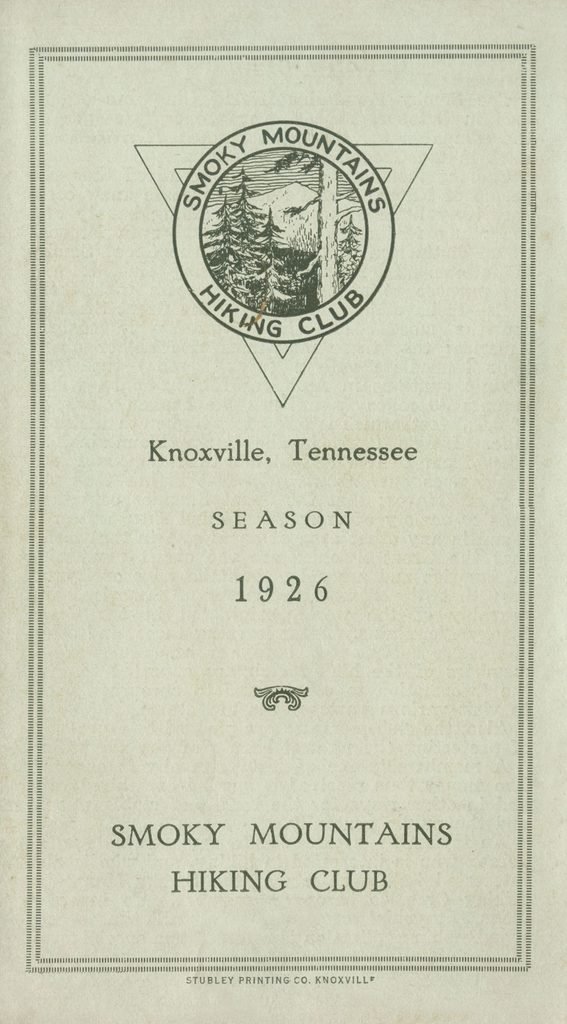
The Smoky Mountains Hiking Club grew out of an October 1924 hike to Mount Le Conte. By 1926, the club had a regular schedule of hikes and social events, along with practical guidance on what hikers should wear and bring.4,5 

Club members also supported efforts to establish the national park.4 

Kinzel Springs Drew Visitors 

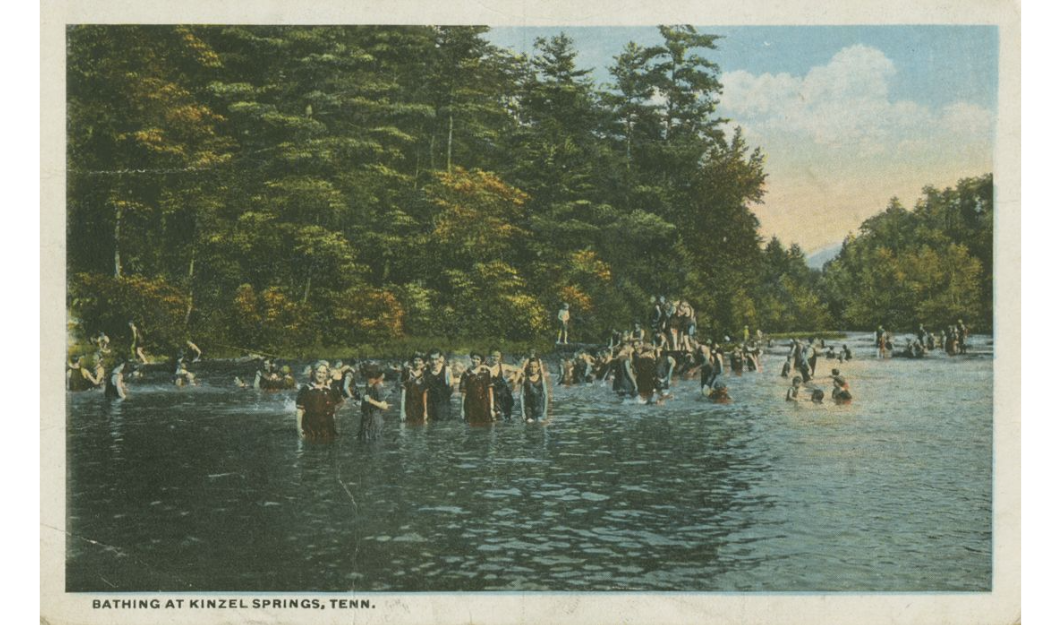
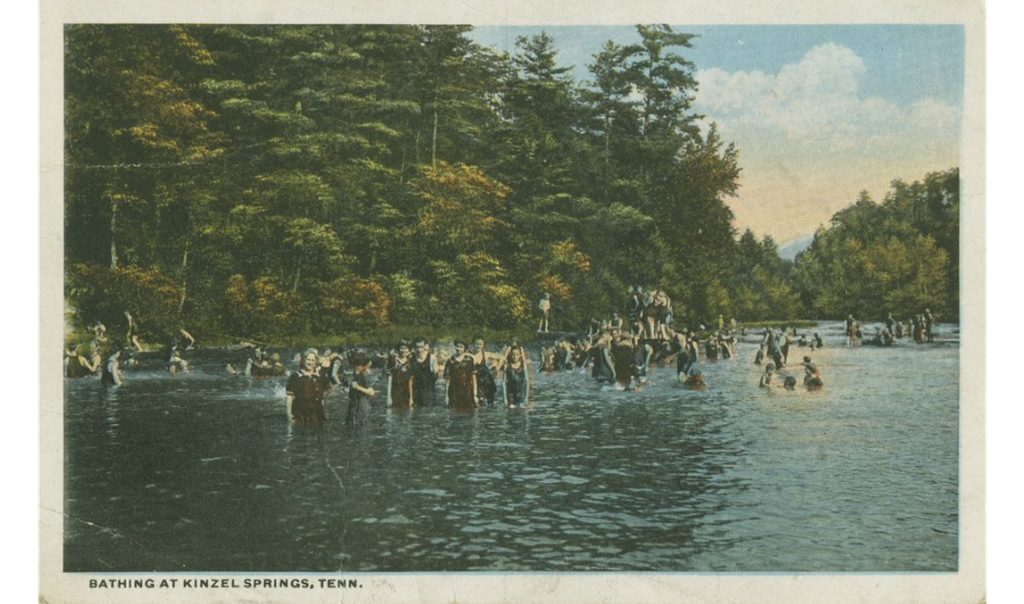
“Bathing at Kinzel Springs, Tenn.,” postcard mailed in 1926. Courtesy of University of Tennessee Libraries, Postcards from the Great Smoky Mountains Collection.

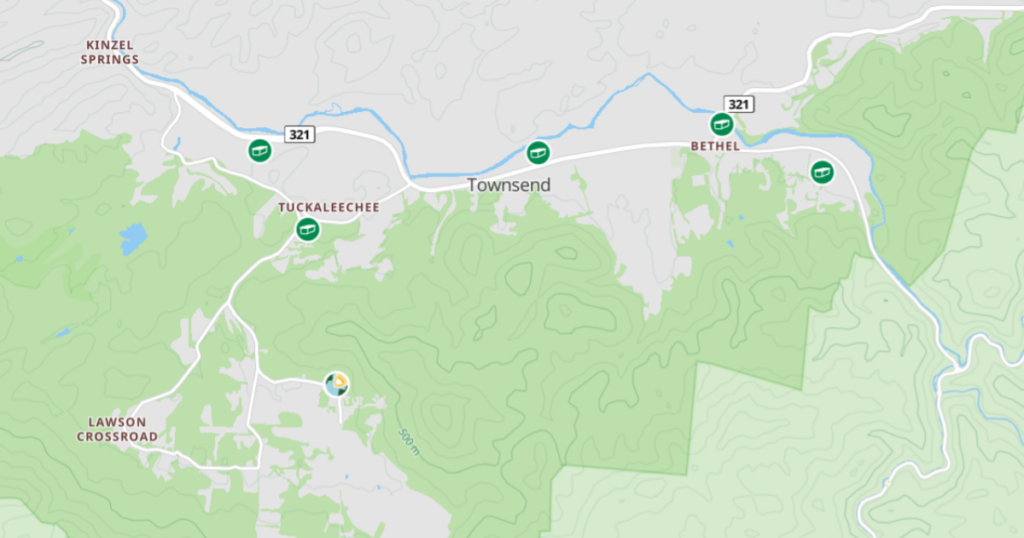
Kinzel Springs developed into a resort community near the western end of Tuckaleechee Cove. E.J. Kinzel acquired property there in 1894, and railroad service beginning in 1902 brought more visitors to the area. By 1914, the Kinzels had added a 28-room hotel and 10 cottages; a post office followed in 1925.6 

By 1926, visitors were coming to Kinzel Springs to stay near the mountains and swim.6,7 

Related read: “The Early 20th Century on the Peaceful Side of the Smokies, Through Postcards”

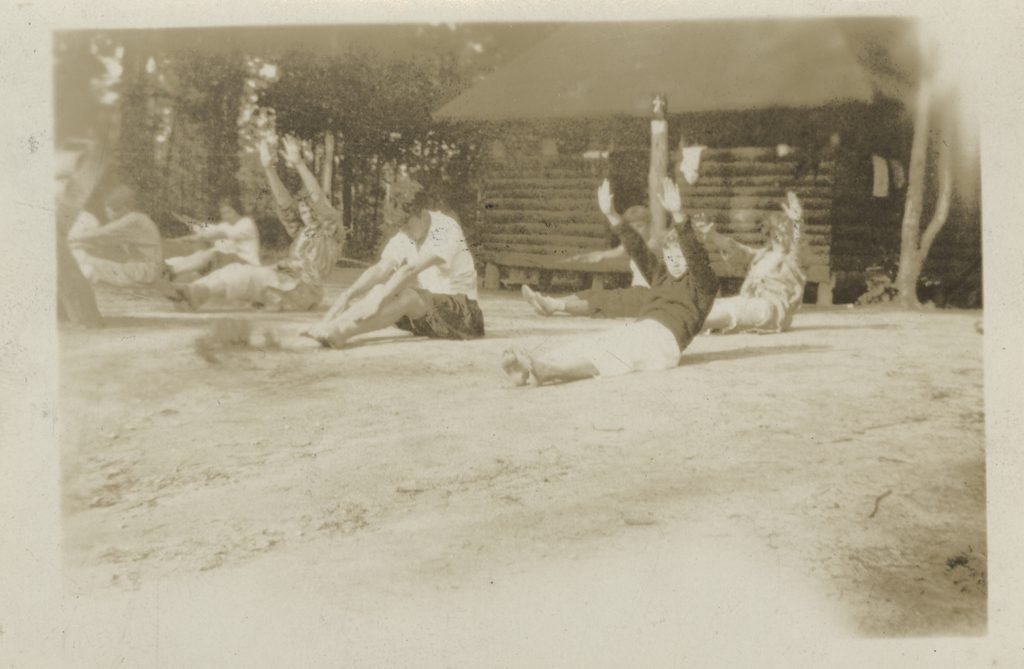
Girl Scouts Camped in Walker Valley 

Girl Scouts at summer camp in Virginia, 1926. Courtesy of Virginia Commonwealth University Libraries.

Camp Margaret Townsend was a Girl Scout summer camp in Walker Valley, on land that is now home to Great Smoky Mountains Institute at Tremont. 

The camp opened in 1925 and held four two-week sessions each summer, making 1926 its second season. Camp life was rustic: there was no electricity, and the girls bathed in the Little River in the early years.8

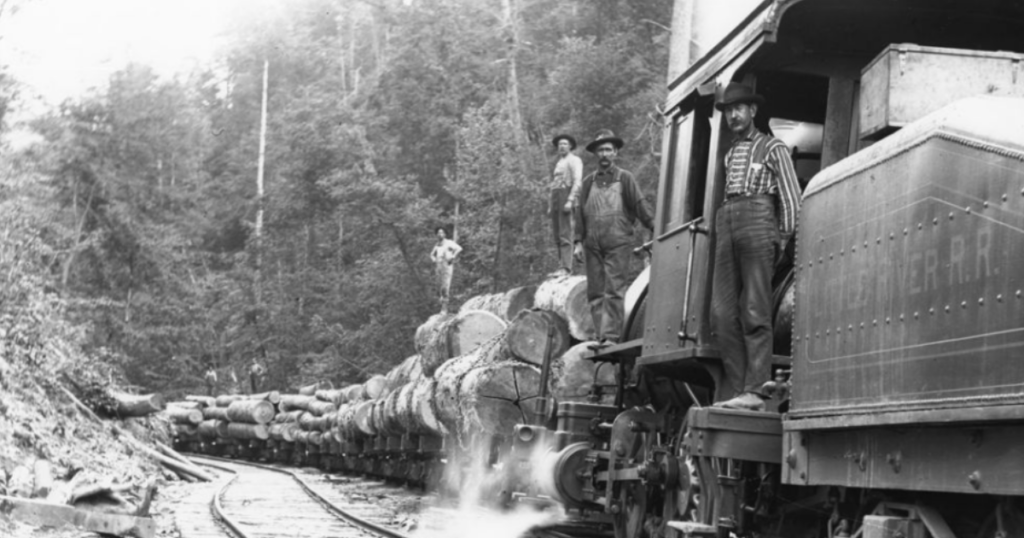
Tremont Became a Logging Town 

Little River Railroad during the logging era in the Smokies. Courtesy of University of Tennessee, Knoxville Special Collections.

Little River Lumber Company laid railroad tracks into Walker Valley and began logging there in 1924. By 1926, Tremont was a company logging town at the confluence of Lynn Camp and Thunderhead prongs.9 

The community housed workers and supported logging operations in the Middle Prong watershed. A hotel also opened that year, providing lodging for logging workers and visitors.10 

Logging continued in Walker Valley until 1938.9 

Related read: “How Townsend Got Its Name: History of the Little River Railroad and Lumber Company”

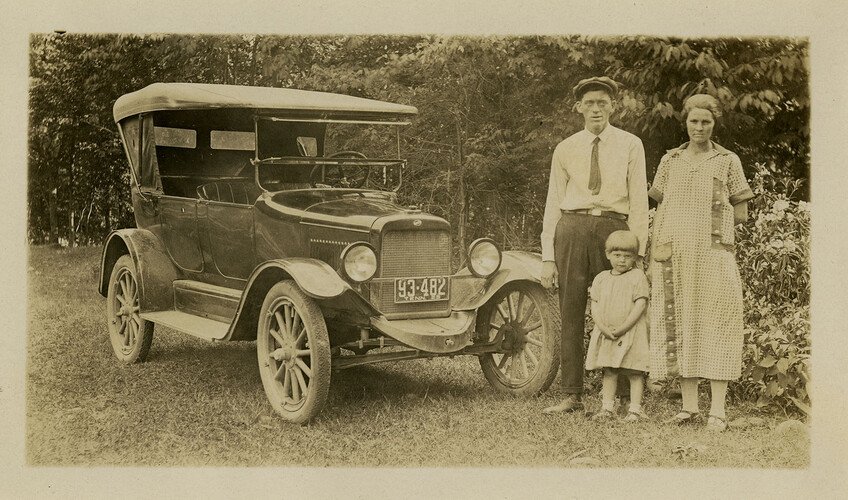
Automobile Travel Expanded 

The first automobile in Elkmont. Courtesy of Hunter Library Special Collections, Western Carolina University.

Little River Lumber Company ended train service to Elkmont in 1925 and removed the tracks. In 1926, the former railroad bed from Townsend to Elkmont was converted into a gravel automobile road.11 

Cars also played a role in the national park campaign. In 1923, members of the Knoxville Automobile Club helped organize the group that became the Great Smoky Mountains Conservation Association to promote the proposed park.12 

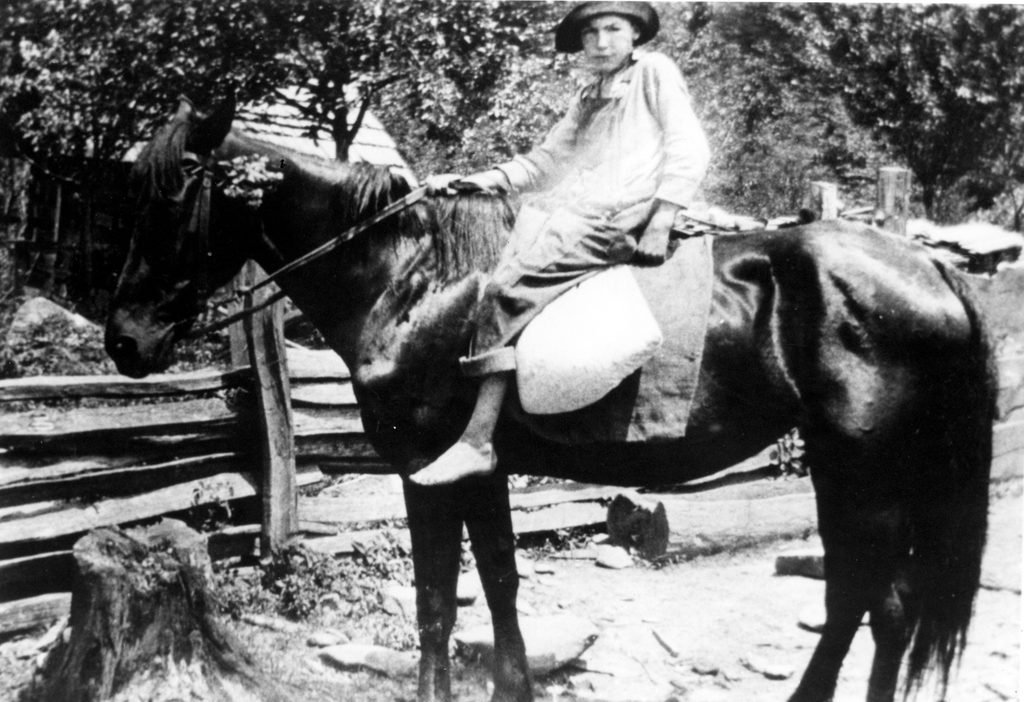
Families Lived in Cades Cove

A boy takes corn to the mill in Cades Cove, 1920. Courtesy of National Park Service.

Families still lived, farmed, attended church and school and worked alongside their neighbors in Cades Cove in 1926. Neighbors also came together for corn huskings, molasses making and chestnut gathering.13 

Tourists were already visiting the Cove. By 1924, resident John W. Oliver was renting cabins to visitors. He built a tourist lodge in 1928.14 

A major park-related purchase in 1927 included most of the mountains north of Cades Cove.13 

Related read: “Courtship in Cades Cove: Corn Husking, ‘Sparking’ and Weaner Cabins”

Born and raised in Maryville, Tennessee, with roots tracing back to Cades Cove, Emily Huffstetler is a proud Maryville College graduate and storyteller of the Greater Smokies region. She holds a Master of Science in Conservation Education from Mississippi State University.
_________________________________________________________________________________________________________

The Phantom Cat of Cades Cove 

Written by: Emily Huffstetler 

As the story goes, a man was chased all the way to his front porch by a mysterious cat. Exhausted from running, he stopped to catch his breath. Then, the cat spoke. 

“Some footrace we had.” 

The man wasn’t interested in conversation. He replied, “Not like the one we’re going to have,” and took off running again. 

This peculiar tale was once part of Cades Cove’s oral tradition. Similar stories circulated across the South, and some versions were considerably stranger.

Storytelling in Cades Cove 

Historian Durwood Clay Dunn preserved the story in his 1976 University of Tennessee dissertation, Cades Cove During the Nineteenth Century. 

Dunn had close family ties to Cades Cove. His grandfather, John W. Oliver, was born there in 1878, and Dunn grew up hearing former residents share stories about life in the mountain community.  

Passed down by word of mouth, many of these tales had no clear origin. Some were meant to scare listeners, while others were told for fun. The phantom cat was a favorite to share with children. 

The Phantom Cat Across the South 

The phantom cat appeared in print long before Dunn documented the Cades Cove version. In 1905, W. T. Latham of Webster Springs, West Virginia, shared a version in The Bulletin. Fittingly, the magazine was published by a lumbermen’s organization that used a black cat as its emblem. 

Latham’s tale followed two lumbermen who came upon an isolated cabin along the Gauley River. A local warned them that the cabin was haunted, but one of the men dismissed the warning and wagered $25 against the man’s rifle that he could spend the night there alone. 

Around 9 p.m., a large black cat appeared beside the fire and began talking. The lumberman grabbed his hat and fled into the woods, eventually tripping over a log. When he got up, the cat was standing on the log, smiling. 

“Stranger, that was a hell of a race we had.” 

The lumberman took off again. 

In 1919, folklorist Tom Peete Cross published another version in Witchcraft in North Carolina. This time, a man accepted a wager to spend the night in a haunted house, where he encountered a black cat with eyes that looked like moons. 

The man escaped through a window, taking the sash with him, and ran until he could go no farther. When he stopped to rest on a roadside log, the cat was already sitting at the other end. 

“That was a right good race we had,” it remarked. 

Cross also noted an earlier version from Guilford County and another popularized by entertainer Polk Miller throughout eastern Virginia and North Carolina. 

The Headless Cat 

The story took an even stranger turn in Foxfire 2, published in 1973. The book was part of the Foxfire project, which began in the 1960s when students in northeast Georgia started interviewing Appalachian residents about daily life and folklore.  

One of those storytellers, Ethel Corn, recalled a tale about a hitchhiker looking for somewhere to spend the night. Someone offered him a place to sleep but warned that the house was haunted. The traveler dismissed the warning and decided to stay anyway.

Later that night, he heard cats moving around the house. Suddenly, one jumped onto his bed. 

This particular cat had no head. 

The traveler fled down the road, running until he thought he’d put enough distance between himself and the house. But when he finally stopped to rest, a voice beside him remarked on what a race they’d had. 

He turned to find the headless cat sitting beside him. 

Keeping the Stories Alive 

Cades Cove’s historic cabins, churches and mill remain, but the stories once shared among residents are harder to preserve. 

Today, the Smoky Mountain Storytellers Association continues the region’s oral storytelling tradition through Appalachian folktales, personal narratives and more. On February 27, 2027, the Winter Heritage Festival in Townsend will feature Davis Family Storytelling with the association and a storytelling panel hosted by the Cades Cove Preservation Association. 

Born and raised in Maryville, Tennessee, with roots tracing back to Cades Cove, Emily Huffstetler is a proud Maryville College graduate and storyteller of the Greater Smokies region. She holds a Master of Science in Conservation Education from Mississippi State University.     
The Pink Marble History Beneath Friendsville

Written by: Emily Huffstetler 

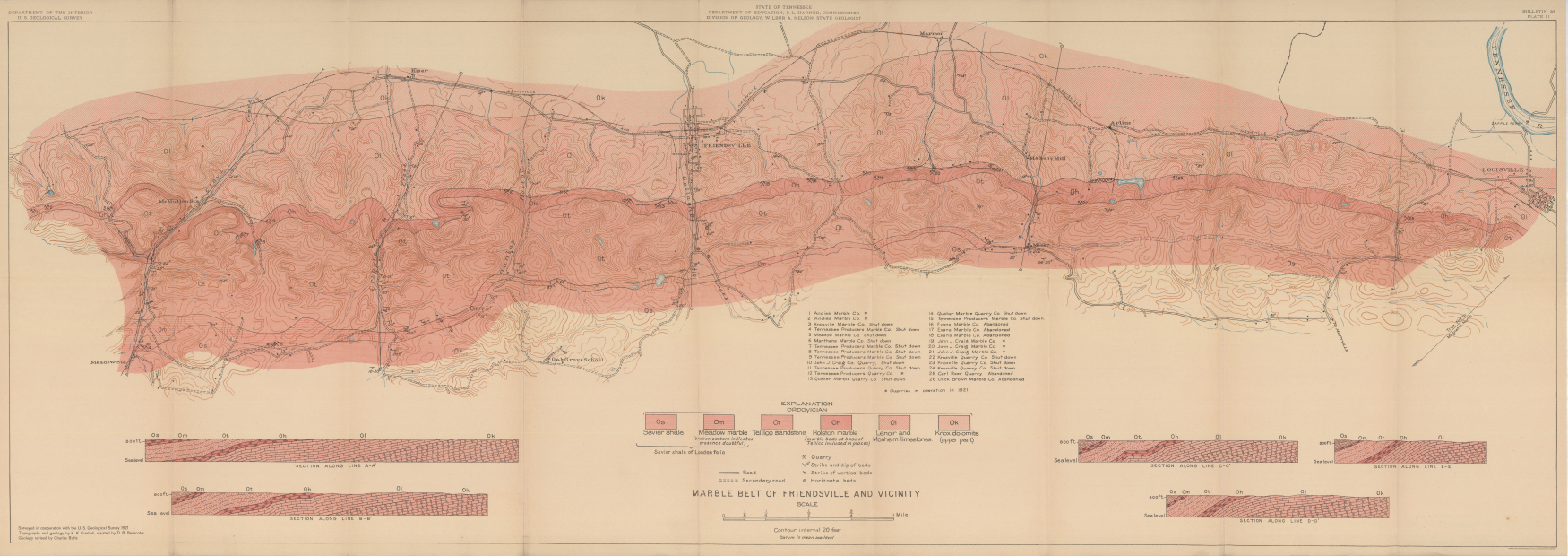
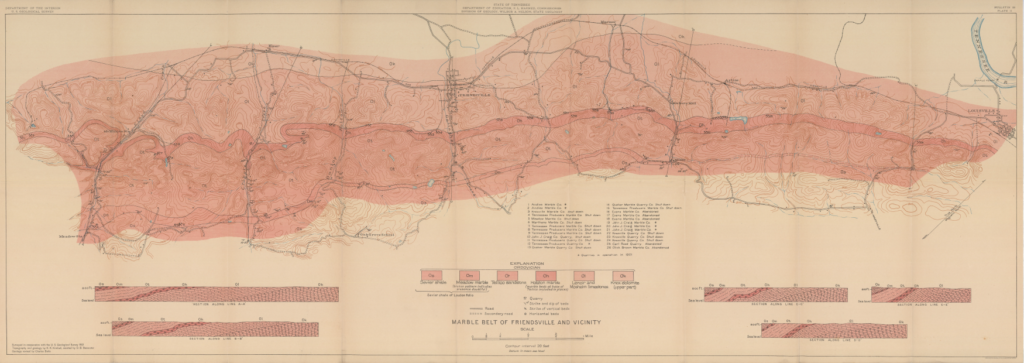
The 1924 map identifies 26 quarry sites along the marble belt around Friendsville, based on a 1921 survey. Courtesy of the Tennessee Geological Survey.

On a 1924 map of western Blount County, 26 quarry sites crowd the countryside around Friendsville. Together, they trace a belt of stone stretching roughly 16 miles from the former community of Morganton toward Louisville.1,2 

Many of the buildings that once supported the industry are gone. Much of the stone also left Blount County before it was polished, carved or installed, so Friendsville was often left out of the story.1,4,5 

Despite its name, Tennessee marble is limestone rather than true marble. Its color, durability and ability to take a high polish made its pink, rose, red and brown varieties popular for floors, walls, stairways and other architectural details.3 

An Industry Takes Shape 

Commercial quarrying took hold in western Blount County after the Civil War. John J. Craig Company became one of the area’s leading producers.1,4 

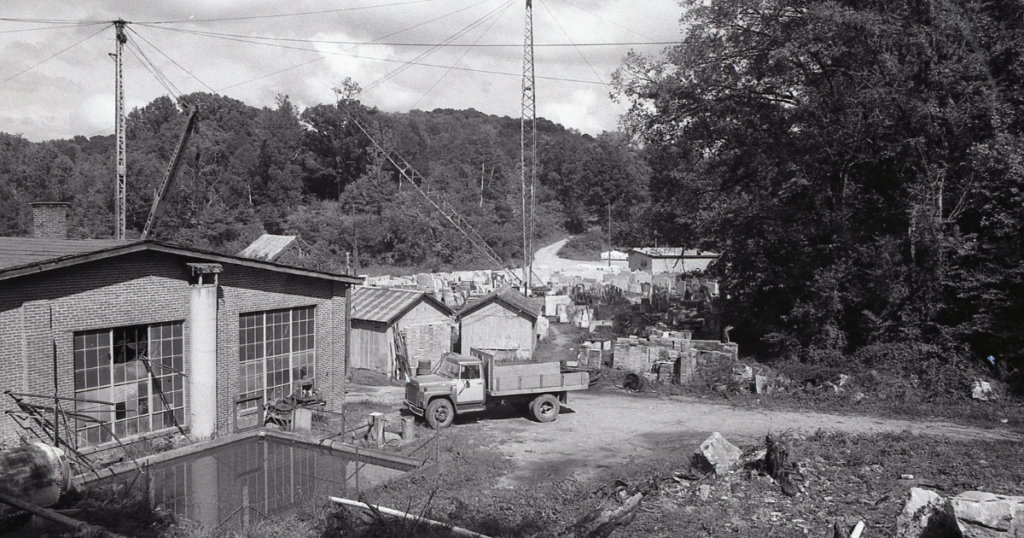
John J. Craig entered the marble business in 1878. His company opened its main Friendsville quarry in 1896 and, by 1903, had built a tram road connecting the property to the railroad. A mill equipped with eight gang saws processed stone sold as Pink Tennessee and Dark Cedar.1,4 

Railcars carried Craig stone to New York, Chicago, Houston, St. Louis and San Francisco. The company also sold marble overseas, including to buyers in Italy and Australia.1,4 

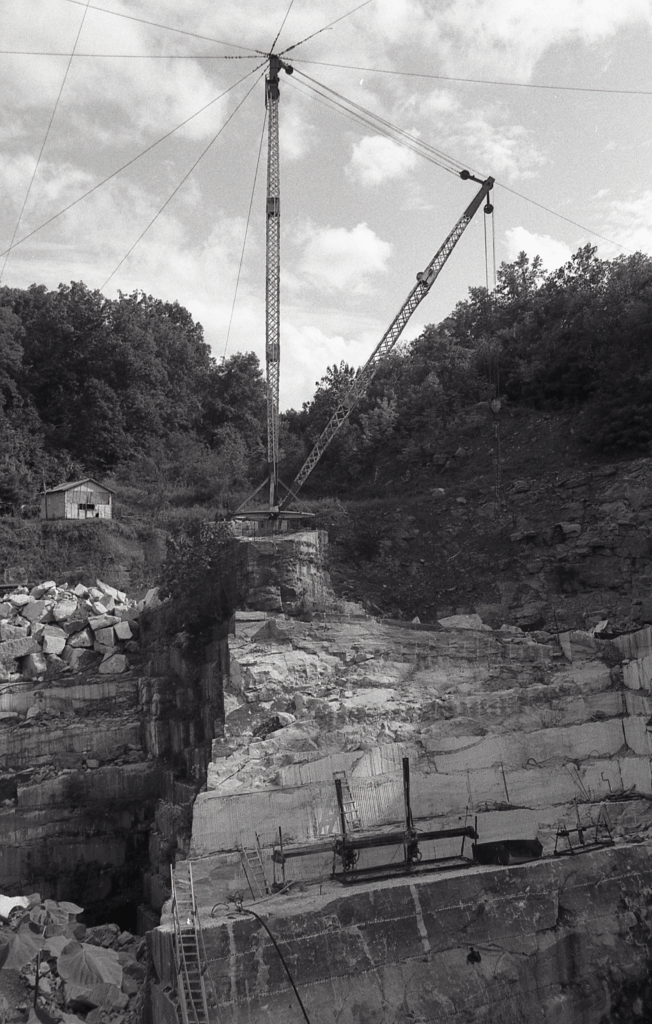
In 1926, Craig expanded the site with a brick gangsaw building, an employee commissary and worker housing. Steel derricks lifted blocks from the pit, while belt-driven saws cut them for shipment.1 

Where Friendsville’s Name Disappeared 

The Friendsville quarries supplied raw material, but much of the finishing happened in Knoxville.4,5 

In 1914, Craig and several business partners established Candoro Marble Company in South Knoxville. Candoro handled milling, finishing and shipping for a network of quarry operations that included Craig’s Blount County properties.4,5 

The former Candoro Marble Works cutting facility in South Knoxville was built in 1914. Photo by Brian Stansberry via Wikimedia Commons, CC BY 3.0.

Craig maintained a local presence, too. In the late 1930s, the company converted a former bank near the Friendsville railroad tracks into an office and showroom with marble floors and wainscoting.4 

After the stone left Friendsville, records might name only the company that finished it or identify it simply as “Tennessee marble.”4,5 

From the Marble Belt to National Landmarks 

The National Register nomination for the Craig quarry credits its Friendsville operation with interior marble used in the National Gallery of Art’s West Building in Washington, D.C. The project drew on three East Tennessee companies and stone from several quarries.1,4

The local industry remained active well after the Gallery opened in 1941. Blount County had eight working marble quarries in 1962. At six of those sites, crews were extracting stone for a new Smithsonian building that became the Museum of History and Technology, now the National Museum of American History.4 

One of the clearest Friendsville connections came from the Endsley Quarry. Tennessee Valley Marble supplied stone for the First Amendment tablet installed on the Newseum’s 74-foot-tall Pennsylvania Avenue facade. Crews quarried 278 tons to obtain 50 tons with a consistent appearance.6 

The First Amendment tablet on the former Newseum showed the pale pink color of Tennessee marble. Photo by David Monack via Wikimedia Commons, CC BY-SA 3.0 US.

After the Newseum closed, the tablet was moved to the National Constitution Center in Philadelphia. Installation was completed in January 2022.7 

The Industry Continues 

By the late 20th century, many of East Tennessee’s historic marble companies had closed. The Craig family retained its Friendsville quarry property until 1982.1,4 

The Craig quarry pit was still active when the property was documented for the National Register in 1988. Photo courtesy of the Tennessee Historical Commission.

The modern Tennessee Marble Company was founded in 1993. It is separate from an earlier company that operated under the same name during the mid-20th century.4,9 

The company supplied Tennessee Dark Rose marble during Grand Central Terminal’s 1990s restoration.8 In 2007, it acquired Tennessee Valley Marble’s assets, including additional quarry and mineral rights.9 

Grand Central Terminal’s Main Concourse, where Tennessee marble was used in the flooring. Photo by D. Benjamin Miller via Wikimedia Commons, CC0 1.0.

In 2014, the company purchased 70 acres associated with the historic Craig property, joining that land with its Brown Quarry holdings along the marble belt. Tennessee Marble Company also operated the Endsley Quarry as a source of Dark Pink marble.10

In November 2025, Raider Quarries LLC, an affiliate of Silvara Stone, acquired Tennessee Marble Company’s operational assets. The new owners announced plans to continue supplying the company’s established marble varieties and fabricating custom stone projects.11 

Today, marble is still quarried and fabricated in Friendsville, more than a century after the area became one of East Tennessee’s major centers of production.10,11 

For a more comprehensive look at where Tennessee marble has been used around the world, visit the Tennessee Marble Company’s project directory.

Born and raised in Maryville, Tennessee, with roots tracing back to Cades Cove, Emily Huffstetler is a proud Maryville College graduate and storyteller of the Greater Smokies region. She holds a Master of Science in Conservation Education from Mississippi State University.     
_________________________________________________________________________________________________________

The Six Sisters Who Kept One of the Smokies’ Last Homesteads  

Written by: Emily Huffstetler 

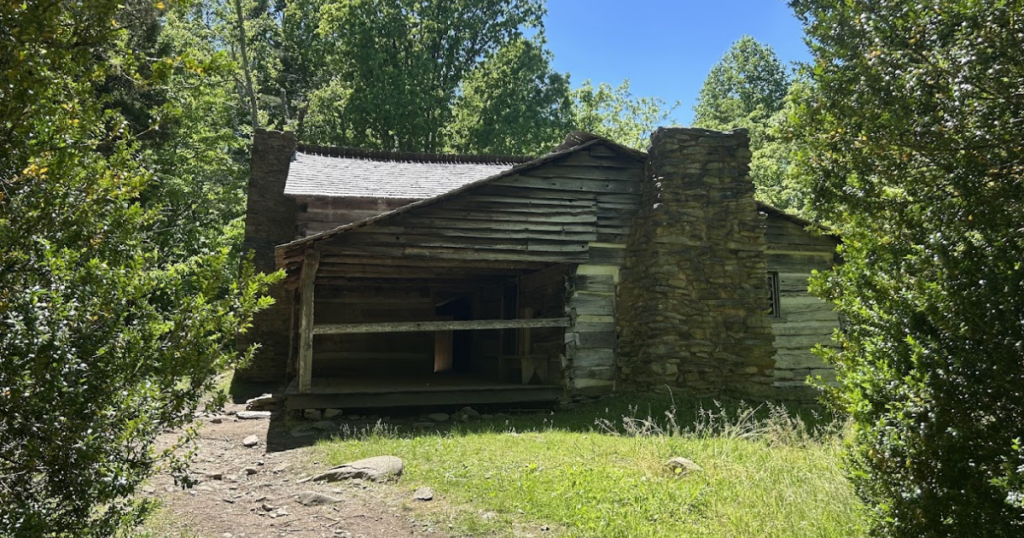
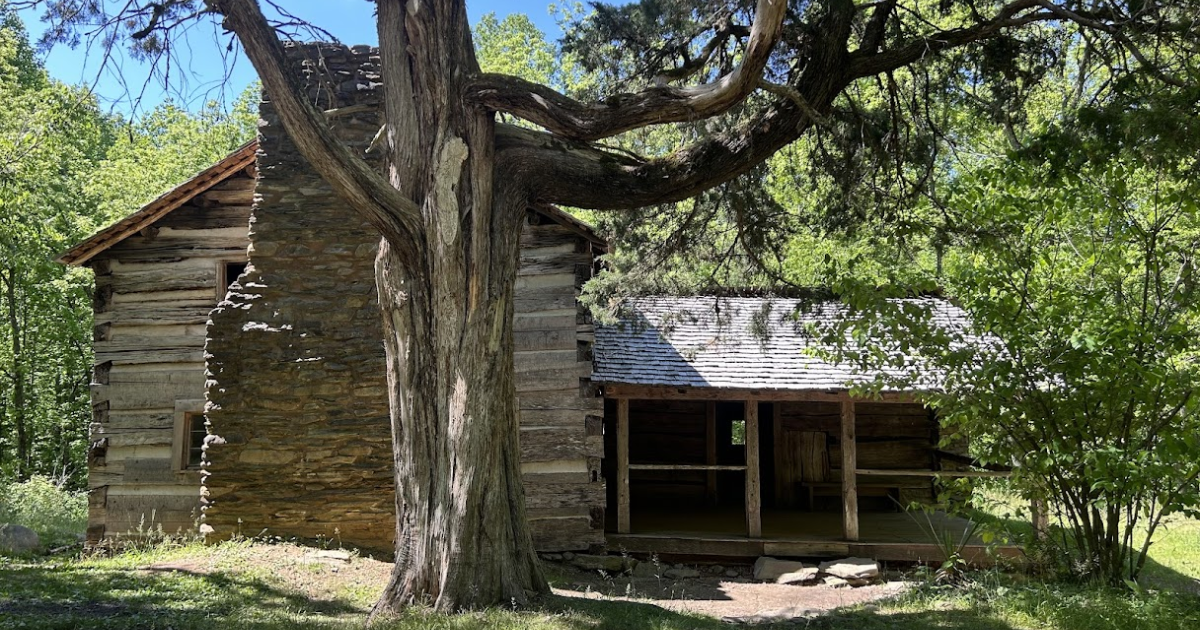
View of the Walker sisters’ cabin from the trail. Photo by Emily Huffstetler.

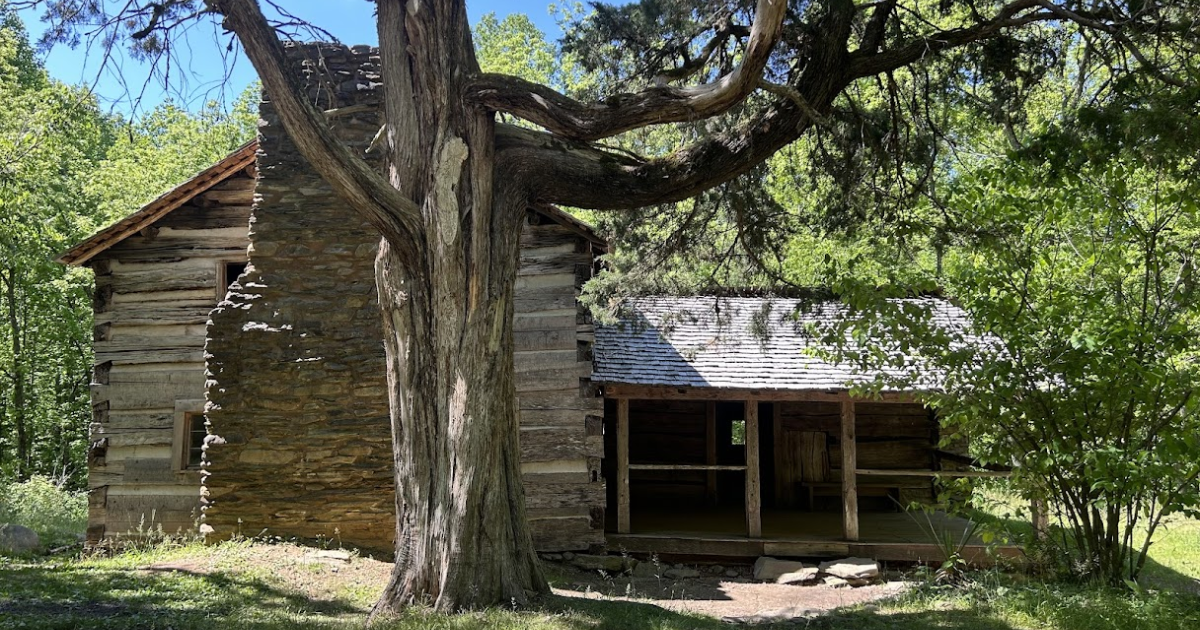
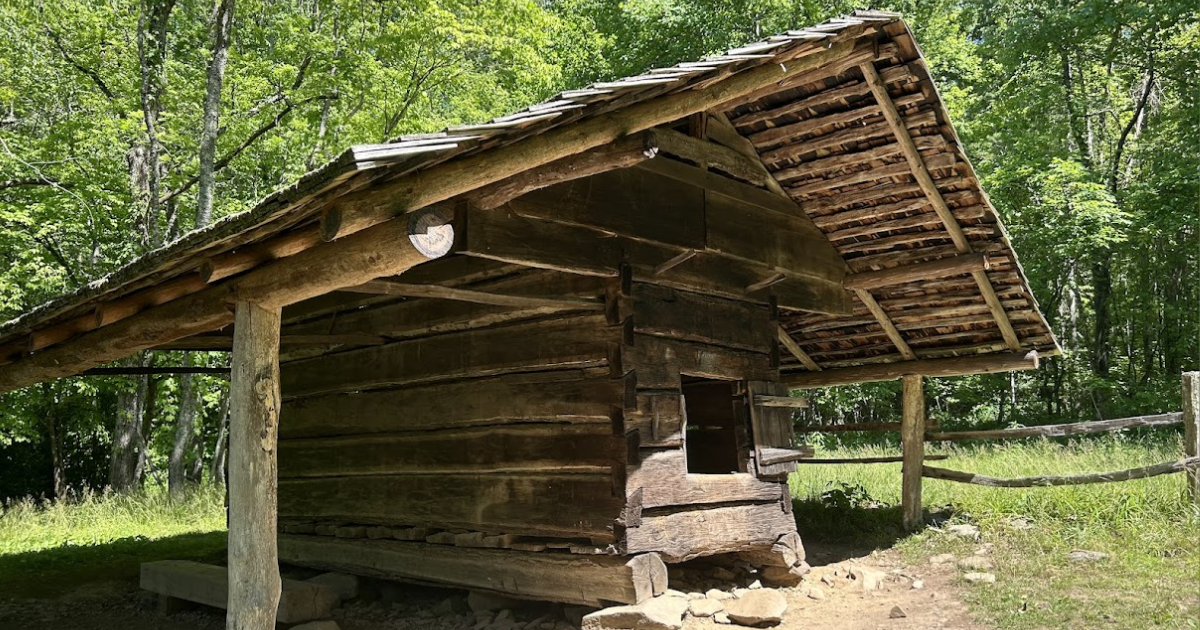
Just beyond Townsend, a quiet trail leads to one of the Smokies’ best-preserved homesites. Starting at Metcalf Bottoms, the 3.4-mile route passes Little Greenbrier Schoolhouse and follows an old roadbed to a preserved cabin, springhouse and corn crib. Six sisters, all unmarried, lived here together as the surrounding land became Great Smoky Mountains National Park. 

John and Margaret Jane Walker raised 11 children in Little Greenbrier: seven daughters and four sons. The sons left home or married, and one daughter, Sarah Caroline, married and moved away. 

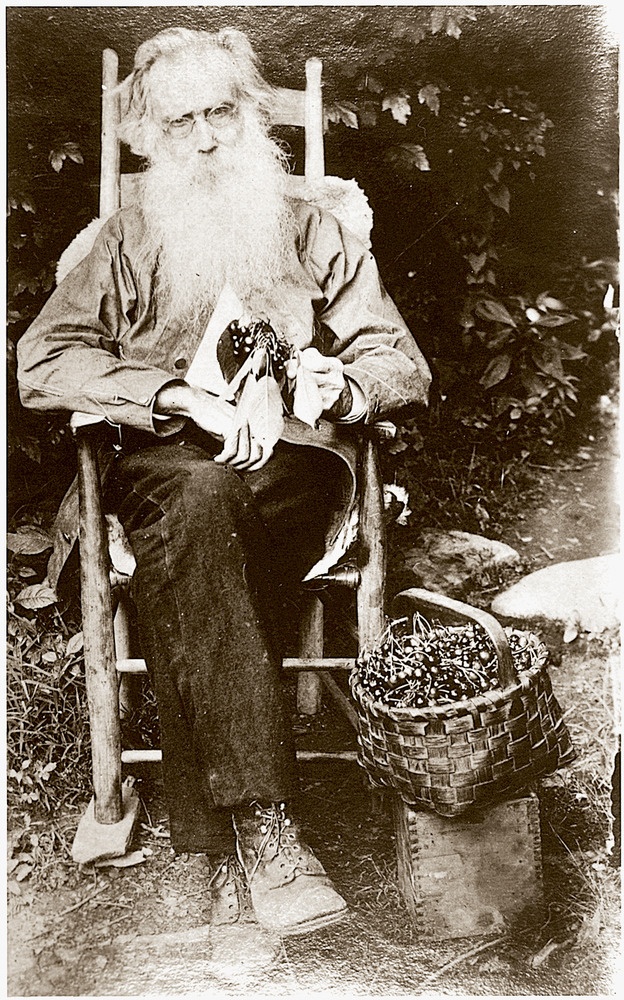
John Walker, father of the Walker sisters, poses with cherries from his orchard. He was a blacksmith, carpenter, miller and farmer. NPS Archives.

Margaret Jane, Mary Elizabeth ‘Polly,’ Martha Ann, Nancy Melinda, Louisa Susan and Hettie Rebecca remained on the family farm, which was fully in their hands after their father’s death in 1921. Martha and Polly were engaged to be married, but their fiancés both tragically died in work accidents.  

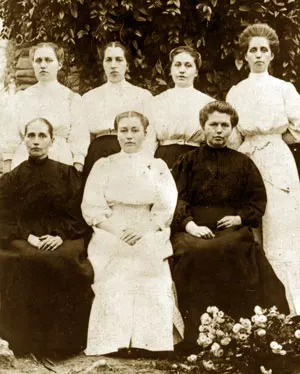
The seven Walker sisters in 1909. Front row, left to right: Margaret, Louisa and Polly. Back row, left to right: Hettie, Martha, Nancy and Caroline. Photo by Jim Shelton, 1909.

The sisters lived off the land and worked for what they had. They tended herb and vegetable gardens, raised sheep and hogs, spun and wove cloth, sewed clothing and preserved food by pickling, smoking and salting. 

When Congress authorized the Great Smoky Mountains National Park in 1926, land buyers began negotiating for private property across the region, including the Walkers’ 122-acre farm.  

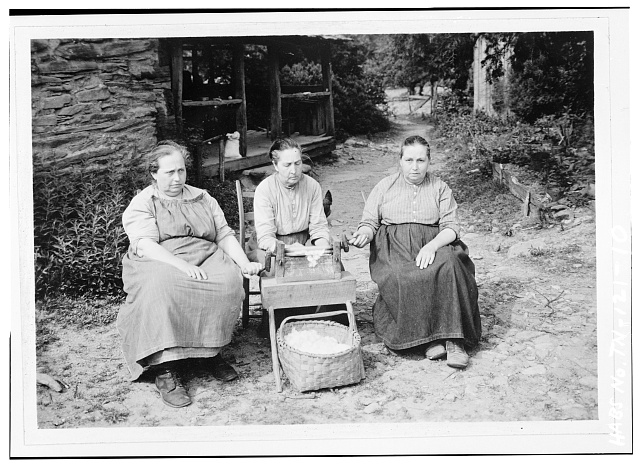
Hettie, Martha and Louisa Walker gin cotton at the family farm. Photo by Edouard E. Exline, 1936. Library of Congress.

The sisters resisted several offers. A NPS report says they worked with an attorney and asked for $7,000 after a 1939 appraisal of $5,466. Faced with condemnation, they ultimately accepted $4,750 and a lifetime lease. 

The lifetime lease came with limits. Park rules barred hunting, fishing and grazing livestock. Tourists also began visiting what became known as Five Sisters Cove.  

The National Register notes that the sisters were “at first suspicious and shy” around park visitors, but they gradually warmed to them. They even made souvenirs to sell, including tiny baskets, toys, crocheted doilies and fried apple pies. 

By the mid-1940s, the sisters had become part of the Smokies visitor experience. A 1946 Saturday Evening Post feature invited readers to “spend a leisurely autumn afternoon with the Walker sisters” in Little Greenbrier Cove. The article described visitors gathering around the kitchen fireplace while beans simmered over hickory logs and bread baked on the hearth.  

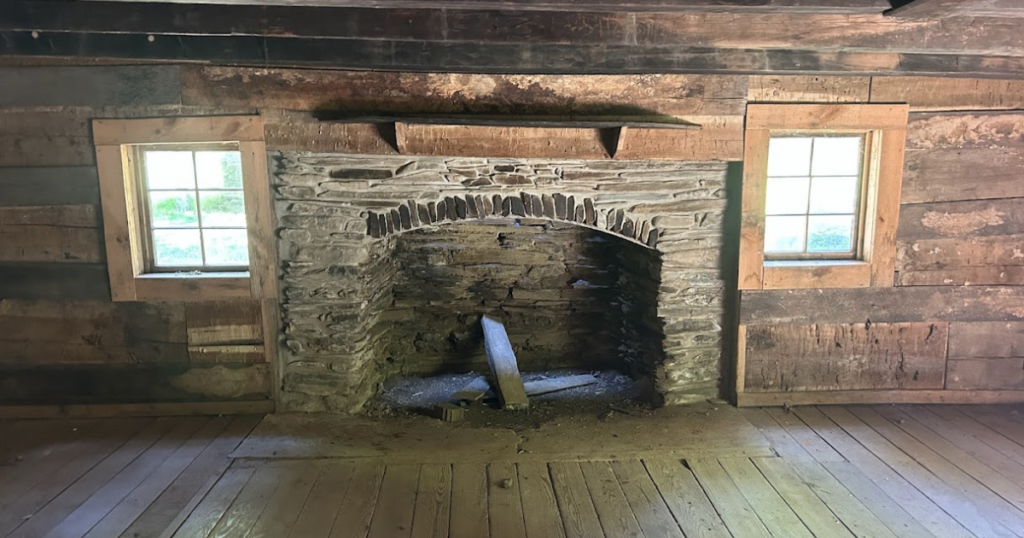
One of the fireplaces inside the Walker sisters’ home. Photo by Emily Huffstetler.

It framed the Walkers’ lifestyle as practical, not primitive. “Why, they reason, should anyone want to worry about changes and improvements when the ground is so fertile, one of their two cows is always fresh, their spring flows freely, and heavy forests around them provide all the fuel they need?” 

Polly died in 1945, Hettie in 1947 and Martha in 1951. By 1953, only Margaret and Louisa remained at the homestead. With more work than the two could manage alone, they wrote to the park superintendent and asked that the sign directing visitors to their homesite be removed. 

“We are not able to do our work and receive so many visitors, and can’t make [souvenirs] to sell like we once did and people will be expecting us to have them, last year we had so many people it kept us [busy] from sun up till sun down,” the sisters wrote. 

The Walker sisters’ three-room, two-story log home in Little Greenbrier still stands at the end of the old roadbed that once brought visitors to their door. Some of their belongings are preserved in Townsend at the park’s Collections Preservation Center. 

Born and raised in Maryville, Tennessee, with roots tracing back to Cades Cove, Emily Huffstetler is a proud Maryville College graduate and storyteller of the Greater Smokies region. 
Tiny Treasures in Townsend, TN 

Written by: Emily Huffstetler 

Townsend is all about slowing down. Look closer, and you’ll find the small stops many visitors miss, from a bakestand under a great oak tree to a neighborhood book box and faerie villages along the River Walk. Some are tucked along roadsides, others are hidden in plain sight, but all are worth the hunt.

Bakestand on Schoolhouse Gap Road 

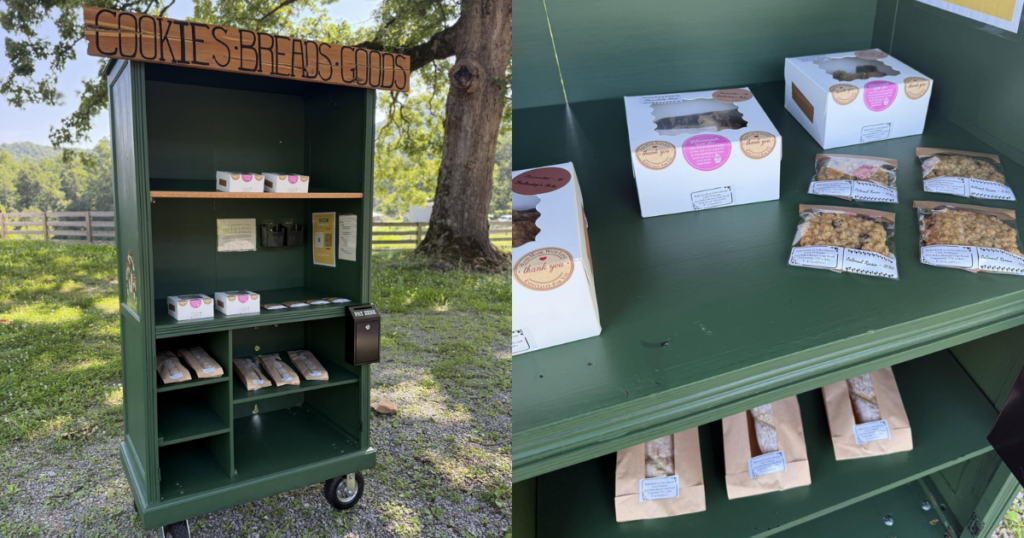
Photo: Carli Williams, Bakestand on Schoolhouse

A small bakestand opened this spring at 909 Schoolhouse Gap Road. It offers a rotating selection of fresh baked goods, including cookies and baguettes.

Hours are Wednesday through Saturday from 9 a.m. to dusk. Follow the Bakestand on Schoolhouse Facebook group for updates on what’s in stock. 

Little Free Library on Tiger Drive 

Outside the Townsend Municipal Building at 133 Tiger Drive, a Little Free Library gives visitors and neighbors a place to swap books. Take a book, leave a book. The library is sponsored by the Blount County Friends of the Library and listed as Charter #57896. 

Chicken Feet Fleet Farm Egg Stand 

Photo: Chicken Feet Fleet Farm

Chicken Feet Fleet Farm is a veteran-owned small family farm in Townsend specializing in free-range eggs and produce. At 1027 Dry Valley Road, the farm keeps a self-serve roadside stand stocked with fresh eggs on weekends and select weekdays. 

The selection depends on the day and season, but if the “open” sign is up, eggs are available. Sometimes, they also offer homemade bread, butter and jelly, announced on their Facebook page. 

Townsend River Walk & Arboretum 

The Townsend River Walk & Arboretum is full of small discoveries. Along the walk, find faerie villages, painted stones, wood spirits, a hand-carved bear, the Townsend Express train, nature play areas, tree markers and other small details that reward a slower pace. 

Families can also use the Adventure Lab app to follow “Welcome to the Townsend Riverwalk and Arboretum,” a self-guided hunt along the trail. 

Geocaching Around Townsend 

Photo: Geocaching.com

Townsend has other treasures you can only find with the Geocaching app. Geocaching is an outdoor treasure hunt that uses your phone’s GPS to guide you to hidden caches nearby. 

Several Townsend caches are free to access with a basic Geocaching account, including Capt’n Dave’s Flying Pig near the Little River, Choo Choo Stop at the Little River Railroad & Lumber Company Museum, An Apple a Day at Apple Valley Mountain Village and Our Smoky Mountain Heritage at the Great Smoky Mountains Heritage Center. 

A traditional geocache usually contains a small container and a logbook. When you find it, sign the log and return the cache exactly where you found it. Some caches include small trade items; the idea is to take something and leave something of equal or greater value. 

Additional caches in the area may require a paid Geocaching Premium membership. 

The next time you’re in Townsend, leave a little room in the day for the places you didn’t plan to find.

Born and raised in Maryville, Tennessee, with roots tracing back to Cades Cove, Emily Huffstetler is a proud Maryville College graduate and storyteller of the Greater Smokies region. She holds a Master of Science in Conservation Education from Mississippi State University.     
Townsend Fall Heritage and Bluegrass Festival Canceled Due to Hurricane Helene

In consultation with local authorities and out of an abundance of caution due to expected inclement weather produced by Hurricane Helene, the Blount Partnership made the difficult decision to cancel the Townsend Fall Heritage and Bluegrass Festival scheduled for September 27-28 at the Townsend Events Center in Townsend.

With the safety of attendees, performers, and vendors as the top priority, this decision was made in light of the significant rainfall and high winds expected in the region as a result of the hurricane. These conditions are anticipated to create hazardous travel and saturated grounds, posing a safety risk for those attending and participating in the event.

This marks the first time in the festival’s 30-plus year history that it has been completely canceled, underscoring the severity of the weather forecast. The festival, a beloved annual celebration of heritage, bluegrass music, and community spirit, will be sorely missed this year, but the decision reflects the Partnership’s commitment to the well-being of all involved.

“While we are deeply disappointed to cancel this year’s event, the safety of our attendees and everyone involved must come first,” said Blount Partnership Communications Director Jeff Muir. “With the saturated grounds and continued rainfall, we could not guarantee a safe and enjoyable environment for our festival-goers.”

The Blount Partnership encourages all those who planned to attend to stay safe and monitor local weather updates. They also extend their gratitude for the ongoing support of the community and look forward to hosting the festival again next year under safer conditions.

Event sponsors are Danielle Snipes Allstate Insurance, Century 21 Legacy, Harvest Thyme, Leaf Filter, Little Arrow Outdoor resort, Renewal by Andersen, Rocky Branch Mountain Music, and Senior Care Partners of East Tennessee.

Townsend, Tennessee: A Hidden Gem Stealing the Spotlight

Nestled in the heart of the Great Smoky Mountains, Townsend, Tennessee, has long been cherished as the “peaceful side of the Smokies.” But 2024 was its year to shine. This charming small town has garnered national—and even international—recognition, inspiring countless travelers to experience its natural beauty.

From awe-inspiring scenery to unparalleled outdoor activities, Townsend has received glowing praise from major publications. Let’s take a look at how the world has fallen in love with this hidden gem—and why it should be at the top of your travel list.

Southern Living’s Love Letter to the Peaceful Side

Southern Living celebrated Townsend in their East Tennessee Road Trip feature, calling it “a gateway to adventure and serenity.” The article highlighted its proximity to the Great Smoky Mountains National Park and its reputation as a quiet haven for families and outdoor lovers.

Another Southern Living piece, Nostalgic Summer Camp Destinations, encouraged readers to embrace a slower pace in Townsend, where simple pleasures like stargazing, hiking, and campfire nights feel timeless.

This desirable locale also made Southern Living’s list of The 10 Best Tennessee Mountain Towns To Visit This Year

Townsend: A Darling Among Small Towns

In AFAR’s Charming Small Towns Near National Parks, Townsend was praised as “a quiet retreat for nature lovers.” Its easy access to iconic locations like Cades Cove and its slower pace were highlighted as perfect for those looking to escape crowds.

Yahoo Lifestyle featured Townsend in its 10 Best Tennessee Mountain Towns roundup, describing it as “a haven for tranquility” and a perfect blend of adventure and relaxation.

PBS showcased Townsend in a Hometowns episode.

World Atlas Names Townsend a Top Destination

World Atlas couldn’t resist Townsend’s charm, featuring it in multiple articles this year:

Travel + Leisure’s Smoky Mountain Highlight

Travel + Leisure included Townsend in their Guide to Great Smoky Mountains National Park, applauding its blend of small-town charm and gateway access to some of the park’s best hiking trails and scenic spots.

Townsend also made Travel + Leisure’s list of 10 Best Mountain Towns According to Locals. 

Only in Your State’s Springtime Favorite

For seasonal adventures, Only in Your State recommended Townsend as a top destination for springtime exploration in Spring Getaways in Tennessee. The blooming wildflowers, crisp mountain air, and serene vistas make it a must-visit.

Yahoo’s Spotlight on Budget-Friendly Adventures

In another feature, The Cheapest U.S. National Parks to Visit in 2024, Yahoo Lifestyle highlighted Townsend as an affordable gateway to the Great Smoky Mountains National Park, emphasizing its budget-friendly lodging and dining options.

PR Magic in Action

This year’s incredible media buzz was partly the result of a targeted public relations campaign that introduced Townsend to 435 million people and boosted county tourism tax revenue by 20%. Interested in the strategy behind this success? Read more about the power of collaboration in this blog post.

Plan Your Visit 

Whether you’re seeking a peaceful retreat, thrilling outdoor adventures, or a gateway to the Smokies, Townsend is the perfect destination. Come experience the charm that’s captivated national attention—you might just fall in love with the “peaceful side of the Smokies.”

Get started on your adventure today at Smoky Mountains Tourism.

Tremont Institute Hosts Virtual Naturalist Week with Activities for All Ages

From June 17-21, 2024, the Great Smoky Mountains Institute at Tremont is hosting Naturalist Week, a free virtual event designed to connect people with nature from wherever they are. Kids and adults are encouraged to explore their backyards, local parks, or any green spaces to notice the nature around them.

Naturalist Week features the Level Up Challenge, where participants earn points by engaging in outdoor activities such as eating a meal outside, following an insect’s travel path, or camping in the backyard. Participants collect 25 points to win a prize and enter a drawing for a custom Tremont experience. Point totals should be submitted online by Monday, June 24 to receive a prize in the mail.

Last year, 56 individuals ranging from 4 to 77 years old from 13 states completed the Level Up Challenge, earning a total of 2,088 points. A local participant shared with event organizers, “I noticed how magical it is to share time and perspectives with someone else while in nature. My daughter and I love similar experiences, but introduced new ways of seeing something to each other.”

On Thursday, June 20, Tremont is hosting The Big Day, a challenge to document as many species as possible, including plants, mammals, fungi, insects, birds, and lichens. For each observation shared on Tremont’s website or social media, a generous donor will donate a dollar to support Tremont’s environmental education programs.

“Over the last two years, we have stories of people exploring with their grandkids, taking intentional time outside during lunch breaks at work, and discovering nature mysteries in their backyards,” said Tremont’s Marketing Director, Erin Rosolina. “It’s incredibly heartening to see people explore biodiversity and find wonder in their own outdoor spaces.”

To wrap up the week, Tremont is hosting a family-friendly happy hour at Yee-Haw Brewing Company in Knoxville on Friday, June 21, from 6 to 10 p.m. A dollar from each pint sold will support Tremont’s programming.

Virtual Naturalist Week is taking place at the same time as an in-person Naturalist Week on Tremont’s campus inside Great Smoky Mountains National Park. The in-person event is an overnight environmental camp for adults, and includes several of the same activities as the virtual event, including The Big Day. A few spots remain for the in-person Naturalist Week camp; learn more at gsmit.org/event/naturalist-week.

Though not required to participate, Tremont encourages donations to Naturalist Week; the funds raised throughout the week will support the nonprofit’s year-round work to connect people of all ages with nature, both through on-campus experiences in the Smokies and educational outreach in the surrounding communities.

Learn more about Naturalist Week activities, including the Level Up Challenge and species documentation, at gsmit.org/naturalist.

Tremont Writers Conference now accepting applications

Great Smoky Mountains Institute at Tremont is pleased to announce the second annual Tremont Writers Conference, an intensive five-day retreat for writers of fiction, nonfiction and poetry coordinated in partnership with Smokies Life, formerly Great Smoky Mountains Association. Applications to participate in the event may be submitted online now through April 30 at writers.gsmit.org.
Tremont Writers Conference,

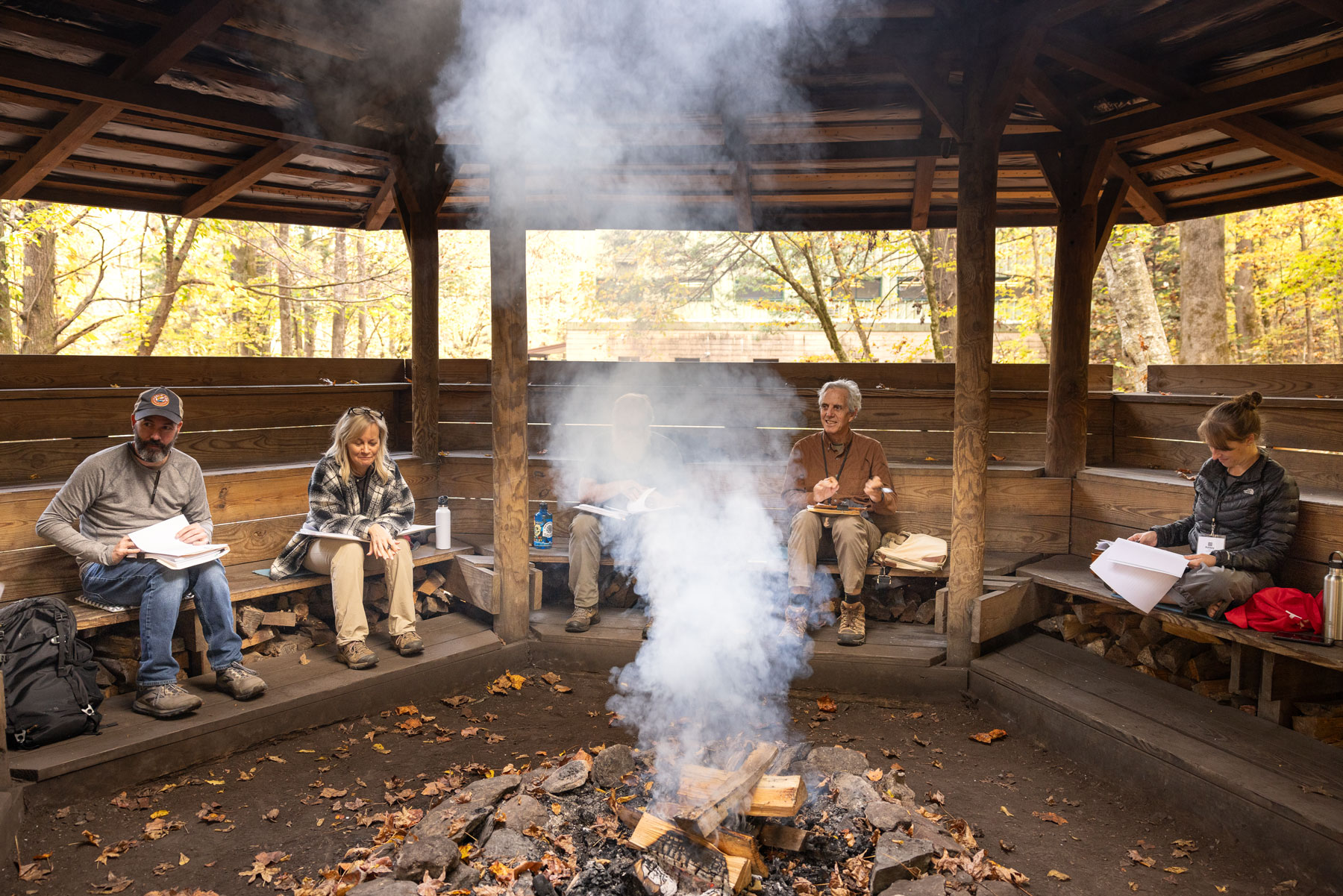
From Wednesday, October 23, through Sunday, October 27, a small group of selected writers will join renowned authors and professional park educators on Tremont’s campus in Great Smoky Mountains National Park. Participants will enjoy brainstorming and fine-tuning their work with award-winning author workshop leaders while also learning and writing throughout the day.

Morning workshops in fiction, nonfiction and poetry will take place outdoors, led by faculty members Monic Ductan (fiction), David Brill (nonfiction) and Maurice Manning (poetry). Guest author Frank X Walker, the first African American Kentucky Poet Laureate and workshop leader at the 2023 conference, will lead several sessions for the entire group, including a guided discussion on the craft of writing. Each afternoon, writers will join experienced Tremont naturalists for guided explorations that spark curiosity and wonder through a deeper connection to the region’s cultural and natural history. Evenings will conclude with hearty dinners, fellowship with peers, and readings by writing faculty. Meals and lodging are provided.

“A sense of community came from the gathering of creative souls dedicated to their crafts — attendees seeking growth and honing, and leaders sharing their insights and guiding us with their experience,” said writer and photographer Michele Sons who participated in the inaugural Tremont Writers Conference in October 2023, which brought together 20 writers from all over the country. “By stepping out of my comfort zone, I gained confidence in my writing, and I came home with concrete ways to improve my manuscript based on the feedback of our leaders and the group at large.”

Applications for the October conference should be submitted no later than April 30. Acceptance to conference workshops is based on manuscript evaluation, with chosen writers notified by July 14. Additional information about the Tremont Writers Conference and complete 2024 application guidelines can be found at writers.gsmit.org.

Tremont Writers Conference now accepting applications

Tremont Writers Conference

Great Smoky Mountains Institute at Tremont is pleased to announce the fourth annual Tremont Writers Conference, an intensive five-day retreat for writers of fiction, nonfiction and poetry coordinated in conjunction with Smokies Life. Applications to participate may be submitted online now through May 15 at writers.gsmit.org.

Held Wednesday, Oct. 21, through Sunday, Oct. 25, the conference on the Tremont campus invites participants to brainstorm projects and fine-tune their work alongside award-winning author workshop leaders and professional park educators in Great Smoky Mountains National Park. This year’s faculty members include guest writer and “New York Times” best-selling author Ron Rash; recent Kentucky poet laureate and memoirist Crystal Wilkinson (leading the nonfiction cohort); celebrated playwright and Knoxville poet laureate Linda Parsons (poetry cohort leader), and award-winning Cherokee novelist Kelli Jo Ford (leading the fiction cohort).

“This is a rare opportunity for writers to work closely with authors they admire in a setting as immersive as it gets: the Smokies,” said Frances Figart, conference co-director and creative services director for Smokies Life. “We keep the retreat intentionally small — choosing writers who are deeply engaged with their work and excited to challenge themselves in a new setting. It’s that level of collective commitment that bolsters the creative process and makes the experience so productive for our writers.”  

Faculty members will lead daily morning group workshops and also mentor writers in optional one-on-one sessions throughout the retreat. Each afternoon, experienced Tremont naturalists will guide participants in activities meant to create a deeper connection to the region’s cultural and natural history. Evenings will conclude with group dinners, fellowship and readings by the featured authors. Meals and lodging are provided.

“Like all of Tremont’s programs, roughing it (a little!) is part of the experience,” said co-director Jeremy Lloyd, who serves as Tremont’s manager of field and college programs. “Most of the workshops take place outdoors, where we can take in and be inspired by our beautiful natural surroundings — with fewer distractions from the modern world. This format is part of what makes the Tremont Writers Conference unique, paving the way for more meaningful connections with workshop leaders and fostering a sense of community among participants.”

Acceptance to conference workshops is based on evaluation of submitted writing samples, with all writers notified of their acceptance status by mid-July. One conference participant will be selected to receive the Debbie Ellis Scholarship in the amount of $1,000. The scholarship is funded by Ron Ellis in memory of his late wife, Debbie, who channeled her love of the Tremont area into her writing, including “Elkmont Settlement: A Microcosm of Appalachian Challenges,” in “Perspectives in History” (Northern Kentucky University, Vol. XXIII, 2007-2008).

Also available to select 2026 participants is the $5,000 Laurel Rematore Tremont Writers Conference Scholarship, distributed between three or more chosen writers whose attendance is dependent on financial aid. The scholarship’s namesake, the former CEO of Smokies Life, strongly believed in the power of the arts and was integral to the retreat’s founding.

Applications for the October conference should be submitted no later than May 15. Additional information about the Tremont Writers Conference and complete 2026 application guidelines can be found at writers.gsmit.org.

Tremont Writers Conference is created, managed and produced as a joint partnership between Smokies Life and Great Smoky Mountains Institute at Tremont. It brings writers of fiction, nonfiction and poetry to an ancient and wild setting, where they can receive feedback from established authors, connect with writing peers and find renewal and inspiration. In addition to creative workshops, writers will join experienced Tremont naturalists for guided explorations that spark curiosity and wonder.